Stop Undercharging: Handyman Pricing for 2026 with Free Tools

Stop Undercharging: Handyman Pricing for 2026 with Free Tools
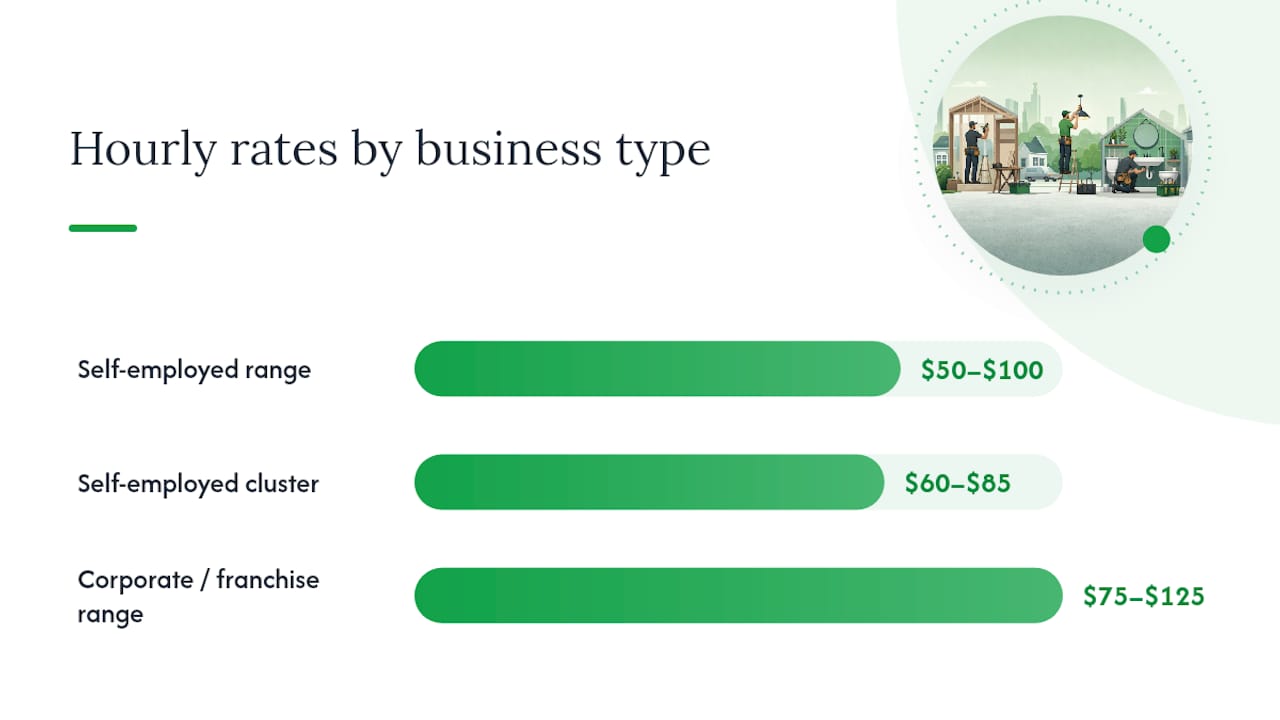
Independent handymen typically charge $50 to $100 per hour, while corporate and franchise outfits run $75 to $125. Flat-rate jobs often beat hourly work on effective earnings. A quick TV mount priced in the low to mid hundreds can pay more per hour than a metered service call. The next move isn’t guessing. It’s running your own numbers through a pricing formula or a rate calculator to find the figure that actually covers your costs.
TL;DR:
- Flat-rate pricing often yields higher effective hourly rates for quick, repeatable jobs like TV mounts and faucet swaps compared to hourly charges.
- Incorporating a minimum service fee, trip charges, and material markup ensures you cover all costs and protect your profit margin.
- Your realistic billable hours are around 30 per week, and using a detailed formula helps set a defensible hourly rate that covers expenses and desired income.
- Many handymen undervalue overhead costs, travel time, and material expenses, leading to consistent underpricing and income shortfalls.
- Raising your rates gradually when demand increases or costs rise allows sustained growth without losing existing clients.
Table of Contents
- What Do Handymen Charge? Market Ranges Explained
- Hourly, Flat-Rate, or Cost-Plus: Which Pricing Model Fits?
- How to Calculate Your Real Hourly Rate
- Average Prices for Common Handyman Jobs
- How to Build a Professional Handyman Quote
- Setting Fees, Markups, and Premiums the Right Way
- Five Pricing Mistakes That Are Costing You Money
- Knowing When It’s Time to Raise Your Rates
- Your Pricing Checklist for This Week
- Legal and Tax Considerations for Handyman Pricing
- What Most Handymen Get Wrong About Pricing
- QuoteLock for Handymen: Quote Faster, Get Paid Sooner
- Sources
What Do Handymen Charge? Market Ranges Explained
Rates vary more by business structure than most people expect. Self-employed handymen usually land between $50 and $100 an hour, with national averages clustering closer to $60 to $85 depending on region and specialty, according to Housecall Pro’s pricing benchmarks. Corporate and franchise operations charge more, typically $75 to $125 an hour, because they carry higher overhead: dispatch staff, marketing budgets, insurance policies covering multiple employees.
That gap isn’t arbitrary. A solo operator working from a truck has fewer fixed costs to recover per hour. A franchise has to fund a call center and a brand.
Flat-rate pricing complicates the comparison in a good way. A job billed at a flat $200 that takes 90 minutes works out to roughly $133 an hour, well above what most hourly quotes would capture for the same task. This is why experienced pros price short, repeatable jobs as packages instead of tracking the clock, an approach HandymanCan’s pricing breakdown recommends specifically for quick installs and swaps.
A few factors consistently push rates toward the high end of any range:
- Licensing requirements. Electrical and plumbing work that legally requires a license commands a premium over general handyman tasks.
- Specialization. Smart home installs, tile work, and deck building pay more than generic repairs because fewer people do them well.
- Urban cost of living. A handyman in a major metro area faces higher insurance, fuel, and rent costs than one in a rural county, and rates follow.
- Demand density. Markets with more homeowners and older housing stock generate steadier repair demand, giving pros room to charge more.
Pricing platforms like Thumbtack show this variance clearly at the city level, with identical services priced 30 to 40 percent apart between metro areas. Treat any national average as a starting point, not a target.
Hourly, Flat-Rate, or Cost-Plus: Which Pricing Model Fits?
Most handymen default to hourly pricing because it feels safe. It’s rarely the most profitable choice, and it’s almost never the easiest to sell. Three models cover nearly every job you’ll quote, and each has a specific use case.
- Hourly pricing charges a set rate per hour worked, sometimes with a minimum block. It fits jobs where scope is unclear until you’re on-site, like diagnosing a mystery leak or troubleshooting an electrical fault. You’re protected if the job runs long; the client accepts some uncertainty in exchange for not overpaying if it runs short.
- Flat-rate pricing sets one price for a defined task regardless of how long it takes. It works best for repeatable jobs you’ve done dozens of times, where you already know the real time investment. TV mounts, faucet swaps, and ceiling fan installs are classic flat-rate candidates because the variance between jobs is small.
- Cost-plus pricing charges your cost for materials and labor plus a set markup percentage. It suits material-heavy projects like fence repair or deck rebuilds, where lumber and hardware costs fluctuate and you need a formula that scales with the job size instead of a fixed guess.
The decision comes down to three questions: How predictable is the scope? How much of the cost sits in materials versus labor? Is diagnostic work involved before you can even estimate?
If the answer to the first question is “very predictable,” build a flat rate. If materials dominate the bill, go cost-plus. If you genuinely don’t know what you’re walking into, hourly protects you both. Most working handymen end up running all three models simultaneously, matched to job type rather than picking one and forcing every quote through it. HandymanCan’s guide makes the same case: a hybrid approach consistently outperforms a single-model business.
How to Calculate Your Real Hourly Rate
Guessing your rate from what competitors charge is how handymen quietly go broke while staying busy. The formula that actually protects your income is: (Annual expenses + desired take-home pay + taxes) ÷ annual billable hours = your real hourly rate.
The tricky variable most people get wrong is billable hours. A 40-hour work week does not mean 40 billable hours. Drive time, estimates, invoicing, and slow weeks all eat into that number. A conservative and realistic estimate is 30 billable hours a week across 48 working weeks, which works out to 1,440 billable hours a year, a benchmark HandymanCan uses specifically because overestimating billable hours is the single most common reason handymen underprice their work.
Here’s a sample annual expense breakdown to plug into the formula:
Vehicle costs deserve extra attention because they’re the line item people lowball most. The IRS 2026 business standard mileage rate sets the reimbursement benchmark at 72.5 cents per mile, a useful multiplier for estimating what your truck actually costs you per job once you factor in wear, fuel, and depreciation.

Pro Tip: Run your own vehicle mileage for one full month and multiply it by the IRS rate. Most handymen are shocked to learn their “free” truck is quietly costing them $4,000 to $7,000 a year once fuel, tires, and maintenance are counted honestly.
Now the worked example. Say you want $50,000 in take-home pay, expect to owe roughly $9,300 in self-employment taxes, and your expenses total $12,700 as above. That’s $72,000 divided by 1,440 billable hours, which comes out to $50 an hour flat. Add a margin for slow seasons or unexpected repairs and you land close to $55 to $65 an hour as your real, defensible rate, a range that lines up almost exactly with HandymanCan’s own worked example landing near $65/hr under similar assumptions.
That’s the number you should be quoting from, not whatever your competitor down the street posted on their van.
Average Prices for Common Handyman Jobs
A flat-rate menu built around your most frequent jobs saves you from re-deriving a price every time the phone rings. Here’s a starting reference point based on typical market ranges, though your real numbers should come from tracking your own time on these exact tasks.
| Service | Typical price range | Estimated time | Effective hourly |
|---|---|---|---|
| TV mount (standard wall) | $164 to $300 | about 1 hour | $100–$200 |
| Faucet repair or swap | $100 to $250 | 1–2 hrs | $75 to $150 |
| Light fixture swap | $75–$200 | around 1 hour | $75 to $150 |
| Drywall patch (small hole) | $100–$300 | 1–2 hrs | $75 to $150 |
| Ceiling fan install | $150 to $350 | about 2 hours | $80 to $140 |
| Smart thermostat install | $125 to $275 | about 1 hour | $85 to $180 |
| Furniture assembly | $75–$200 | 1–2 hrs | $50–$100 |
| Interior room painting | $300–$800 | 4 to 6 hours | $50–$100 |
| Deck staining (mid-size) | $400 to $900 | 5 to 8 hours | $50–$90 |
These ranges line up with what Angi’s cost data reports for average project totals, which run from roughly $164 to $648 for common repairs, with more intermediate jobs pushing past $1,200 depending on scope and materials involved. Thumbtack’s city-level pricing data shows the same jobs priced 25 to 40 percent higher in expensive metro markets than in smaller cities.
A few patterns worth noting once you look at this list closely:
- Short jobs pay better per hour. The TV mount and light fixture swap generate the highest effective hourly rates on this table, which is exactly why experienced pros stack their schedule with quick jobs when they can.
- Licensing changes the math entirely. Anything touching electrical wiring beyond a simple fixture swap, or plumbing beyond a faucet, may require a license in your state or city, and that credential typically adds 20 to 40 percent to the price.
- Painting and staining scale with square footage. These aren’t good flat-rate candidates unless you’ve priced by room size consistently; a $300 quote on a 400-square-foot room and the same quote on 800 square feet will burn you on one of them.
- Bundling changes effective hourly. A client booking a TV mount plus a fixture swap in the same visit lets you spread your trip cost across two billable jobs, which is where package pricing earns its keep.
Build your own version of this table using your actual completed jobs from the last six months. The numbers above are a starting frame, not gospel for your market.
How to Build a Professional Handyman Quote
A quote that wins the job and protects your margin needs more than a price. It needs structure the client can trust and terms that protect you if the scope shifts.
- Gather the full scope before quoting. Ask for photos or a video walkthrough if you can’t see the job in person. Vague scope is the number one cause of underpriced jobs.
- Estimate time and materials separately. Don’t bundle guesswork into one number. Break out labor hours and material costs as distinct line items from the start.
- Apply your minimum service fee. If the job falls under your threshold (commonly $100 to $200), state that minimum clearly rather than quoting an artificially low hourly number that won’t cover your trip.
- Add your trip fee if the address falls outside your standard service area. Set this as a flat charge or a per-mile rate beyond a defined radius.
- Mark up materials by your standard percentage, typically 20 to 50 percent, and show that markup as part of the material line rather than hiding it in labor.
- State payment terms and deposit policy explicitly. A deposit of 25 to 50 percent for jobs over a few hundred dollars protects you from cancellations after you’ve already bought materials.
Here’s what that looks like assembled into an actual line-item quote:
Notice materials and markup sit as separate lines. That transparency builds trust, and it’s a habit Angi’s guidance on markups points to as one of the simplest ways to avoid client pushback on price. A quote template that already has these fields built in saves you from rebuilding this structure by hand every time, which is exactly what a tool like QuoteLock’s quote templates are set up to handle, alongside a markup calculator that does the math for you.

Setting Fees, Markups, and Premiums the Right Way
Extra charges only work if you can explain them in one sentence. Clients don’t push back on fees they understand; they push back on fees that feel sprung on them at the invoice stage.
- Minimum service fee ($100–$200). This covers your trip cost and setup time on jobs too small to justify an hourly breakdown. Frame it as “our minimum visit charge” up front, not as a surprise line item.
- Trip or mileage fees. Charge a flat fee beyond a defined service radius, or bill per mile using a rate anchored to your actual vehicle cost. The IRS mileage rate of 72.5 cents per mile is a reasonable floor for this calculation.
- Material markup (20–50%). This isn’t padding your invoice. It compensates you for sourcing time, store trips, and the risk of buying the wrong part.
- After-hours and emergency premiums. Same-day service, weekend calls, and holiday work commonly carry a 25 to 50 percent premium over standard rates, reflecting the real disruption to your schedule.
Pro Tip: Put your minimum fee and trip radius directly on your quote template so it never has to be an awkward phone conversation. Clients accept structure far more easily than they accept a fee that feels invented on the spot.
Five Pricing Mistakes That Are Costing You Money
Most underpriced handymen aren’t bad at the trade. They’re bad at accounting for costs they can’t see on a given day.
- Undercalculating overhead. Fuel, insurance, and non-billable admin time vanish into “just part of the job” instead of getting counted. Fix it by running the full formula, not just labor and materials.
- Not charging for travel. Short trips across town add up to real unpaid hours over a month. Set a trip fee and a defined service radius so this stops being invisible.
- Hourly pricing on predictable tasks. If you’ve installed 50 ceiling fans, you already know how long the 51st takes. Build a flat-rate menu for anything you do often.
- No material markup. Handing over receipts at cost means you’re working for free every time you drive to the hardware store. Itemize materials and apply your 20 to 50 percent markup consistently.
- No minimum fee or price cap. A job with no floor can lose you money on a 20-minute visit; a job with no ceiling can run over scope for free. Set both boundaries before you quote.
Knowing When It’s Time to Raise Your Rates
A full schedule booked weeks out is the clearest signal you’re underpriced, not the sign you should work faster. Rising fuel and material costs squeezing your margin, or demand consistently outpacing your capacity, are the other two signs worth acting on.
The safest way to raise rates is in phases rather than all at once. Test a new, higher rate on incoming leads first while grandfathering existing repeat clients at their current price for a few more months. This limits the risk of losing steady business while you validate the new number against fresh demand.
A simple script for existing clients: “Starting [date], our standard rate is adjusting to $[new rate]/hr to reflect rising material and vehicle costs. Your next service will be booked at this rate. Thanks for being a longtime customer, we value the relationship.”
Your Pricing Checklist for This Week
You don’t need a new business model to fix underpricing. You need to run through these steps in order and stop guessing at numbers.
| Step | Action | Why it matters |
|---|---|---|
| 1 | Calculate your real hourly rate using the formula | Gives you a defensible floor for every quote |
| 2 | Build flat-rate prices for your top 8–10 jobs | Saves time quoting and boosts effective hourly on quick work |
| 3 | Set a minimum service fee and trip radius | Protects margin on small or distant jobs |
| 4 | Apply a consistent material markup (20–50%) | Recovers sourcing time and risk |
| 5 | Define emergency and after-hours premiums | Compensates for schedule disruption |
| 6 | Update your quote template with these fields built in | Removes friction from every future quote |
Legal and Tax Considerations for Handyman Pricing
Setting your prices is only half the job. How you document and report them determines whether that income stays legal and audit-proof. Every dollar you invoice, whether paid by check, card, or cash, is reportable income. There’s no exemption for cash jobs, and treating them as off-the-books income creates real exposure if you’re ever audited.
Keep a written record for every quote and invoice, even informal jobs for neighbors or friends. This protects you two ways: it gives you defensible documentation if a client disputes a charge, and it gives you clean records at tax time instead of a shoebox of memory come April.
Licensing matters here too. Charging for work that legally requires a license you don’t hold, electrical and plumbing being the most common examples, can expose you to fines that dwarf whatever you earned on the job. Check your state and local licensing board before you price any work outside general handyman tasks.
Payment processing fees also eat into your effective rate more than most handymen budget for. If a meaningful share of your invoices go through card processing, factor that fee into either your rate or your markup. A partner resource like PaySec’s construction payment guide breaks down how processing costs on larger tickets can quietly shrink your margin if you’re not accounting for them up front.
None of this replaces advice from a licensed accountant or attorney familiar with your state’s rules, but the baseline habit, document everything and price your license risk into your rates, applies almost everywhere.
What Most Handymen Get Wrong About Pricing
The biggest mistake in this trade isn’t charging too little for an hour of work. It’s not knowing what an hour of work actually costs to deliver. Handymen routinely price against what a competitor charges instead of against their own expense structure, and that habit quietly bankrupts otherwise skilled tradespeople who stay busy every single week.
The fix isn’t complicated, but it does require discipline most people skip: run the formula once a year, track your billable hours honestly, and stop treating your truck as a free expense. A rate calculator or a markup tool won’t make you a better handyman, but it will stop you from subsidizing your own business out of your own pocket.
Where I see pros lose the most ground isn’t in the pricing formula itself. It’s in the gap between quoting a fair price and actually getting paid on time for it. A quote sitting unopened in someone’s inbox for two weeks costs you as much as an underpriced job does. Tools like QuoteLock’s rate calculator and its markup calculator exist because the math should take five minutes, not an afternoon, and the templates exist because a professional-looking quote closes faster than a text message with a number in it.
— Robert
QuoteLock for Handymen: Quote Faster, Get Paid Sooner
Every formula and price list in this guide gets you a number worth charging. Turning that number into a job that actually pays on time is a separate problem, and it’s the one that eats the most hours in a handyman’s week. Quote-lock is built specifically to close that gap: create a professional, branded quote in minutes, send it without asking the client to create a login or learn new software, and convert it into an invoice with one click the moment they accept.

Where Quote-lock earns its keep is the part most quoting tools ignore entirely: it tracks when a client actually opens your quote and sends automatic reminders if they go quiet, so a job doesn’t die from silence instead of a “no.” That’s especially valuable for solo tradespeople juggling five quotes at once, and for small teams that need every job status visible without a group text chain. Pair it with the free hourly-rate calculator and markup calculator covered earlier in this guide, and you’ve got the pricing and the paperwork solved in one place. Start a free trial and send your next quote through QuoteLock for Handymen today.
Sources
- How to Price Handyman Work: Complete Pricing Guide (2026) | HandymanCan
- How Much Does It Cost to Hire a Handyman? | Angi
- Handyman prices (Thumbtack) — 2026
- IRS: 2026 business standard mileage rate