Why Professional Invoices Build Trust With Clients

Why Professional Invoices Build Trust With Clients
Yes — professional, detailed invoices build client trust by turning a routine bill into a clear value statement. Clients who can see exactly what they paid for are far less likely to question the price, delay payment, or walk away after the job. Here are three things you can change today:
- Itemize one flat-fee line. Break “Landscaping Services — $1,200” into three line items: site prep, planting, and cleanup. The price stays the same; the perceived value goes up.
- Add a one-sentence value statement in the notes field. Something like: “All work completed to spec, site left clean, and materials sourced to your budget.”
- Attach a branded PDF template with your logo, consistent colors, and a professional font. First impressions happen at the invoice, not just the quote.
Pro Tip: Set your invoicing software to auto-attach a branded PDF every time. Consistency across every touchpoint signals that you run a tight operation.
Key Takeaways
Professional invoices build client trust by making your work visible, your terms clear, and your brand consistent — the combination that gets invoices approved faster and clients returning.
| Point | Details |
|---|---|
| Itemize every job | Break flat fees into line items to trigger the labor illusion and reduce price objections. |
| Add a value statement | One sentence in the notes field confirms deliverables and cuts dispute rates. |
| Brand your template | Consistent logo, colors, and layout are linked to payment arriving 5–7 days faster. |
| Automate reminders | Schedule follow-ups at 3 days before due and 1 day overdue to protect cashflow without manual effort. |
| Use Quote-lock | Quote-lock converts accepted quotes into branded, itemized invoices in one click, with built-in reminders and payment tracking. |
Table of Contents
- Why do detailed invoices change how clients see your business?
- What every professional invoice must include
- How professional invoices reduce disputes and keep clients coming back
- What your invoice design and wording say about your brand
- A step-by-step workflow for sending invoices that get paid
- Payment terms, late fees, and handling disputes professionally
- What the research actually says about transparent invoicing
- The invoice format experiment worth running this month
- About Quote-lock: built for contractors who bill professionally
- Sources
Why do detailed invoices change how clients see your business?
The short answer is psychology. When clients receive a vague invoice, their brain fills in the gaps — usually with doubt. A single line reading “Services rendered — $3,500” gives a finance manager nothing to approve with confidence. A detailed invoice showing eight line items, each with a description, quantity, and rate, tells a completely different story.
This is the labor illusion at work. Research from Projectworks explains that when clients can see the component parts of a job, they perceive more effort and therefore more value — even when the total is identical to a flat-fee invoice. Breaking a project into visible steps shifts the client’s mental frame from “is this worth it?” to “I can see exactly what I got.”
The practical consequences are real. Vague invoices trigger questions. Detailed invoices trigger approvals. A client’s accounts-payable team processes dozens of invoices a week; a well-structured one with sequential numbering, clear tax callouts, and itemized charges moves through that queue faster than a one-liner. A poorly formatted or noncompliant invoice, on the other hand, signals disorganization to both the client and their accounting team — and that perception sticks.
What clients actually think when they receive your invoice:
- Vague invoice: “This feels rushed. Are they organized? Should I push back on this number?”
- Detailed, branded invoice: “They clearly track their work. I know what I paid for. I’d hire them again.”
- Professional invoice with a value note: “They went the extra step. This is a business I can trust.”
The difference between a client who pays on time and refers you to a colleague, and one who ghosts your follow-up, often comes down to that first invoice.
What every professional invoice must include
According to Investopedia, an invoice is a time-stamped commercial document that itemizes a transaction. Get these fields right and you cover both the legal basics and the trust signals clients expect:
- Invoice number — sequential, unique, never repeated
- Invoice date — the date you issued it
- Due date and payment terms — Net 14, Net 30, or a specific calendar date
- Your contact information — business name, address, phone, email
- Client contact information — name, company, billing address
- Itemized line items — each service or product on its own line with a short description
- Unit rate and quantity — hours × rate, or unit price × quantity
- Subtotal, taxes, and total — broken out clearly, not bundled
- Accepted payment methods — ACH, card, check, payment link
- Notes and value statement — a brief sentence reinforcing what was delivered
Here is what a compact, field-ready invoice structure looks like in practice:
- Header: Your logo, business name, and contact details (top left); “Invoice” label and invoice number (top right)
- Client block: Bill-to name, company, and address
- Dates block: Invoice date and due date on the same line
- Line items table: Description | Qty | Rate | Amount — one row per service
- Subtotal row: Sum of all line items
- Tax row: Tax rate and calculated amount (e.g., sales tax where applicable)
- Total due: Bold, prominent, unmissable
- Payment instructions: How to pay and where to send it
- Notes / value statement: One or two sentences confirming deliverables and expressing appreciation
Pro Tip: Write your value statement as a completion confirmation, not a sales pitch. “All electrical work completed to code, inspected, and signed off” does more for trust than “Thank you for your business.”
How professional invoices reduce disputes and keep clients coming back
Clarity is the mechanism. When a client can match every line item on your invoice to something they remember approving, there is nothing to dispute. Stripe’s invoice guidance makes this point directly: clear, accurate invoices increase customer satisfaction and reduce payment friction. The more detail you provide — tax breakdowns, itemized charges, multiple payment options — the fewer questions land in your inbox.
The business outcomes stack up quickly:
- Fewer disputes: Itemized invoices give clients a paper trail that answers their questions before they ask them.
- Faster payment: Branded, well-designed invoices are associated with payment arriving 5–7 days sooner and payment completion rates roughly 12–15% higher than generic invoices.
- Higher retention: Clients who trust your billing process trust your business. A smooth invoice experience is one of the quietest drivers of repeat work.
Consider the difference in practice. A landscaping contractor sends a single-line invoice for $2,800 after completing a commercial property job. The client’s office manager has no record of what was agreed, emails to ask for a breakdown, waits three days for a reply, and finally pays on day 22. The same contractor, using an itemized invoice with a value note and a payment link, gets paid on day 9 — no questions asked.
The invoice itself acts as a relationship signal. Polite tone, timely delivery, and a clear structure tell the client you are organized, professional, and worth hiring again. That perception compounds over time.

What your invoice design and wording say about your brand
Design is not decoration. Color choices, font hierarchy, and layout affect how fast an accounts-payable clerk can scan your invoice and how professional your business looks to a new client. Industry analysis links branded, well-designed invoices to faster payment behavior and stronger brand perception — the visual cues do real work.
Design checklist:
- Consistent logo placement (top left is standard and expected)
- Brand colors used for headers and totals, not the entire page
- Legible hierarchy: your details → client details → line items → total
- Tax and total callouts in a distinct row, never buried in notes
- Enough white space that the eye can scan without effort
Tone and wording — what works and what doesn’t:
| Do | Don’t |
|---|---|
| “Payment due within 14 days of invoice date” | “Please pay when you can” |
| “Late payments may incur a 1.5% monthly fee” | “We’d appreciate prompt payment” |
| “All work completed as agreed on [date]” | “Thanks for the business!” |
| “Questions? Call us at [number]” | Leaving no contact for disputes |
Your value statement sits in the notes field and should be one sentence. It confirms what was done, not what you hope the client thinks. A cleaning business might write: “Full commercial clean completed March 14 — all areas inspected and signed off per your checklist.” A builder might write: “Framing and drywall completed to plan, site cleared, ready for electrical inspection.”

That one sentence reinforces the deliverable, reduces the chance of a dispute, and reminds the client why they hired you.
A step-by-step workflow for sending invoices that get paid
The best invoice in the world does nothing sitting in a draft folder. Timing and process matter as much as content.
- Issue immediately after the milestone. For project work, send the invoice the same day you complete a phase. For recurring services, send on a fixed day each billing cycle. Delays signal disorganization.
- Send deposits upfront. For jobs over a set threshold (many contractors use $500–$1,000), send a deposit invoice before work begins. This protects your cashflow and sets a professional tone from day one.
- Deliver electronically. Email a branded PDF and, where possible, include a payment link in the body of the email. Fewer steps between “invoice received” and “payment sent” means faster cash.
- Track opens and views. If your invoicing tool shows when a client opened the invoice, you know whether a follow-up is warranted or whether the email was missed entirely.
- Send a polite reminder at 3 days before due. Automated, brief, friendly. “Just a reminder that invoice #1042 is due Friday — here’s the payment link.”
- Follow up at 1 day overdue. Personal, not automated. A short email referencing the specific invoice number and offering to answer any questions.
- Escalate at 7 days overdue. Reference your late-fee policy, keep the tone professional, and offer a call to resolve any concerns.
What to automate vs. what to keep personal:
- Automate: template population, sequential numbering, initial reminders, payment-link delivery
- Personalize: value statement notes, dispute replies, overdue follow-ups beyond the first reminder
Pro Tip: Batch your invoices once a week at the same time — say, every Friday at 9 AM. Invoicing software that auto-fills templates from your job records lets you send ten detailed, itemized invoices in the time it used to take to write one from scratch. The “I don’t have time to itemize” excuse disappears.
Payment terms, late fees, and handling disputes professionally
Clear payment terms belong on every invoice, not just in your contract. Clients should never have to guess when payment is due or what happens if it’s late.
Sample payment term phrases you can use today:
- “Payment due within 14 days of invoice date (Net 14).”
- “A 50% deposit is required before work begins; the balance is due upon completion.”
- “Early payment discount: 2% off if paid within 5 days.”
- “Invoices unpaid after 30 days will accrue a 1.5% monthly late fee on the outstanding balance.”
Accepted payment methods — offer at least two:
- ACH bank transfer (lowest friction for B2B clients, no card fees)
- Credit or debit card via a payment link
- Check (still common in construction and trades)
Stripe’s research confirms that offering multiple payment options reduces friction and increases the likelihood of on-time payment. A client who can’t pay by their preferred method is a client who delays.
When a client disputes an invoice:
- Acknowledge within 24 hours — never go silent.
- Reference the specific line item in question.
- Attach the original quote or scope document.
- Offer to adjust if the dispute is valid; explain clearly if it is not.
- Confirm the resolution in writing before closing the thread.
A ready-to-use response template:
That tone — calm, specific, fast — preserves the relationship even when the conversation is uncomfortable.
What the research actually says about transparent invoicing
The evidence connecting invoice quality to business outcomes is consistent across behavioral research and industry observation.
- Labor illusion: Projectworks cites behavioral research showing that visible effort increases perceived value. Breaking a flat fee into line items is a direct application of this principle.
- Behavioral economics support: HBS faculty research supports the idea that transparency and visible process cues increase perceived fairness in business transactions.
- Payment speed: Industry analysis links branded, well-structured invoices to payment arriving 5–7 days faster and completion rates roughly 12–15% higher.
- Relationship outcomes: Zintego’s analysis finds that invoice clarity, polite tone, and timely delivery increase the likelihood of on-time payment and repeat engagement.
- Compliance and credibility: Correct tax fields, sequential numbering, and complete contact information reduce friction for B2B clients whose accounting teams must verify invoices before approving payment.
The practitioner takeaway: itemization and branding are not extras for when you have time. They are the mechanism by which invoices get paid faster and clients come back.
The invoice format experiment worth running this month
Most contractors assume their invoice format is “fine.” The ones who test it are usually surprised.
Here is a 30-day experiment worth running. Take your last ten invoices and split them into two groups: the ones you sent with a flat-fee single line, and the ones where you itemized. Compare average days-to-payment for each group. If you have been sending all flat-fee invoices, pick five upcoming jobs and send itemized invoices with a value statement. Track days-to-payment and whether any of those clients followed up with questions.
The expected result: itemized invoices with a value note pay faster and generate fewer queries. If your sample is too small to be definitive, the directional signal is usually clear enough to change your default template.
What this experiment also reveals is how much of your invoicing process is habit rather than strategy. Most contractors send invoices the way they always have — not because it works best, but because they never measured the alternative.
About Quote-lock: built for contractors who bill professionally
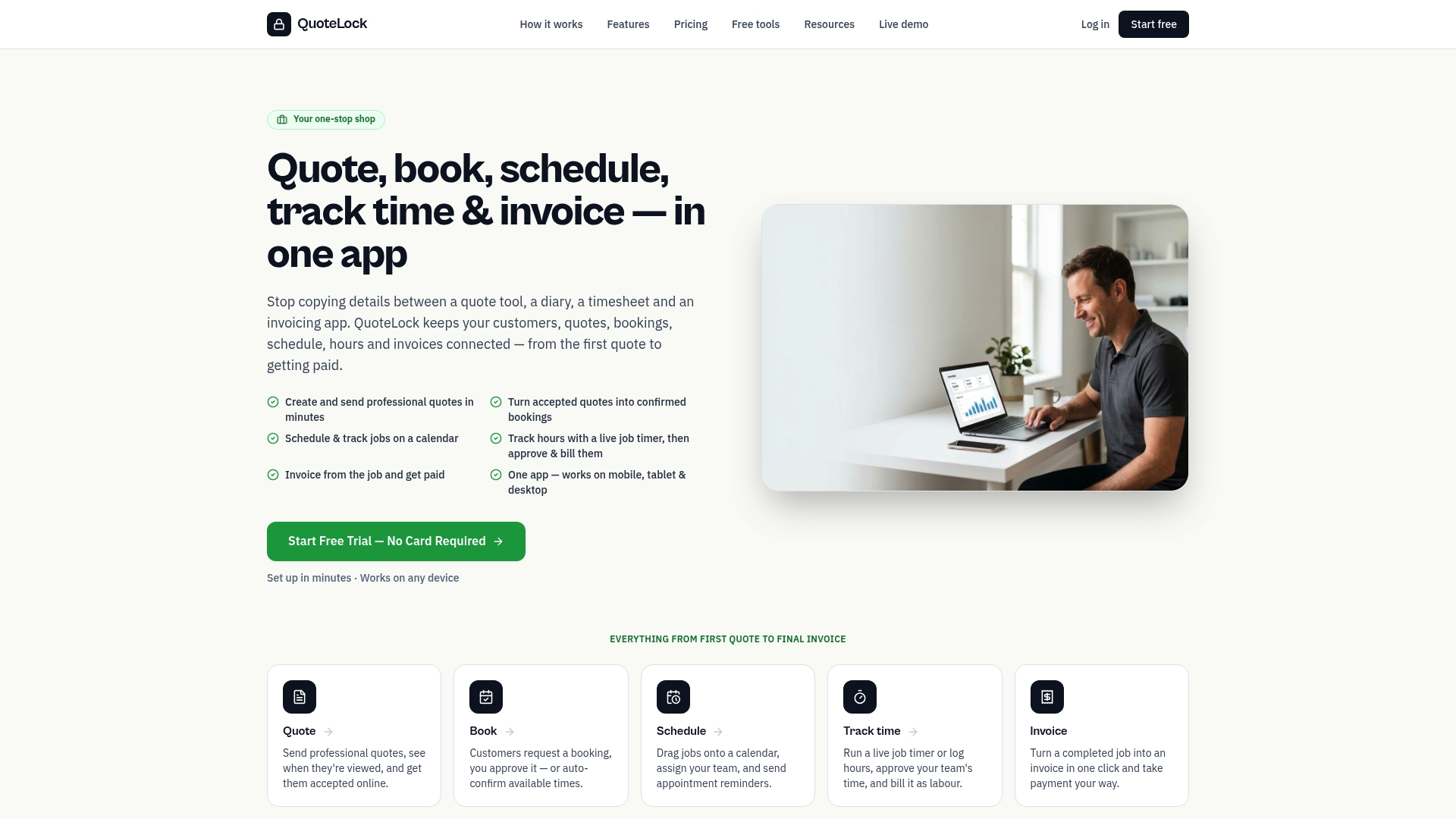
Quote-lock is built specifically for trade contractors and service businesses that need to invoice fast without sacrificing detail. The platform converts accepted quotes directly into branded, itemized invoices in one click — no re-entering data, no formatting from scratch. Automatic sequential numbering, tax calculations, and payment links are built in, so every invoice you send meets the professional standard this article describes.
Automated reminders handle the follow-up sequence for you, and the invoicing software tracks payment status so you always know what’s outstanding. Builders, landscapers, cleaners, and handymen use Quote-lock to cut invoice admin from hours to minutes while sending documents that actually look like they came from a serious business.
Start a 7-day free trial at Quote-lock and send your first professional, itemized invoice today — no client login required, no training needed.
Sources
- The Psychology of Invoicing: Why Transparency Builds Client Trust | Projectworks
- Invoice definition and explanation | Investopedia
- Invoice requirements and best practices | Stripe
- Professional branding and invoice design psychology | eInvoice Blog
- Turn invoices into relationship-building tools | Zintego