What Is Progress Billing for Home Improvement Projects?

What Is Progress Billing for Home Improvement Projects?
Progress billing is a payment method that lets contractors invoice for work in stages, tied to how much of the job is actually done, instead of waiting for one lump sum at the end. It’s the standard way most large or long-running renovation jobs get paid, and if you’re a contractor or a homeowner facing a lengthy remodel, you’ll almost certainly encounter it.
Here’s what matters most:
- Schedule of values: a line-item breakdown of the contract price that becomes the backbone of every invoice
- Percent-complete vs. milestone billing: two different math methods for deciding how much to invoice at each stage
- Retainage: a percentage held back from each payment until the job wraps up and passes final inspection
Progress billing shows up most on jobs that stretch past a few weeks, involve financing, or require the contractor to keep buying materials and paying crews before the final walkthrough.
Key Takeaways
Progress billing ties payment directly to verified work completed, using a schedule of values, retainage, and either percent-complete or milestone math to structure every draw.
| Point | Details |
|---|---|
| Definition | Progress billing invoices work completed in stages rather than billing one lump sum at project end. |
| Schedule of values is essential | A granular, itemized SOV reduces disputes by making percent-complete calculations objective. |
| Retainage runs 5% to 10% typically | Retainage protects homeowners but can strain contractor cash flow if held too long. |
| Documentation prevents disputes | Dated photos, sign-offs, and separate change-order tracking resolve most billing disagreements. |
| Software reduces friction | QuoteLock converts accepted quotes into staged invoices with retainage tracking and evidence attachments built in. |
Table of Contents
- Progress Billing Definition and How It Varies by Contract Type
- How Does Progress Billing Work Step by Step?
- What Contract Terms Determine How Much You Can Bill?
- Progress Billing Examples: Two Worked Calculations
- Benefits and Risks of Progress Billing
- Best Practices for Contractors Managing Progress Billing
- How Should Progress Billing Be Recorded in Your Books?
- How Do You Handle Disputes Over Billed Amounts?
- What I’ve Learned Watching Progress Billing Play Out on Real Jobs
- Simplify Progress Billing With the Right Invoicing Tools
- Frequently Asked Questions
- Sources
Progress Billing Definition and How It Varies by Contract Type
At its core, progress billing means splitting a project’s total price into a series of invoices, each one reflecting work completed to that point rather than work promised. A kitchen remodel priced at $40,000 might generate five invoices over four months instead of one bill at closeout. Investopedia describes progress billings as invoices issued at set stages of a long-term project, usually anchored to a schedule of values and a retainage figure.
The mechanics shift depending on contract type. Percent-complete billing calculates the invoice as a share of the total contract based on how much of the work is physically finished. Milestone billing assigns fixed dollar amounts to specific deliverables, like “invoice $8,000 when framing passes inspection,” regardless of what percentage that represents.
Contract structure changes the approach further:
- Lump-sum contracts use a fixed total price, broken into draws by percent complete or milestone
- Time-and-materials (T&M) contracts bill periodically based on hours logged and materials purchased, with less reliance on a fixed schedule
- Unit-price contracts invoice per unit installed (per square foot of flooring, per linear foot of fencing), so each draw is a direct multiplication
Check your contract’s payment clause first. If it lists percentages tied to phases, you’re looking at milestone billing. If it references “percent complete” or requires a measured progress report, you’re in percent-complete territory.
How Does Progress Billing Work Step by Step?
The workflow follows a predictable sequence, and skipping a step is where most disputes start.
- Set the schedule of values at contract signing. Break the total price into line items (demo, framing, electrical, drywall, finish work) before any work begins. This becomes the reference point for every future invoice.
- Measure percent complete. This can be a visual walkthrough, a third-party inspector, or a checklist of finished deliverables. Photos and dated logs matter here because they turn “trust me” into evidence.
- Build the invoice. A proper progress billing invoice lists the total contract amount, the value completed to date, the current draw being requested, retainage withheld, and the remaining contract balance. Stripe’s overview of progress invoicing notes that dividing a project into staged invoices gives businesses steady revenue and gives clients a clearer sense of what they’re paying for at each point.
- Get sign-off. The homeowner or an inspector confirms the work matches what’s billed. On larger jobs, this might involve a lien waiver exchanged at the same time as payment.
- Collect payment on the agreed timeline. Most contracts specify net 10 or net 15 from invoice date, though this varies by region and contract.
Miss step one and the whole system falls apart. Without a schedule of values, “percent complete” becomes a subjective argument instead of a calculation.
What Contract Terms Determine How Much You Can Bill?
Three contract elements decide when a contractor gets paid and how much: the schedule of values, milestone definitions, and retainage.
A schedule of values (SOV) should break a home improvement job into enough line items that no single one represents a huge chunk of the total. Ten to fifteen line items on a mid-size remodel is typical. A vague SOV with three broad categories invites disputes because there’s no objective way to say “framing is 60% done.”
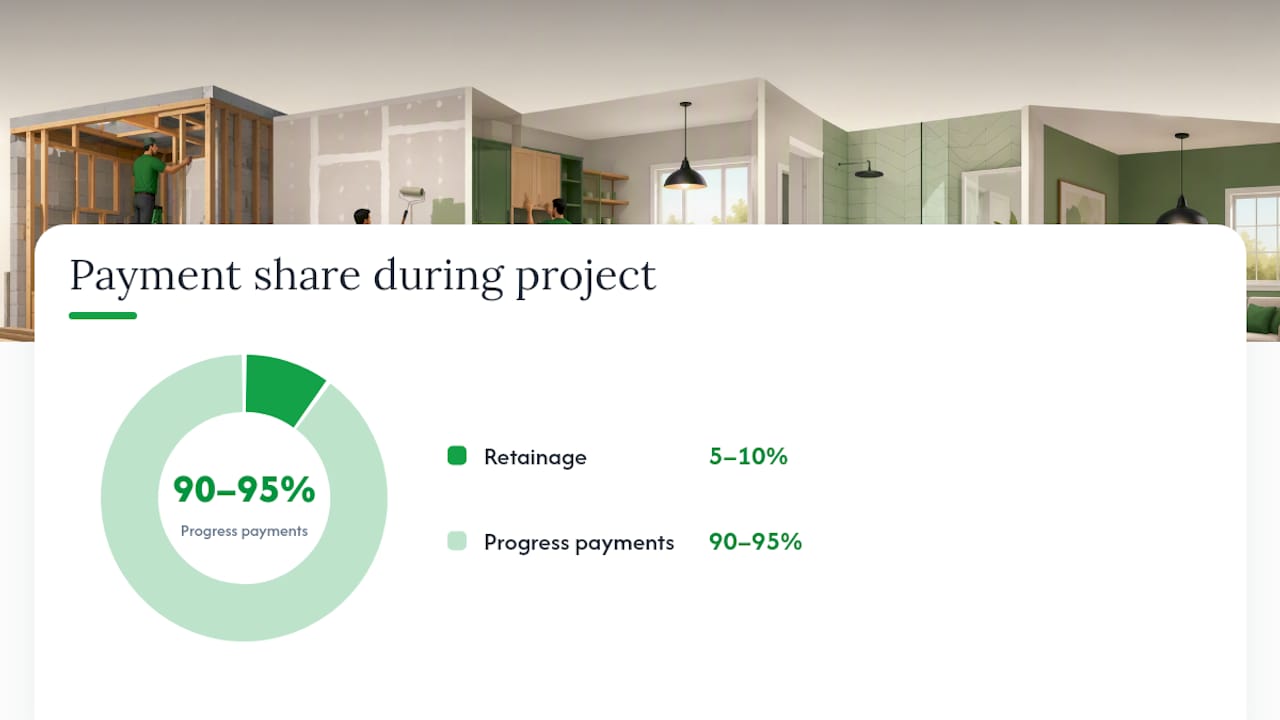
Retainage is the percentage withheld from each draw until the project closes out. Common industry guidance places retainage between 5% and 10%, though some jurisdictions and contract types push higher. That holdback protects the homeowner against incomplete or defective work, but it also means a contractor might not see 5% to 10% of the entire contract value until months after the last invoice.
- Negotiate whether retainage applies to materials as well as labor
- Clarify who verifies percent complete: the homeowner, a third-party inspector, or both
- Consider an escrow arrangement for large deposits on materials with long lead times
- Ask for a materials draw separate from labor draws to offset retainage pressure on cash flow
ConsensusDocs Contract 710-2 offers standardized language for application-of-payment procedures, which is worth reviewing even for smaller residential jobs, since it shows what objective milestone criteria look like in writing.
Progress Billing Examples: Two Worked Calculations
Numbers make this concept click faster than definitions do. Here are two common draw calculations side by side.
Percent-complete example:
- Contract total: $50,000
- Work completed to date, verified by walkthrough: 40%
- Value earned: $50,000 × 0.40 = $20,000
- Retainage withheld at 10%: $2,000
- Amount invoiced this draw: $18,000
- Remaining contract balance after this draw: $30,000
Milestone fixed-draw example: A roofing and siding job worth $22,000 might be broken into four milestones: 25% at material delivery, 25% at tear-off and dry-in, 30% at installation complete, and 20% at final inspection. If installation is only half finished at billing time, the contractor typically bills half of that milestone’s value ($3,300 of the $6,600 milestone) rather than the full amount, unless the contract specifies otherwise.
A clean sample invoice should include:
- Contract number and total contract value
- Schedule of values reference for the line items billed
- Percent complete for each billed item
- Current draw amount and cumulative billed-to-date
- Retainage withheld this period and cumulative retainage held
- Remaining contract balance
- Any approved change orders, listed separately from the original scope
Keep a running work-in-progress (WIP) schedule alongside these invoices. It’s the only reliable way to catch overbilling or underbilling before it becomes a bigger accounting headache at project close.
Benefits and Risks of Progress Billing
For contractors, progress billing means steadier cash flow. You’re not floating six weeks of payroll and material costs on your own dime waiting for a single final check.
Homeowners benefit too. Paying for verified progress instead of a full deposit reduces the risk of paying for work that never gets finished. NetSuite’s overview of progress billing points out that it’s the standard method for high-cost, long-duration projects precisely because it keeps everyone’s incentives aligned.
The risks run in both directions:
- Retainage can place financial pressure on a contractor’s cash flow if a significant portion of funds is withheld for extended periods
- Disagreements over percent complete are the single most common billing dispute
- Overbilling (invoicing ahead of actual progress) or underbilling can distort both parties’ expectations
Objective milestone definitions, dated photo documentation, and a written sign-off process resolve most of these before they escalate.
Best Practices for Contractors Managing Progress Billing
A little discipline before and during the job prevents most billing headaches.
- Before work starts, agree on the schedule of values, set retainage terms in writing, and define what “complete” means for each milestone, whether that’s an inspection, a photo, or a signed punch list.
- During the job, document everything. Daily logs and dated photos aren’t busywork; they’re your evidence if a draw ever gets questioned.
- On every invoice, list percent complete clearly, separate any change orders from the original scope, and attach backup documentation.
- When collecting, follow the agreed schedule and use conditional lien waivers tied to payment receipt rather than signing them before funds clear.
Pro Tip: *Take dated photos at every milestone before you invoice, even for small jobs.
How Should Progress Billing Be Recorded in Your Books?
Progress billings typically show up in a contractor’s accounting under specific account types: a “billings on construction in progress” account, a contract receivable line, and a work-in-progress (WIP) asset account that tracks earned revenue against what’s been invoiced.
Retainage should be tracked separately from regular receivables since it won’t convert to cash until project closeout; lumping it in with normal accounts receivable makes your cash flow projections misleading.
- Reconcile monthly by tying each invoice back to its schedule of values line items
- Record approved change orders as separate contract additions, not adjustments to the original SOV
- Track retainage held as a distinct balance until final release
Revenue recognition rules for long-term contracts vary by accounting standard and jurisdiction, so this is one area worth a conversation with an accountant rather than guesswork.
How Do You Handle Disputes Over Billed Amounts?
Most progress billing disputes trace back to the same triggers: vague milestone language, undocumented work, or change orders that were never formally approved.

Preventing this starts with objective criteria written into the contract, a clear sign-off process at each draw, and a running photo log that both parties can reference. Third-party inspection helps on larger jobs where trust between parties hasn’t been established yet.
If a dispute happens anyway, go back to the schedule of values first. Present the documentation, propose a partial release for the undisputed portion, and consider mediation before anything more formal. If lien rights are involved, document every notice carefully and talk to local counsel before filing; lien laws vary significantly by state and this isn’t a place to guess.
What I’ve Learned Watching Progress Billing Play Out on Real Jobs
Material price spikes and weather delays are where progress billing either saves a job or sinks it. When lumber prices jumped a few years back, contractors with a solid schedule of values could show homeowners exactly which line items were affected and negotiate a change order calmly. Contractors billing off vague percentages had a much harder time making that case.
One pattern shows up again and again: jobs with granular, itemized schedules of values rarely end in payment disputes, because there’s no ambiguity about what “45% complete” means. Jobs with three broad line items and a handshake understanding of progress are where arguments happen, usually right when cash is tightest for everyone involved.
The other lesson is simpler. Never bill for unapproved extras, even small ones. Keep every change order as its own line, documented and signed, separate from the original contract value. It’s the fastest way to lose a homeowner’s trust and the easiest problem to avoid entirely.
Simplify Progress Billing With the Right Invoicing Tools
Doing progress billing right by hand means juggling a schedule of values in one spreadsheet, retainage math in another, and photo evidence scattered across your phone. QuoteLock puts all three in one place. You can convert an accepted quote directly into a staged invoice, attach photos and sign-off evidence to each draw, and track retainage without a separate ledger.

Automated payment reminders mean you’re not the one chasing down a homeowner three weeks after a milestone was hit, and a clean, itemized invoice format cuts down on the “what am I actually paying for” conversations that turn into disputes. If you run renovation or building projects, the construction quoting tools built for builders and renovators are worth a look, and QuoteLock’s quoting software lets you set up a schedule of values once and reuse it across every draw. Start a free trial and send your next progress invoice in minutes instead of an afternoon.
Frequently Asked Questions
What is progress billing in home improvement? Progress billing is a payment method where a contractor invoices a homeowner in stages as work is completed, rather than billing the full contract price upfront or only at the end. Each invoice reflects a percentage of work done or a specific milestone reached.
How is a progress payment amount calculated? It’s calculated either as a percentage of the total contract value based on work completed, or as a fixed dollar amount assigned to a specific milestone in the schedule of values, minus any retainage withheld.
What percentage is typically held back as retainage?
How many progress payments should a homeowner expect on a remodel? Homeowners on mid-size renovations typically expect several progress payments spread across the project timeline, with the exact number depending on project length and payment schedules.
What should be included on a progress billing invoice? A complete invoice lists the total contract amount, value completed to date, current draw requested, retainage withheld, remaining balance, and any approved change orders listed separately from the original scope.
Can a homeowner dispute a progress billing invoice? Yes. Disputes usually center on disagreements over percent complete or undocumented work. Reviewing the schedule of values, requesting photo evidence, and negotiating a partial release are the standard first steps before considering mediation.
Sources
For deeper reading, review ConsensusDocs Contract 710-2 for standardized payment application language, Investopedia’s progress billings overview for core definitions, and NetSuite’s guide to progress billing for accounting context. Grab a ready-made invoice template for trades to build your own schedule of values today.
- Consensusdocs
- Understanding progress billings: Key concepts and benefits — Investopedia
- What is progress invoicing? | Stripe
- Progress billing defined: Advantages & how to implement | NetSuite