Invoice Numbering Systems: What They Do and Why They Matter

Invoice Numbering Systems: What They Do and Why They Matter
An invoice numbering system gives every bill a unique, traceable ID so you can find, verify, and reconcile transactions in seconds. Think of it as the license plate of a transaction — without one, a payment sitting in your bank account is just a number with no name attached. The role of invoice numbering systems goes well beyond organization: they’re the backbone of clean bookkeeping, faster audits, and dispute resolution that doesn’t eat your afternoon.
Every effective system rests on three non-negotiable requirements:
- Uniqueness: no two invoices share the same number, ever.
- Consistency: numbers follow a predictable, documented pattern.
- Traceability: any invoice can be located quickly by issuer or recipient.
The implementation checklist in Section 7 walks you through setting this up in one sitting.
Key Takeaways
A consistent invoice numbering system is the single most cost-effective internal control a small business or freelancer can put in place for cleaner books and faster payments.
| Point | Details |
|---|---|
| Three universal requirements | Every system must deliver uniqueness, consistency, and traceability to support audits and reconciliation. |
| Best default format | INV-YYYY-NNN works for most small businesses — it’s period-clear, resets cleanly each year, and suits e-invoicing. |
| Never delete a void | Mark voided invoices as VOID, log them, and issue the correction as the next sequential number. |
| Compliance varies by country | Check your local tax authority (IRS, GOV.UK, or equivalent) for sequence and retention requirements specific to your jurisdiction. |
| Quote-lock automates the system | Quote-lock auto-increments numbers, prevents duplicates, and logs voids — removing the manual risk that grows with invoice volume. |
Table of Contents
- What exactly is an invoice number?
- Why invoice numbers matter for your business
- Which numbering formats work best for small businesses?
- Compliance basics: what tax authorities actually expect
- How to fix numbering errors, voids, and credit notes
- How to set up your invoice numbering system today
- Why invoice numbering discipline matters more for contractors
- Quote-lock handles invoice numbering automatically
- Sources
What exactly is an invoice number?
An invoice number is a unique identifier assigned to a single invoice at the moment it’s created. Freelancers, sole traders, and businesses of every size use them. The number appears prominently in the invoice header, usually near the date and client name, so both parties can reference it in emails, payment notes, and accounting software without any ambiguity.
A typical format looks like this:
- INV-2026-001 — prefix, year, sequence number
- ACME-2026-1001 — client or company code, year, sequence
- 2026-0047 — year and running count, no prefix
Each segment carries meaning. The prefix (“INV” or your company code) identifies the document type or issuer. The year signals which period the invoice belongs to. The sequence number confirms position in the series. When your accounting software or a client’s accounts-payable system scans that string, every part is machine-readable, which matters more as businesses move toward e-invoicing and automated payment matching.
Why invoice numbers matter for your business
The importance of invoice numbering shows up most clearly when something goes wrong. A client emails to say they paid “the landscaping invoice from last month.” Without a number, you’re cross-referencing dates, amounts, and descriptions to figure out which one they mean. With a number, the conversation is three words: “That’s INV-2026-047.”
The U.S. Small Business Administration recommends consistent recordkeeping and simple internal controls as a direct lever for improving cash-flow visibility and reducing errors. Invoice numbering is exactly that kind of control. Here’s what it does in practice:
- Tracks receivables: you can sort an open-invoice list by number and spot gaps instantly.
- Simplifies bank reconciliation: match a deposit to an invoice number rather than hunting by amount and date.
- Supports audits: sequential, gap-free numbering creates a complete audit trail; unexplained gaps or reused numbers raise red flags that can prolong the process.
- Prevents duplicate billing: a unique number stops the same job from being invoiced twice.
- Speeds customer service: your client’s AP team can approve payment faster when they can search by invoice number.
- Enables AP automation: clients running automated payment systems need a consistent, machine-readable identifier on every document you send.
Which numbering formats work best for small businesses?
There’s no single globally mandated format, so the right choice depends on your volume, client mix, and whether you file e-invoices. The four most common approaches each suit a different situation.
| Format | Example | Best for |
|---|---|---|
| Sequential | INV-001 | Very low volume, single client type |
| Date-based sequential | INV-2026-001 | Most small businesses and freelancers |
| Client-coded | ACME-001 | Agencies or trades with a small, named client list |
| Hybrid (client + year + sequence) | ACME-2026-001 | Project-based contractors, builders, engineers |
Sequential numbering is the simplest starting point. You pick a number, increment by one, never skip. The downside: once you cross into a new year, you either keep counting (INV-1,247 in year three) or reset, which requires a documented decision and a new prefix to avoid collisions.
Date-based sequential (INV-YYYY-NNN) is the format most commonly recommended for small businesses. The year prefix makes the period obvious at a glance, annual resets are clean and logical, and the format survives a move to e-invoicing without modification. Reset the sequence at the start of each tax year and document that reset in your invoice log.
Client- or project-coded formats add a short code for the client or project before the sequence number. A builder invoicing three active sites might use SMITH-2026-003, JONES-2026-001, and PARK-2026-007. This makes project-level reconciliation fast but requires discipline: every new client needs a unique, documented code, and you’re managing multiple series simultaneously.
Hybrid formats combine all three elements. They’re the most informative but also the most complex to maintain manually. If you run multiple series, document the mapping clearly and confirm all series feed into your tax returns so nothing gets missed.
- Sequential: easy to start, harder to manage across years without a reset policy.
- Date-based: clean annual resets, period is always visible, e-invoice friendly.
- Client-coded: fast project lookup, requires a code registry.
- Hybrid: maximum information density, best handled by software.
Compliance basics: what tax authorities actually expect
Most tax authorities share three baseline expectations, even when the specific rules differ by country.
- Uniqueness: never reuse a number, even for a voided invoice.
- Sequence: some jurisdictions, including EU member states for VAT purposes, require consecutive numbering with no unexplained gaps. The Gov notes that invoices must be identifiable and that sequential numbering is required in certain contexts.
- Retention: the IRS requires businesses to keep records long enough to support their tax returns; the exact period depends on the type of record and your situation. In the UK, HMRC generally expects business records to be kept for at least six years.
Country rules vary significantly. Always verify requirements with your local tax authority rather than relying on general guidance. The Useful Sources section at the end of this article lists the key official links.
Disclaimer: this article provides general information only and is not a substitute for professional tax or legal advice. Confirm current rules with your local tax authority or a qualified accountant.
How to fix numbering errors, voids, and credit notes
Mistakes happen. The key is correcting them without breaking your sequence or creating compliance gaps.
- Identify the error. Confirm whether the wrong number was issued, the invoice was sent to the wrong client, or the amount was incorrect.
- Mark the invoice as VOID. Add “VOID” clearly to the document. Never delete it from your records.
- Keep the voided record. Log it in your invoice ledger with its original number, the void date, and the reason. Never reuse that number — it must remain in the sequence as a documented void.
- Issue a credit note if money changed hands. A credit note cancels or adjusts an invoice that was already sent or paid. It gets its own unique number (e.g., CN-2026-001) and must reference the original invoice number in its body.
- Issue the corrected invoice with the next available number. If INV-2026-047 was voided, the corrected version becomes INV-2026-048. Your ledger now shows: 047 (VOID), 048 (corrected replacement).
- Update your log immediately. A gap in your sequence without a corresponding void record is exactly what auditors flag.
Example ledger entry:
| Number | Date | Client | Status | Notes |
|---|---|---|---|---|
| INV-2026-047 | March 3, 2026 | Acme Corp | VOID | Wrong amount — replaced by 048 |
| INV-2026-048 | March 3, 2026 | Acme Corp | Issued | Corrected replacement for 047 |
How to set up your invoice numbering system today
You can have a working system in place within an hour. Here’s the sequence that covers every decision you’ll need to make.
- Choose your format. For most freelancers and small businesses, INV-YYYY-NNN is the right default. It’s clean, period-obvious, and e-invoice compatible.
- Set your prefix rules. Decide whether your prefix is “INV,” your initials, or a company code. Write it down. Consistency from invoice one is what matters.
- Pick your starting number. Don’t start at 001 if you’re new.
Pro Tip: Starting at 1000 rather than 001 is a small but effective way to avoid signaling that you’re brand new. Most accounting tools let you configure the starting point.
- Document your rules. Write a one-page “invoice numbering policy” — format, prefix, starting number, reset rules, and void procedure. Even a note in a shared folder counts.
- Create your ledger. A simple spreadsheet with columns for invoice number, date, client, amount, status (issued/paid/void), and notes is enough to start. Keep it updated in real time.
- Define your void procedure. Agree on the steps in Section 6 before you need them, not after.
- Train anyone who touches invoices. If you have a bookkeeper or admin, they need to know the format and the void rule before they issue their first invoice.
Pro Tip: If you plan to reset your sequence annually, add the year to your prefix from day one — INV-2026-001 rather than INV-001. Retrofitting a year prefix after two years of invoices is a headache you don’t need.
When to move to software: manual spreadsheets work fine at low invoice volumes. Beyond that, the risk of a missed number, a duplicate, or a void that doesn’t get logged grows fast. Automated invoicing tools auto-increment numbers, prevent duplicates, and maintain a searchable, auditable log of every invoice including voids — removing the human error that manual systems can’t fully eliminate.
Why invoice numbering discipline matters more for contractors
Contractors and tradespeople face a specific version of this problem that generic small-business advice tends to gloss over. You’re often juggling multiple active jobs, issuing progress invoices against a single project, and chasing payment across several clients at once. A numbering system that breaks down under that load doesn’t just create bookkeeping headaches — it creates disputes.

A builder invoicing three phases of a renovation needs to know instantly which phase a client’s payment covers. A landscaper with eight recurring clients needs to match a bank transfer to the right job without calling the client. The numbering system is what makes that possible without friction. When the system is consistent, reconciliation takes minutes. When it isn’t, it takes an afternoon and a few awkward emails.
The other thing contractors underestimate: their clients’ AP departments. Larger clients often run automated payment systems that match invoices by number. Send them an invoice with no number, a duplicate number, or a format that changes every month, and you’re creating a manual exception in their system. That exception delays payment. Consistent numbering is, in that sense, a cash-flow tool.
Quote-lock handles invoice numbering automatically
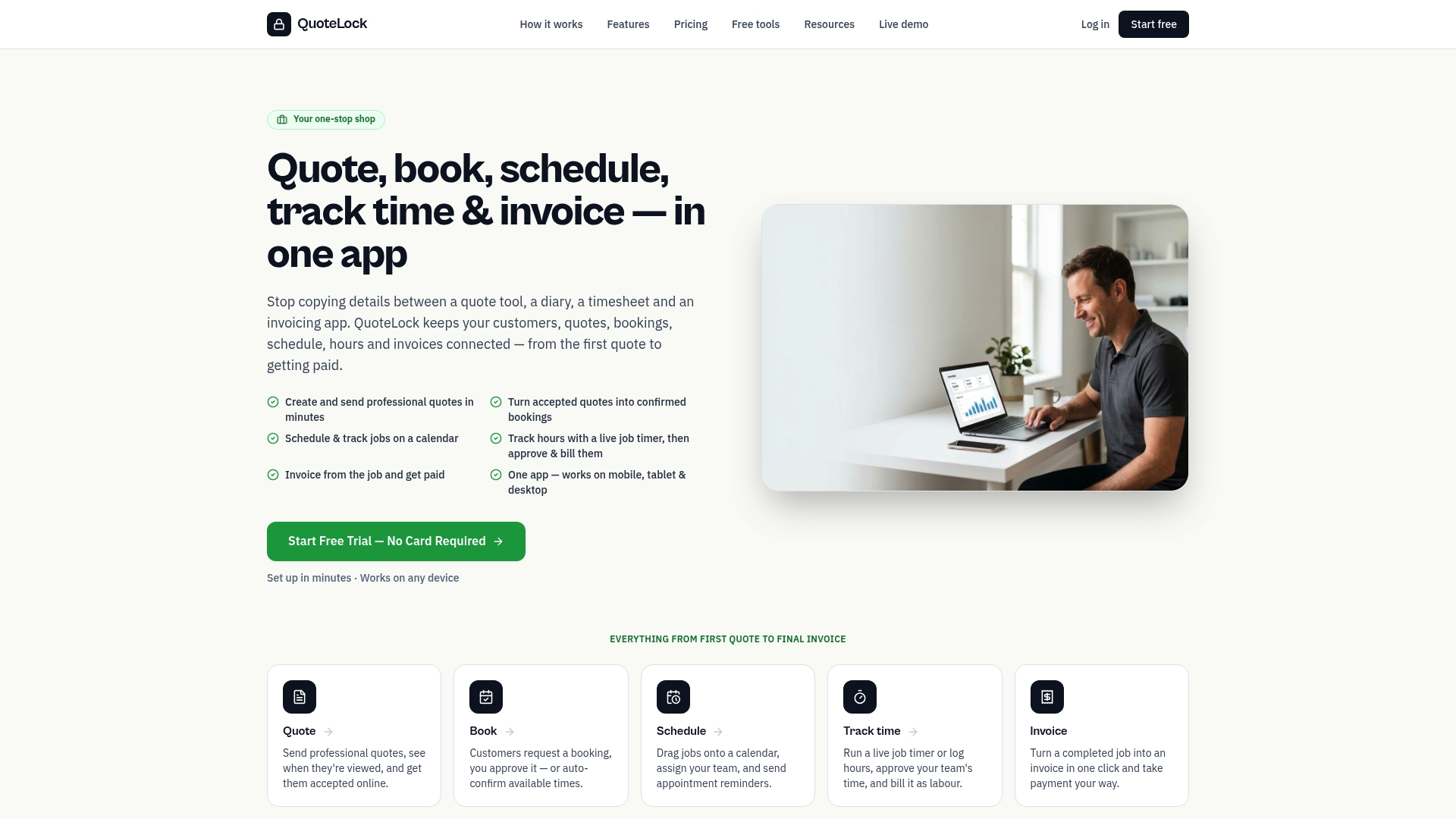
Quote-lock’s invoicing software for trades auto-increments every invoice number from the moment you create your first document, so you never have to track a sequence manually or worry about a duplicate slipping through. Accepted quotes convert to invoices in one click, carrying the correct number, your branding, and automatic tax calculations — no re-keying, no formatting decisions.
Key features that directly address the problems covered in this guide:
- Auto-incrementing numbers with configurable prefixes
- Duplicate detection before an invoice is sent
- Void and credit note handling with a full audit log
- Exportable invoice ledger for accountants and tax prep
- Payment tracking and follow-up reminders tied to invoice numbers
Builders, landscapers, and service contractors use Quote-lock to cut the admin time between job completion and payment. Start a 7-day free trial at Quote-lock and see how much faster reconciliation gets when the numbering takes care of itself.
Sources
These official resources are the right starting points for verifying invoice numbering and recordkeeping requirements in your jurisdiction.
- Invoice Number: Meaning, Importance & How to Generate It
- What is an invoice number? | Stripe
- Gov
- Recordkeeping | Internal Revenue Service
- Manage your finances | U.S. Small Business Administration
Always verify requirements with your local tax authority or a qualified accountant — rules on sequence, retention, and e-invoicing mandates change, and what applies in one country may not apply in another.