Examples of Scope-of-Work Quote Breakdowns

Examples of Scope-of-Work Quote Breakdowns
This article gives you three contractor-ready, anonymized quote breakdowns plus copy-paste templates and a checklist for comparing bids without getting burned. You’ll see how identical jobs get quoted three different ways, and why the lowest number on the page is often the most expensive one by the final invoice.
Here’s what’s inside:
- Anonymized side-by-side comparisons for a painting job, a flooring job, and a gate/fence repair
- A field-tested checklist covering every section a defensible quote needs, from header data to acceptance wording
- Copy-paste template language for allowances, exclusions, and change orders you can drop straight into your next estimate
- A step-by-step process for reading and comparing bids so completeness gets checked before price
Jump to the line-item comparisons if you want the examples first, or start with the checklist if you’re building a quote from scratch.
Key Takeaways
A detailed, itemized scope-of-work quote reduces disputes and protects margin because it forces prep, allowances, and subcontractor costs into the open before work starts.
| Point | Details |
|---|---|
| Completeness beats price | Check whether prep, cleanup, and disposal are itemized before comparing any totals. |
| Cap every allowance | State a dollar amount and an overage formula, never a vague “allowance” with no figure. |
| Match payment schedule to job size | Use deposit-plus-milestone structures for medium and large jobs, not flat 50/50 splits. |
| Put change control in writing | Require a signed change order before any work outside the original scope proceeds. |
| Standardize your template | Quote-lock’s branded templates apply this line-item structure and convert accepted quotes straight into invoices. |
Table of Contents
- Why a Detailed Scope of Work Quote Protects Your Margin
- The Essential Sections and Line-Item Fields Every Quote Needs
- Anonymized Line-Item Comparisons: Painting, Flooring, and Gate Repair
- A Step-by-Step Checklist for Reading and Comparing Quotes
- Copy-Paste Templates and Wording That Prevent Disputes
- What Standardizing Quote Breakdowns Actually Changes on the Job
- How QuoteLock Turns These Templates Into Faster, Trackable Quotes
- Frequently Asked Questions
- Sources
Why a Detailed Scope of Work Quote Protects Your Margin
Vague scope is the single biggest source of unpaid extras in trade work. When a quote says “prep as needed” or “flooring installation” with no unit breakdown, both sides are guessing. The contractor guesses low to win the bid, the client assumes everything is included, and somewhere around week two the change orders start.
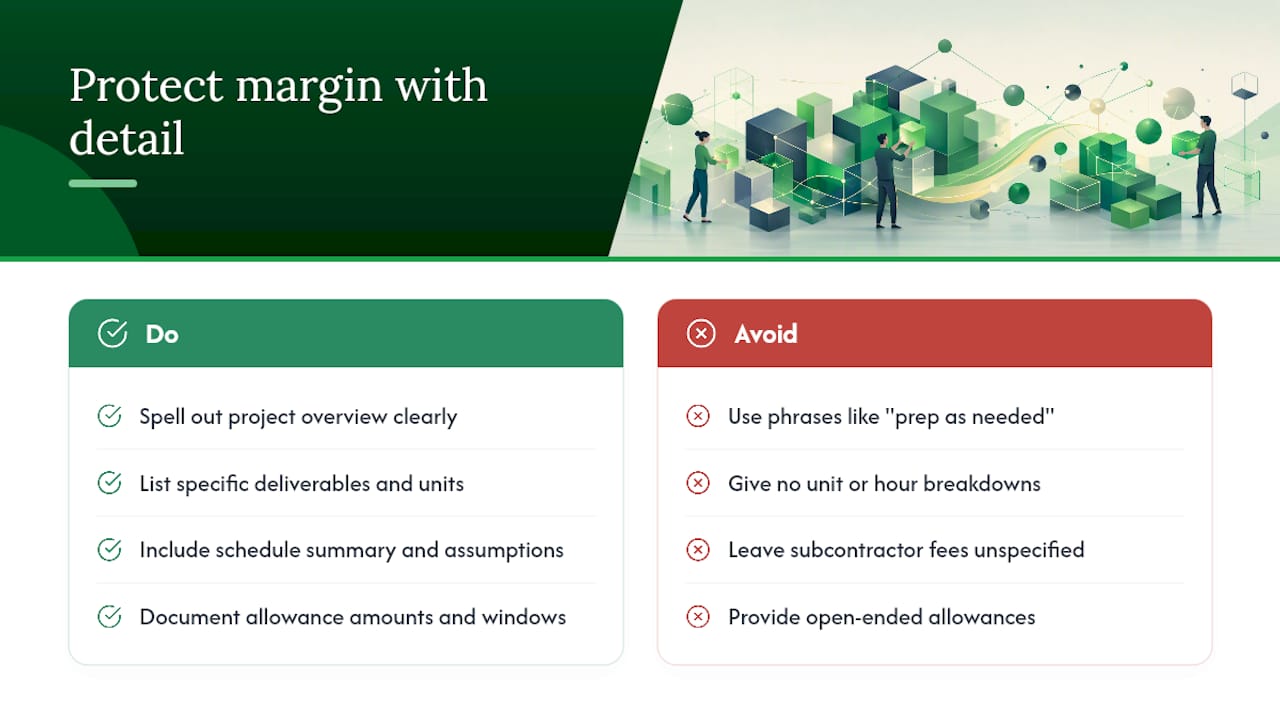
The gap usually shows up in three places: surface prep, allowances, and subcontractor fees. A painting quote that skips patch and sand hours will look cheaper on paper but cost the client extra in a change order once the walls turn out rougher than expected. An allowance with no dollar cap invites disputes the moment the client picks tile that costs more than the contractor assumed. Subcontractor fees for electrical rough-in or permit pulls get left off entirely, then appear as a surprise line item once the job’s underway.
Industry guidance is consistent on the fix: a construction scope of work should spell out the project overview, deliverables, schedule summary, and assumptions up front, precisely so nothing gets treated as implied. Practitioners who build these breakdowns for a living rank prep and cleanup inconsistencies as the most frequent reason a cheap quote turns expensive, because they’re the easiest line items to skip and the hardest to argue about after the fact once the crew’s already on site.
Documenting exact allowance amounts, selection windows, and overage formulas before work starts is what keeps tile allowance disputes from becoming costly arguments. The contractors who skip this step are the ones fielding angry calls in week three.
The pattern holds across trades. Flooring jobs hide cost in subfloor prep and underlayment. Fence repairs hide it in disposal fees and post-hole depth. The line item that’s missing is rarely random. It’s whatever takes the most time and shows the least on a walkthrough.
The Essential Sections and Line-Item Fields Every Quote Needs
A quote that holds up under scrutiny follows a structure, not a vibe. Below is the field-by-field checklist Quote-lock recommends building into every estimate, whether you’re quoting a $600 gate repair or a $60,000 remodel.
1. Header data
Every quote needs identifying information before it needs a single price. Skip this and you’ll spend more time chasing down “which quote was this again?” emails than you’d think.
- Client name and job site address (if different from billing address)
- Unique quote reference number
- Issue date and validity period (“Valid for 30 days from issue date”)
- Contractor license number and insurance reference, where applicable
2. Scope summary and work packages
Write two or three plain-English sentences describing the job before any line items appear. Then group the work into packages, sometimes called a work breakdown structure, or WBS. Project management training consistently points to WBS-based grouping and deliverable-based sections as what makes a scope verifiable, because the client can check off “demo complete” or “rough-in passed inspection” against something concrete instead of a vague promise.
For a bathroom remodel, that might mean four packages: demolition, rough-in (plumbing and electrical), finish work, and cleanup/disposal. Each package gets its own subtotal before you roll up to a grand total.
3. Line-item format
This is where most quotes fall apart. A defensible line item has five fields, not two:
- Description — specific enough that a competitor’s estimator would price the same thing (“Remove and dispose of 220 sq ft existing vinyl flooring” beats “flooring removal”)
- Quantity — the actual measured amount, not a round-number guess
- Unit — sq ft, linear ft, each, hour, whatever fits the trade
- Unit price — your rate per unit, so a client can spot-check your math
- Subtotal and notes — the extended price plus any caveat (“assumes standard subfloor condition”)
A contractor quote template built around header details, grouped line items, and explicit terms is the standard practitioners point to for preventing disputes, mainly because it forces the same level of detail on every line rather than letting the biggest cost items stay vague.
Pro Tip: Use the word “included” instead of “as needed” wherever you can. “Two coats of primer included” closes a loophole. “Priming as needed” opens one.
4. Allowances that actually protect both sides
An allowance without a dollar figure and a pricing formula for overages isn’t an allowance. It’s a blank check. The insider practice that experienced estimators use looks like this:
That single sentence does three things: sets a ceiling, defines what’s included, and states exactly how overages get priced. Compare that to “tile allowance: $500” with nothing else, which leaves both sides negotiating from scratch the day the client falls in love with $9-a-square-foot porcelain.
5. Labor phases, subcontractor items, and third-party fees
Break labor into phases that match your work packages rather than one lump “labor” line. If a subcontractor is doing the electrical, list their scope and price separately, and note whether their warranty terms differ from yours. Permit fees, inspection fees, and disposal tipping fees belong as their own line items with the actual amount, not folded into “general job costs” where nobody can check them.

6. Payment schedule examples
The size of the job should set the shape of the payment schedule:
- Small job (under $2,000): 50% deposit to schedule the work, 50% due on completion
- Medium job ($2,000 to $20,000): 30% deposit, 40% at a defined milestone (rough-in complete, materials delivered), 30% on completion
- Large job (over $20,000): deposit plus three to four milestone draws tied to inspections or phase completion, with a final holdback (commonly 10%) released after a walkthrough
7. Change control and acceptance wording
State plainly how changes get approved: “Any work outside this scope requires a signed change order with updated pricing before work proceeds.” Then close with acceptance language the client actually signs: “By signing below, client approves this scope of work and agrees to the payment schedule outlined above.” No signature, no start date. That line alone resolves more disputes than any clause you could add about liability.
Anonymized Line-Item Comparisons: Painting, Flooring, and Gate Repair
Numbers tell the story better than warnings do. Below are three anonymized comparisons pulled from real bid patterns, each showing how the same job produces wildly different quotes depending on what’s actually itemized.
Interior painting: three bedrooms, 1,400 sq ft
Quote C looks like the winner until you notice it excludes ceilings, prep, and cleanup entirely. Once a client adds those back in as change orders, the real total typically lands above Quote B. Anonymized quote comparisons consistently show that low totals hide missing prep, allowances, or exclusions rather than genuine efficiency, and this is close to a textbook case.
Three quick actions before accepting any of these: ask Quote C’s contractor to itemize prep and cleanup in writing, confirm whether “paint and supplies” in Quote A includes primer, and get ceiling inclusion or exclusion stated explicitly on every bid.
Flooring: 450 sq ft luxury vinyl plank
Quote B looks competitive, but no underlayment line item usually means it’s either being skipped (a real problem for vinyl plank over concrete) or buried in the labor rate with no way to verify it. Quote A skips subfloor prep entirely, which becomes expensive fast if the existing subfloor has dips or squeaks that only show up mid-install.
Before accepting: confirm underlayment type and whether it’s a vapor barrier or just a foam pad, request a subfloor inspection note or contingency clause, and ask whether trim and transitions are itemized or absorbed into labor.
Gate and fence repair: 20 linear feet, one gate
Quote B is $245 cheaper, but it’s missing old post removal and disposal, both of which someone has to do. If the client ends up paying a separate hauling fee, the real gap narrows to almost nothing.
Before accepting: ask directly whether old materials removal and disposal are included, get post depth and concrete footing specs in writing (frost line depth matters more than people expect), and confirm hardware brand or grade since gate hinges vary enormously in longevity.
A Step-by-Step Checklist for Reading and Comparing Quotes
Comparing bids in the order most people use, cheapest first, guarantees you’ll pick the riskiest option more often than not. Work through completeness before you even glance at the total.
- Check scope completeness first. Does the quote cover prep, cleanup, and disposal, or are those silently missing?
- Read the acceptance wording. Vague language like “standard installation” should be a red flag; ask what “standard” means in writing.
- Convert every allowance into a capped price. If a quote says “allowance” with no dollar figure, that’s not a real allowance yet.
- Compare unit prices, not just totals. A $2,800 flooring quote at $6.20/sq ft installed is a different conversation than one at $8.90/sq ft with less material specified.
- Look for a defined change-order process. No mention of how changes get priced usually means changes get priced however the contractor feels that week.
- Confirm subcontractor and permit costs are itemized, not folded into a general labor number.
- Ask clarifying questions in writing, so the answer becomes part of the record: “Does this quote include disposal of removed materials, yes or no?”
- Document agreed allowances and change-order rates before signing, even if it’s just an email confirming the number both sides discussed on the phone.
Red flags worth pausing on: a total that’s noticeably lower than every other bid with no explanation, allowance language with no dollar figure attached, and any quote that skips a payment schedule entirely and just asks for “deposit due on start.”
Pro Tip: Standardize one quote template across every estimator on your team. When every quote uses the same fields in the same order, clients can compare your bids against a competitor’s in minutes instead of hours, and that speed wins jobs.
Copy-Paste Templates and Wording That Prevent Disputes
You don’t need to write this language from scratch every time. Here’s a template map you can adapt line by line.
- Header block: “Quote #[XXX] | Prepared for: [Client Name] | Site: [Address] | Issue date: [Date] | Valid through: [Date + 30 days]”
- Scope summary: “This quote covers [brief description] at [address], including [work package 1], [work package 2], and [work package 3]. Work excludes [specific exclusions].”
- Allowance wording: “Allowance of $[amount] for [material], covering material cost only. Selections exceeding this amount billed at cost plus [X]%, with labor billed separately at $[rate]/hour.”
- Exclusions: “This quote does not include permit fees, structural repairs discovered after demolition, or relocation of existing utilities unless specified above.”
- Change-order approval: “Any scope change requires a written change order signed by both parties before work proceeds. Verbal approvals will not be honored for billing purposes.”
- Acceptance line: “Client signature below constitutes acceptance of this scope of work, pricing, and payment schedule.”
For payment schedules, adapt the small/medium/large structure from the checklist section above and plug in the actual dollar amounts for the job in front of you.
If you’d rather start from a built structure than a blank page, Quote-lock offers free quote templates for trades and small business built around this exact line-item format, along with a free hourly rate calculator for converting labor hours into defensible unit rates.
What Standardizing Quote Breakdowns Actually Changes on the Job
Once a contractor moves from a one-line estimate to a structured breakdown, the biggest shift isn’t in how the quote looks. It’s in how few phone calls happen mid-job. Clients stop calling to ask “wait, was that included?” because the answer’s already on the page they signed.
The real payoff shows up in change-order friction. A crew that’s trained to say “that’s outside the scope we quoted, here’s the line item for the addition” closes disputes in a sentence instead of an argument. Piloting a standardized template on two or three jobs before rolling it out across a whole team is worth doing, because estimators need a week or two to stop reverting to habit and start filling in every field.
One tactical habit worth building into crew training: have field leads read the scope summary out loud to the client before work starts on day one. It takes ninety seconds and catches misunderstandings before they cost anyone money.
How QuoteLock Turns These Templates Into Faster, Trackable Quotes
Building a detailed breakdown by hand in a word processor works, but it’s slow, and slow quotes lose jobs to the contractor who replies first. Quote-lock is built to take the exact structure covered above, header, work packages, line items, allowances, payment schedule, and turn it into a quote you can send in minutes instead of an hour.
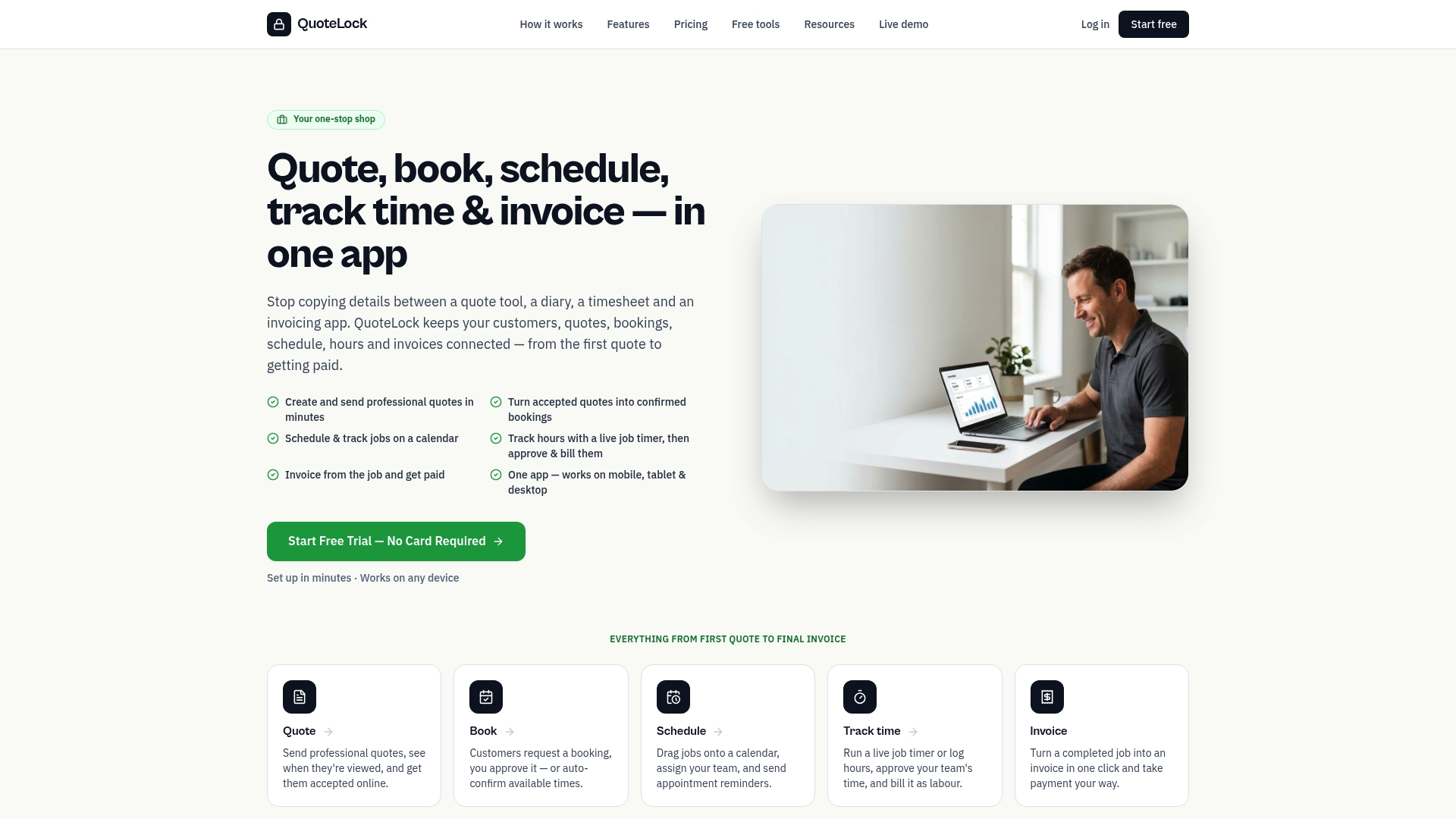
The platform’s branded templates already carry the header and line-item fields this article walks through, so you’re filling in numbers rather than rebuilding a layout from scratch every time. Once a client accepts, Quote-lock converts that same quote directly into an invoice with one click, no retyping the line items you already itemized. You also get view tracking and automatic reminders, so you know the moment a client opens a quote and never lose a job to a bid that quietly went cold in someone’s inbox.
For contractors juggling multiple active bids, that combination, structured templates plus tracking plus quote-to-invoice conversion, replaces hours of admin work each week. Try building your next estimate with a construction quoting template built for builders, send it, and watch it move from quote to accepted to invoiced without opening a second piece of software.
Frequently Asked Questions
What’s the difference between a scope of work and a quote?
A scope of work defines what work will happen and the deliverables involved; a quote attaches pricing to that scope. Most contractor documents combine both, listing the work packages and line items alongside the dollar amounts, which is what the examples above show.
How detailed should line items be on a small job under $1,000?
Even a small repair benefits from splitting materials, labor, and disposal into separate lines rather than one lump sum. It takes an extra two minutes and prevents the “wait, was hauling included?” conversation after the job’s done.
What’s a reasonable allowance amount to include for materials like tile or fixtures?
There’s no universal number since it depends on the material and market, but the amount matters less than the mechanism. Always pair the dollar figure with a clear formula for what happens if the client picks something pricier.
Should exclusions be listed even if they seem obvious?
Yes. What feels obvious to a contractor (permit fees, structural surprises behind drywall, utility relocation) is rarely obvious to the client reading the quote. Listing exclusions explicitly is what keeps them from becoming disputed change orders later.
How do I compare three quotes that use completely different formats?
Rebuild each one into the same line-item structure yourself before comparing, using the checklist fields covered above, prep, materials, labor, allowances, and exclusions. It takes ten minutes and it’s the only way to compare apples to apples instead of guessing.
Sources
- Contractor Quote Breakdown Examples | RenoCost
- Contractor Quote Template: Line Items, Payment Schedule, and Terms That Prevent Disputes - Ququ Blog
- A construction scope of work (SOW): Tips, templates and examples