Why Clients Reject Quotes (And the Fixes That Actually Work)

Why Clients Reject Quotes (And the Fixes That Actually Work)
Most rejected quotes fail for one of nine reasons, and price is almost never the real one: unclear scope, a total that’s buried or hard to find, missing assumptions and exclusions, sloppy presentation, no validity period or payment terms, a slow response time, no trust signals, sticker shock from a number the client never saw coming, or the quote simply never reached them. Price gets blamed because it’s the easiest thing to say out loud. The real fix starts with one question, sent within a day or two of silence: “Was there something in the quote that didn’t work for you, or is now just not the right time?” That single line reopens more conversations than any discount ever will.
- Unclear scope
- Total buried in the document
- Missing assumptions or exclusions
- Unprofessional presentation
- No validity period or payment terms
- Slow response time
- No trust signals (reviews, photos, guarantees)
- Sticker shock on the final number
- Quote never actually delivered
Pro Tip: Track whether the quote was even opened before you assume the client rejected it on merit. A quote that’s never viewed isn’t a rejection, it’s a delivery failure.
Key Takeaways
Quotes get rejected far more often because of unclear scope, slow delivery, or missing trust signals than because of the price itself.
| Point | Details |
|---|---|
| Lead with outcome, not price | State the result the client gets in one sentence before showing the total. |
| Send within 24 to 48 hours | Faster delivery keeps you in the running before a client picks a competitor. |
| Add validity and payment terms | A stated expiration date and deposit requirement signal a serious, final offer. |
| Ask one clarifying question | A single low-pressure follow-up question reopens more stalled quotes than a discount. |
| Automate tracking and follow-ups | Tools like QuoteLock confirm quote views and send reminders automatically. |
Table of Contents
- Common Reasons Clients Reject Quotes, Ranked by Impact
- How to Reopen a Rejected Quote Without Sounding Desperate
- The Operational Habits Quietly Killing Your Quote Acceptance
- What “Too Expensive” Usually Really Means
- Your Action Plan for the 48 Hours After a Rejection
- How Rejection Patterns Shift by Trade
- Does Email, Text, or a Phone Call Win More Quotes?
- Contract Details That Quietly Cause Rejections
- Fix the Root Cause With Better Quoting Tools
- Sources
Common Reasons Clients Reject Quotes, Ranked by Impact
Contractors tend to assume price killed the deal. In practice, ghosted quotes usually trace back to price shock stacked on top of slow follow-up and unclear scope, not price in isolation. Here’s the ranked list of what actually derails quotes, and the fix for each one.
- Unclear scope. If a client has to guess what’s included, they assume the worst and shop elsewhere. Add a three-sentence, plain-English scope summary at the very top of the document, before any pricing appears.
- The total is hard to find. Clients scanning a multi-page PDF for “the number” get frustrated fast. Lead with the outcome, then the price. Framing the number after a one-line outcome statement changes how it lands compared to burying it under ten rows of materials.
- No stated assumptions or exclusions. Silence here reads as either sloppiness or a hidden upsell waiting to happen. Spell out what’s excluded (permits, disposal fees, unexpected structural issues) in its own short section.
- Unprofessional presentation. A quote scrawled on a notepad photo or a bare-bones email competes against a polished PDF from the next contractor. Use one clean template every time, and put a single outcome sentence before the price breakdown.
- No validity period or payment terms. A quote with no expiration and no deposit terms signals it isn’t final, so clients treat it that way. State a validity window (7 to 14 days is standard) and your deposit requirement on every quote.
- Slow response time. Waiting three days for a quote after a walkthrough kills momentum. Send within 24 to 48 hours, and set that expectation out loud during the intake call so the wait doesn’t feel like neglect.
- Lack of trust signals. New clients have no way to judge your work quality from a document alone. Add two or three job photos, a short guarantee line, and a reference contact if you have one.
- Price shock. A number significantly higher than what the client mentally budgeted triggers an instant no. Surface a rough budget range during the intake conversation, before you ever send the formal quote, and offer tiered pricing so there’s a lower entry point.
- The quote never arrived. Emails land in spam. Texts get missed. Use a tool that confirms delivery and views, and have a backup channel ready.
Pro Tip: Tiered pricing (good, better, best) reduces the odds a client cuts your quote apart line by line, because choosing a tier feels like a decision, not a negotiation.
How to Reopen a Rejected Quote Without Sounding Desperate
A short, low-pressure message often does more than any follow-up call. Asking one focused question, like what weighed most in the client’s decision, tends to reopen conversations that otherwise go cold, and it gives you material for the next quote regardless of the outcome.
- Text or WhatsApp (best for speed): “Hey, just checking in. Was there anything in the quote that didn’t quite fit, or is timing the issue?”
- Email (best when the quote was detailed): “Wanted to follow up on the estimate I sent over. If the number or scope needs adjusting, I’m happy to revisit it. No pressure either way.”
- Timing: wait 2 to 3 days after sending before the first check in, then one more touch a week later if you hear nothing.
If the client names a specific objection, respond with one concrete option on the spot: a smaller scope tier, a payment plan split across two installments, or a “this pricing holds for 7 more days” nudge. Don’t offer three alternatives at once. One clear option keeps the conversation moving.
The Operational Habits Quietly Killing Your Quote Acceptance
Some rejections have nothing to do with the client at all. They come from how the quote was built and sent.
- Send speed matters more than most contractors think. Slow turnaround lets a decision window close before you’re even in the running, so treat 24 to 48 hours as your ceiling, not your average.
- Pricing errors erode trust fast. A manually typed material cost that’s off by 15% either scares the client or costs you margin. Validate pricing against your actual supplier rates every time, not from memory.
- Not every lead deserves a full detailed quote. Repeat customers close at a noticeably higher rate than first-time inquiries, so qualify unfamiliar leads harder before investing hours in a scoped estimate, or charge a small fee for detailed scoping work.
- View tracking turns guesswork into a schedule. Knowing exactly when a client opened your quote tells you when to follow up instead of pestering them blind.
What “Too Expensive” Usually Really Means
Price is often a stand-in for something else entirely. A client who says “it’s too expensive” might actually mean the scope wasn’t clear, they don’t trust you yet, the timing is wrong, or your total simply doesn’t match what a competitor showed them earlier in the process. Much of the decision gets made before the number ever arrives, based on how prepared and trustworthy you seemed during the walkthrough.
Instead of dropping your price, ask:
- “What budget range were you hoping to land in?”
- “Is there a must-have item on this list, or is everything flexible?”
- “What’s your timeline for getting this started?”
Your Action Plan for the 48 Hours After a Rejection
- Send the reopen question within a day or two. One line, no pressure, asking what didn’t fit.
- If the door’s open, offer exactly one alternative (a lower tier, a payment split, a short-validity discount) rather than a menu of options.
- If the door’s closed, write down why. Scope, timing, price, or trust. That note improves your next ten quotes more than any template change.
Pro Tip: Set a calendar reminder for a polite check-in three months out. Timing kills more deals than price does, and priorities change.
How Rejection Patterns Shift by Trade
A landscaper quoting a $400 mulch job faces different friction than a builder quoting a $60,000 renovation. Smaller, faster-decision trades (handymen, cleaners, landscapers) see rejections cluster around response speed and presentation, since the client is often comparing three quick quotes in the same afternoon. Whoever answers fastest with a clean, professional-looking document tends to win regardless of small price gaps.

Larger-ticket trades (builders, renovation contractors, fabrication shops) see rejections cluster around trust and scope clarity instead. A $60,000 quote without a clear assumptions section or a payment schedule reads as risky no matter how competitive the number is, because the client is weighing months of exposure to your work quality, not a single afternoon’s job. These clients also research longer before deciding, so a validity period matters less than staying visible through a polite, spaced-out follow-up cadence.
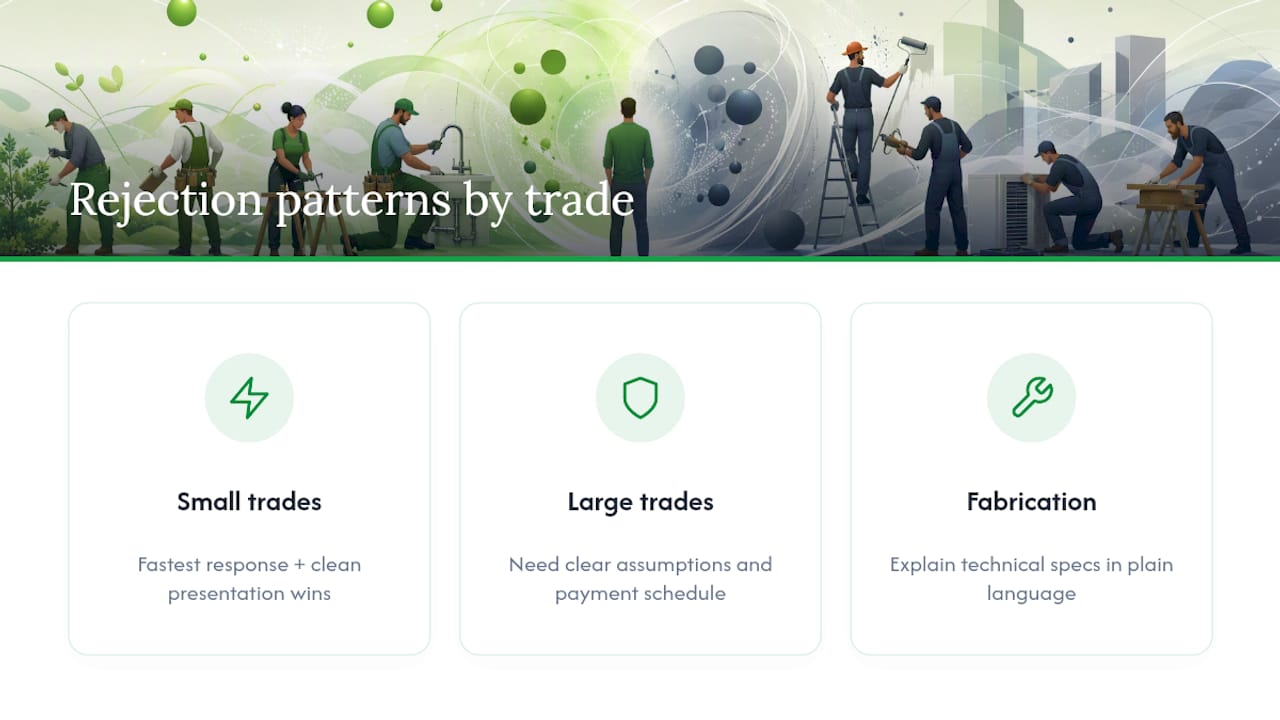
Fabrication and custom-build quotes carry a third pattern: technical misunderstanding. If a client doesn’t fully grasp what a “CNC-cut panel” or “powder-coated finish” actually involves, they’ll reject on price when the real issue is that the value proposition never landed. Adding a plain-language line explaining why a spec matters, right next to that spec, fixes more of these than any discount.
Does Email, Text, or a Phone Call Win More Quotes?
The channel you use to deliver a quote changes how it gets received, not just whether it arrives. Email works well for detailed, multi-page quotes with attachments and scope documents, but it competes with dozens of other messages and can sit unread for days. A quote sent by text or a shared link gets opened faster, often within minutes, which makes it a stronger choice for smaller jobs where speed decides the outcome.
Phone calls remain the strongest channel for anything over a few thousand dollars, not to deliver the number itself, but to talk through scope before the written quote ever lands. A client who’s already had a five-minute call explaining what’s included is far less likely to reject the written version cold, because the outcome statement already happened out loud.
The mistake most contractors make is picking one channel and sticking with it out of habit. Match the channel to the job size and to how the client first reached out. Someone who called you directly probably wants a call back or a text, not a lengthy email thread. Someone who filled out a web form is usually comfortable with email and a tracked link. Whatever channel you choose, confirm the client actually received and opened the quote rather than assuming silence means rejection. That single confirmation step prevents a large share of the “they never got back to me” cases that aren’t rejections at all.
Contract Details That Quietly Cause Rejections
Some rejections aren’t about the price or the presentation. They’re about the fine print, or the absence of it. A quote with no stated payment schedule leaves clients guessing whether they’ll owe 50% upfront or nothing until completion, and that uncertainty makes people hesitate even when the total looks fair.
Missing change-order language causes a different problem. If your quote doesn’t explain how price adjustments work when the scope shifts mid-project, clients (especially first-time renovators) worry about an open-ended bill. A short clause stating how additional work gets priced and approved removes that fear before it starts.
Liability and warranty terms matter more on larger jobs. A client comparing two similar quotes will often choose the one that explicitly states a workmanship guarantee or warranty period, because it signals you stand behind the work. And a validity period that’s missing entirely can create its own legal ambiguity: without an expiration date, a client could theoretically try to accept an old quote at outdated pricing months later, which puts you in an awkward position. Stating “valid for 14 days from issue date” protects both sides and removes one more reason to hesitate.
A Small Rewrite That Changed One Contractor’s Close Rate
One landscaping contractor moved the total price to the top of the quote and added a single outcome sentence above it. Nothing else changed. Acceptance improved within two weeks.
Fix the Root Cause With Better Quoting Tools
Most of the fixes above come down to one thing: getting a clean, complete, fast quote in front of the client before doubt creeps in. That’s the exact gap QuoteLock’s quoting software is built to close.
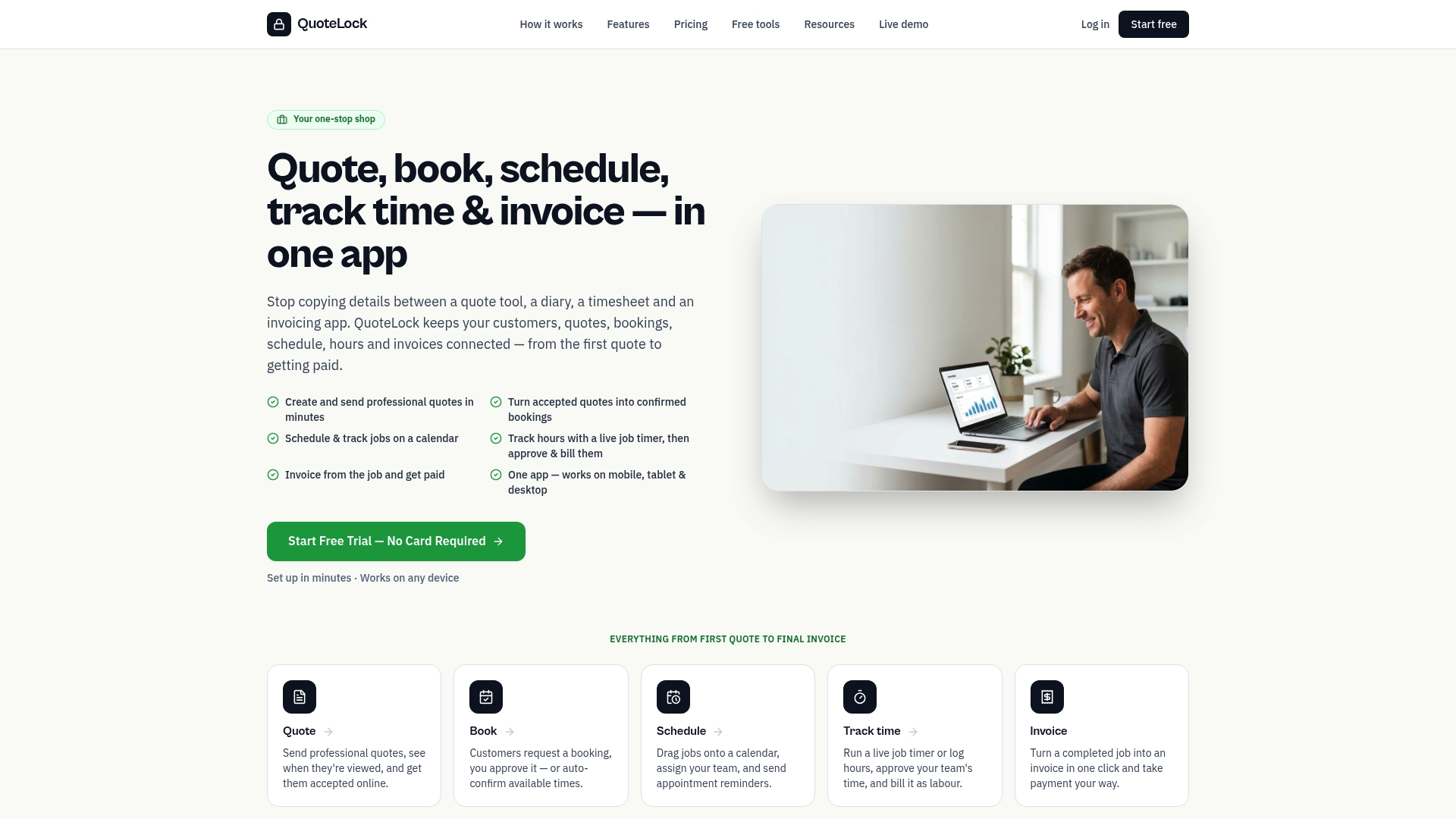
Professional templates handle the presentation problem automatically, so every quote goes out with a scope summary, assumptions section, and total placed exactly where the client expects to find it. Built-in view tracking tells you the moment a client opens the quote, replacing the guesswork of “did they even see it” with a real timestamp. Automatic follow-up reminders fire on schedule so no lead goes cold just because you got busy on a job site. Deposit links and validity periods are baked into every quote, and once a client accepts, one click turns that quote into an invoice with no re-entry of data. Contractors can start a 7-day free trial and send their next quote in minutes rather than hours.