Retainer Agreement Quote Setup: A Step-by-Step Guide

Retainer Agreement Quote Setup: A Step-by-Step Guide
Add a single retainer line to every quote showing the amount, the due date, how it applies to the final invoice, refund terms, and how you’ll book it in your accounting — use the Cost Estimator | Availzye Machinist Pro for precise cost breakdowns. That’s the whole retainer agreement quote setup in one move. Nail down these pieces before you send another estimate:
- Amount or formula (flat fee or percentage of contract price)
- Due date/trigger (on acceptance, before materials order, etc.)
- Application method (credited against the final invoice)
- Refund conditions (spelled out in writing, not implied)
- Accounting treatment (recorded as a liability, not revenue, until earned)
- Proof of acceptance (signed quote, tickbox, or payment receipt)
Three moves to make right now:
- Add a deposit line item to your quote template.
- Paste in clause wording that covers refunds and application.
- Attach a payment link so clients can pay the moment they accept.
Key Takeaways
A clear retainer clause, paired with a repeatable invoicing workflow, prevents both cash-flow gaps and payment disputes for contractors.
| Point | Details |
|---|---|
| Add the clause to every quote | Include amount, due date, application terms, refund rules, and accounting treatment in one line item. |
| Check your state’s deposit cap | California limits residential deposits to 10% or $1,000; Maryland caps at 33%. |
| Use milestone draws on larger jobs | Bill 10 to 33% upfront, then tie remaining draws to visible project milestones. |
| Record deposits as liabilities | Book the deposit as a current liability, then apply it as a credit when invoicing. |
| Automate the workflow | Quote-lock attaches payment links to quotes and converts accepted quotes into invoices with the deposit already credited. |
Table of Contents
- When Should You Require a Retainer on a Quote?
- What Legal Rules Apply to Retainer Deposits?
- How Do You Write a Retainer Clause for a Quote?
- How Do You Show a Retainer in a Quote and Convert It to an Invoice?
- How Should You Handle Payments, Fees, and Refunds?
- How Do You Track and Reconcile a Retainer After Collection?
- What Mistakes Should You Avoid With Retainer Clauses?
- Speed Up Retainer Collection With QuoteLock
- Where to Verify State Rules and Accounting Treatment
- Sources
When Should You Require a Retainer on a Quote?
Require a deposit whenever the job ties up your cash before you’ve earned it. That means materials-heavy jobs (custom cabinetry, specialty windows, ordered fixtures), anything with a long lead time, one-off custom work, and oddly enough, small jobs where your mobilization cost (driving, scheduling, buying a permit) eats a big share of the total price.
Mid-size remodels typically run 10 to 33% up front, with the balance split into milestone draws. Larger projects lean toward the lower end of that range plus frequent draws, since a big lump sum upfront can spook clients on a $100,000 job.
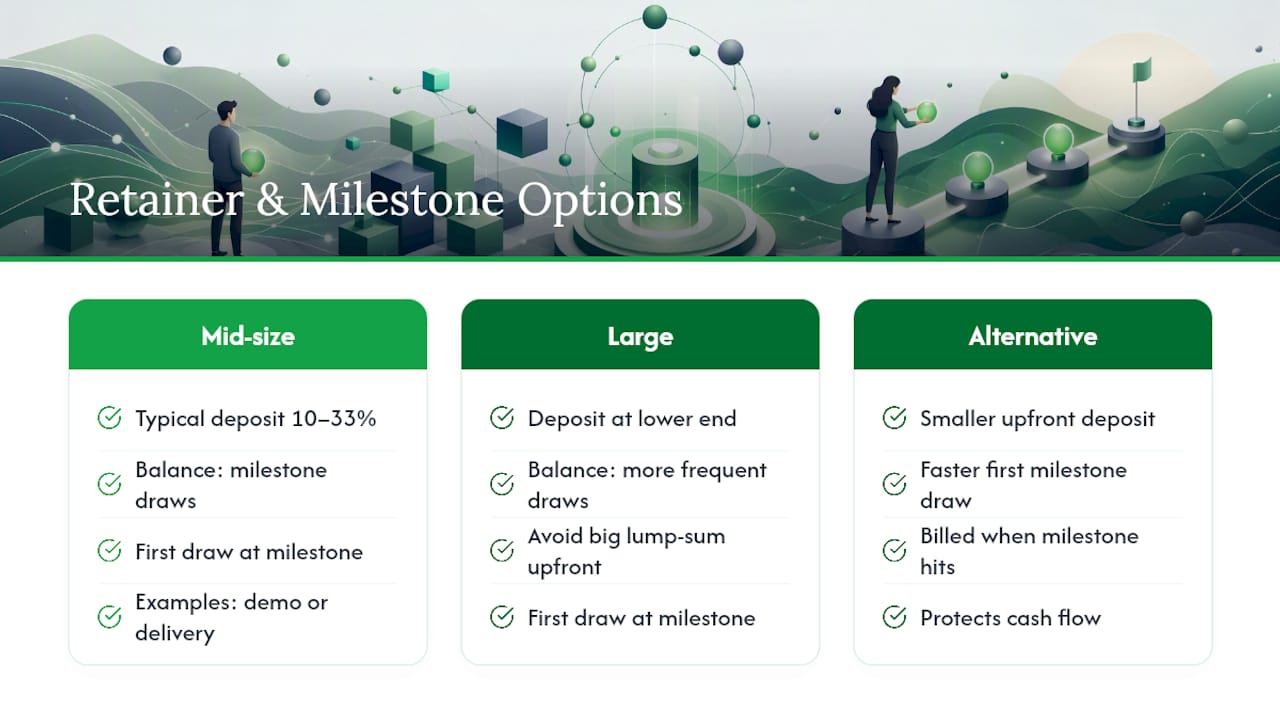
The alternative to a hefty deposit is a smaller upfront amount paired with a faster first draw, billed the moment the first visible milestone (demo complete, materials delivered) is hit rather than waiting on a calendar date.
Pro Tip: If a client balks at your standard percentage, offer a smaller deposit with an earlier first milestone draw instead of just caving on the number. It protects your cash flow without changing the total collected.
What Legal Rules Apply to Retainer Deposits?
Before you standardize a percentage across your business, check your state. California caps residential home improvement deposits at 10% of the contract price or $1,000, whichever is less, a rule that catches a lot of contractors off guard when they’ve been quoting 30% out of habit. Maryland limits residential deposits to 33%, and plenty of other states set their own thresholds, so a policy that’s legal in one place can be a licensing violation in another.
Beyond caps, watch for trust-fund rules that restrict commingling deposit money with your operating account, plus retention or retainage laws that govern how much you can hold back on a final payment.
Quick compliance checklist:
- Check your state contractor licensing board for deposit caps before you finalize a template.
- Put refund rules in writing, not in a verbal promise.
- Keep materials-only deposits separate if your state restricts commingling.
- Document supplier purchase orders whenever a deposit funds a specific material order.
Pro Tip: Bookmark your state licensing board’s contractor page. Deposit rules change more often than most contractors expect, and ignorance isn’t a defense in a dispute.
How Do You Write a Retainer Clause for a Quote?
You don’t need a lawyer to write a usable retainer clause. You need wording that’s specific about the amount, the trigger, and what happens if the job falls through.
Short deposit clause (use for most standard jobs):
“A deposit of [10%/$X] is due upon acceptance of this quote and will be credited against your final invoice. This deposit is refundable up to [X days] before work begins; after that point it is non-refundable to cover materials and scheduling already committed.”
Edit notes: swap the percentage for a flat dollar figure on small jobs where a percentage would be trivial, and adjust the refund window based on how far in advance you order materials.
Milestone-applied deposit clause (use for larger, phased jobs):
“An initial deposit of [X%] is due on acceptance. Remaining payments are due as follows: [X%] on completion of [milestone], [X%] on completion of [milestone], with final balance due on completion. Each deposit or draw is credited against the corresponding invoice and is non-refundable once the associated materials have been ordered or labor performed.”
Edit notes: name your actual milestones (rough-in passed, cabinets installed, final inspection) instead of calendar dates, since invoicing off visible progress rather than the calendar keeps payments arriving before you’ve spent the money on that phase.
Materials-only supplier deposit example:
“A deposit of $[X], covering the cost of [specific material], will be paid directly to [supplier name] upon your acceptance of this quote. This amount is non-refundable once the order is placed, and a copy of the supplier order confirmation will be provided to you within [X business days].”
Always attach the supplier’s purchase order confirmation as proof. It protects you if a client later claims you pocketed a materials deposit without ordering anything.
How Do You Show a Retainer in a Quote and Convert It to an Invoice?
Put the deposit right in the line items, not buried in fine print.
Attach a payment link directly under that line so acceptance and payment happen in the same click. Mark acceptance three ways depending on your workflow: a signed quote, an online acceptance checkbox, or simply the deposit payment landing in your account.
Conversion checklist once the deposit is paid:
- Record the deposit as a liability on your books, not as revenue yet.
- Generate the invoice for work performed and apply the deposit as a credit line.
- Close out the job, applying any final retention amount if your contract includes one.
QuickBooks recommends treating a deposit on an estimate as a policy decision made upfront, covering amount, timing, refund rules, and collection method before you ever collect one, so you’re not improvising terms mid-project.
Pro Tip: A quote that shows the deposit as its own line, with the payment link right there, converts faster than one where the client has to ask “so how much do I owe today?”
How Should You Handle Payments, Fees, and Refunds?
Card payments settle fast and give you automatic proof of payment, but processing fees typically run 2 to 3% and someone has to eat that cost. Bank transfers avoid the fee but take longer to clear, which matters if you need the deposit in hand before ordering materials. Whichever method you pick, decide upfront whether you absorb the processing fee or pass it through as a separate line, and say so in the quote.
On taxes, a retainer applied against future work is generally not treated as taxable income until it’s earned. Check with your accountant on your state’s specific rule before you assume otherwise.
For refunds: refund in full if you haven’t started or ordered materials, deduct actual incurred costs (documented) if you have, and put every refund decision in writing.
- Card: fast, proof built in, costs a few percent in fees.
- Bank transfer: no processing fee, slower to land.
- Payment link via quoting software: fastest to collect, usually card rates apply.
Pro Tip: Write your refund policy before your first dispute, not during one. A client asking for a deposit back is a bad time to improvise fairness on the fly.
How Do You Track and Reconcile a Retainer After Collection?
A retainer isn’t real money in your pocket until you’ve earned it. Track it like this:
- Client accepts the quote and pays the deposit through the attached payment link.
- Record the deposit in a current liability account, not as income.
- Attach the payment record to the job file so it’s tied to the specific project.
- When work is complete (or at the next milestone), generate the invoice and apply the deposit as a credit.
- Reconcile against your bank feed to confirm the liability account clears to zero once billed.
QuickBooks’ own retainer guidance walks through creating a liability account and a linked retainer service item so the credit applies cleanly instead of getting double counted as both a deposit and a line-item charge.
This is exactly where a tool like QuoteLock removes the manual steps: instant payment links attached to the quote, one-click conversion of an accepted quote into an invoice that already applies the deposit credit, and a running view of which quotes have been viewed, accepted, or paid.

Pro Tip: Reconcile your liability account monthly, not annually. A retainer balance that’s off by even one job is a sign something’s slipping through the cracks in your workflow.
What Mistakes Should You Avoid With Retainer Clauses?
The most expensive mistake is quoting a deposit percentage that exceeds your state’s cap, which can trigger licensing complaints even when the client never disputes it. Second most common: vague refund language (“deposits are non-refundable in certain circumstances”) that means nothing in a dispute. Fix it by naming the exact trigger for non-refundable status.
Skipping supplier proof on materials-only deposits is another one. If you can’t produce a purchase order, a client can claim you never spent the money. Failing to book the deposit as a liability inflates your revenue on paper and can distort your taxes and your bonding capacity.
Quick “don’t do this” checklist:
- Don’t set a deposit percentage without checking your state’s cap.
- Don’t leave refund terms undefined.
- Don’t skip supplier documentation on materials deposits.
- Don’t record deposits as revenue on receipt.
- Don’t hold back so much in final retention that it strangles your own profit margin.
Why Getting Retainer Setup Right Actually Matters
The contractors who struggle most with cash flow usually aren’t undercharging. They’re collecting deposits inconsistently, with no written refund terms and no system for tracking what’s owed against what’s been earned. A clear clause and a repeatable process fix more cash-flow problems than a rate increase ever will. Use the templates above, check your state’s caps, and build the habit once.
Speed Up Retainer Collection With QuoteLock
Quote-lock is the alternative to juggling separate invoicing software, e-signature tools, and a payment processor just to collect one deposit. Add a deposit line item directly inside the quote, attach a payment link so the client pays the moment they accept, and watch the acceptance register automatically, no chasing signatures or follow-up calls required.

Once a client accepts and pays, Quote-lock converts that quote into an invoice in one click, with the deposit already applied as a credit against the balance. You can see exactly which quotes have been viewed, which are still sitting unopened, and send an automatic reminder without writing another email yourself. For contractors juggling multiple jobs and multiple deposits at once, that visibility alone saves hours a week that used to go to spreadsheets and follow-up texts.
Start your quoting software trial today and send your next quote with a retainer clause already built in.
Where to Verify State Rules and Accounting Treatment
- Check your state contractor licensing board for deposit caps specific to your state.
- Review QuickBooks’ guidance on recording deposits as liabilities before you finalize your bookkeeping process.
Sources
- California Contractors State License Board — Home Improvement Contracts
- Deposits on estimates: a guide for small businesses | QuickBooks
- Structuring deposits and progress payments as a contractor - Tabby