Why B2B Service Contracts Need Clear Deliverables

Why B2B Service Contracts Need Clear Deliverables
Clear, measurable deliverables in a B2B service contract are the single most effective way to prevent disputes, align payments, and keep scope under control. Without them, you are essentially asking two parties to agree on whether work is “done” using different mental pictures of what done looks like. That gap is where commercial disputes are born.
The practical effects of getting this right are immediate:
- Payment linkage: Milestone payments only release when a defined deliverable is accepted, so invoices are never contested on the grounds of incomplete work.
- Scope control: A written deliverable specification makes it obvious when a client request falls outside the original agreement, giving you a clean basis for a change order.
- Measurable acceptance: Objective acceptance criteria replace subjective judgment calls, so sign-off is a process, not a negotiation.
- Dispute prevention: When both parties can point to the same written description of what was promised, the most common dispute trigger — “that’s not what we asked for” — loses its teeth.
- Timeline governance: Deliverables tied to due dates create enforceable milestones rather than vague project phases.
Key Takeaways
Clear deliverables in B2B service contracts prevent disputes, enable milestone-based payments, and give both parties an objective test for whether work is complete.
| Point | Details |
|---|---|
| Define every deliverable precisely | Specify name, format, quantity, acceptance criteria, due date, and approver for each deliverable in the SOW. |
| Tie payments to acceptance | Link invoice triggers to written deliverable acceptance, not to calendar dates or time periods. |
| Require written change orders | Any modification to scope, format, or timeline needs a signed change order before work begins. |
| Build a formal acceptance process | Include a review window, named approver, rejection criteria, cure period, and deemed-acceptance clause. |
| Use the SOW appendix structure | Keep deliverables in a referenced appendix so the main agreement stays clean and the SOW can be updated by amendment. |
Table of Contents
- Why do B2B service contracts need clear deliverables?
- What exactly is a deliverable in a B2B service contract?
- How do vague deliverables create disputes and business risk?
- Which contract provisions must capture deliverable detail?
- What does a sound acceptance process look like?
- How do you draft measurable, inspectable deliverables?
- How do you manage deliverables once performance starts?
- What do you do when a deliverable cannot be fully specified upfront?
- What does the evidence say about deliverable clarity and project outcomes?
- How to use Quote-lock to capture deliverables before a contract is signed
- The part of this conversation most guides skip
- Sources
Why do B2B service contracts need clear deliverables?
The short answer: because vague scope language is the most common origin of commercial disputes in professional services. Vague scope in professional services contracts is a predictable dispute trigger, and the statement of work (SOW) is the clause where that vagueness either gets fixed or gets worse.
A deliverable, in the contract sense, is a specific, inspectable output or outcome the provider must produce. Documenting deliverables as measurable items turns abstract plans into concrete checkpoints that both parties can verify. That is the mechanism. When a contract says “provide consulting services,” neither party has a clear test for completion. When it says “deliver a written market analysis of no fewer than 20 pages covering the five named competitor segments, in PDF format, by March 14, reviewed and approved by the client’s VP of Strategy within five business days of delivery,” both parties do.
What exactly is a deliverable in a B2B service contract?
A contract deliverable is any tangible or intangible good or service that must be produced and delivered under the agreement. The contract should state what will be delivered, when, and to what standard. That three-part test — what, when, to what standard — is the minimum specification for any deliverable worth putting in a contract.
Deliverables vs. tasks: A task is an activity. A deliverable is the output of that activity. “Conduct stakeholder interviews” is a task. “Deliver a stakeholder interview summary report, in Word format, covering all eight named stakeholders, submitted by April 1” is a deliverable. The distinction matters because tasks are invisible to the client; deliverables are not.
Here are four practical examples across common B2B service categories:
Consulting: A written strategic recommendations report (PDF, 15–25 pages), covering the three business units named in Schedule A, delivered by the date in the project timeline, accepted by the client’s Chief Operating Officer within seven business days.
Software delivery: A tested, deployed web application meeting the functional specifications in Exhibit B, passing all acceptance tests listed in Exhibit C, with zero critical defects open at the time of delivery, deployed to the client’s staging environment by the milestone date.
Training: Three instructor-led training sessions (four hours each), delivered to no more than 20 participants per session, covering the curriculum in Attachment 1, with post-session evaluation scores averaging above the satisfactory threshold.
Maintenance: Monthly preventive maintenance service on the 12 HVAC units listed in Schedule B, including a written service report within 48 hours of each visit, signed by the client’s facilities manager.

Each example specifies what, format, quantity, quality metric, due date, and approver. Strip any one of those fields and you create a gap someone will eventually argue about.
How do vague deliverables create disputes and business risk?
The causal chain is short. Ambiguity in a deliverable description means two parties form different expectations. When the provider delivers against their interpretation and the client evaluates against theirs, the result is a contested acceptance. Contested acceptances delay payment, generate rework costs, and, in high-value deals, produce formal disputes or litigation.
Vague deliverables make it impossible for stakeholders to agree that a project is complete; the project manager’s job is to translate client intent into explicit deliverable definitions before the contract is signed, not after the dispute starts.
Two scenarios illustrate this clearly.
Scenario 1 — “That’s not what we asked for.” A client hires a marketing agency to “redesign the website.” The agency delivers a redesigned homepage and three interior pages. The client expected all 14 pages. Without a deliverable specification listing the exact pages in scope, both parties are technically right. The result: a payment holdback, a rework demand, and a damaged relationship.
Scenario 2 — “We did extra work.” A software firm delivers a product and invoices for 40 hours of work outside the original estimate. The client refuses to pay, arguing the extra work was part of the original scope. Without a written change order tied to a defined deliverable baseline, the provider has no contractual basis to collect.
The business impacts compound quickly: schedule delays cascade into missed client deadlines, scope creep erodes margin, payment holdbacks create cash flow problems, and reputational damage follows when disputes become visible. Missing acceptance criteria and approver assignments are a predictable driver of exactly these outcomes.
Which contract provisions must capture deliverable detail?
Every B2B service contract should address deliverables across several specific clauses. Here is what each one needs to contain:
- Statement of Work (SOW) / Scope of Services: The SOW is where deliverables live. List every deliverable by name, with its description, format, quantity, quality standard, and due date. Explicitly state what is not included. B2B contracts that use SOW appendices help drafters focus on deal-specific items rather than boilerplate.
- Deliverable specifications: For technical or complex deliverables, attach a separate specification document (Exhibit or Schedule) that defines acceptance criteria in measurable terms — test pass rates, word counts, resolution standards, compliance certifications.
- Milestones and timeline: Map each deliverable to a milestone date. A milestone without a deliverable is just a date on a calendar. A deliverable without a milestone date has no enforcement mechanism.
- Acceptance criteria and sign-off process: State the review window (e.g., “ten business days from delivery”), name the approver, and define what constitutes acceptance (written sign-off, email confirmation, or deemed acceptance if no response within the window).
- Payment terms tied to milestones: Link invoice triggers to deliverable acceptance, not to calendar dates. “Invoice upon acceptance of Deliverable 2” is enforceable. “Invoice on the 15th of each month” is not tied to performance.
- Change order process: Require written change orders for any modification to a deliverable’s scope, format, quantity, or due date. Oral agreements to change scope are the single fastest way to lose a dispute.
- Ownership and IP: Specify who owns the deliverable upon acceptance and whether ownership transfers on payment or on delivery.
- Warranties and quality standards: State the standard the deliverable must meet (industry standard, specific regulation, client-defined specification) and the warranty period during which the provider must remedy defects at no charge.
- Remedies for late or nonconforming delivery: Include cure periods, financial credits, milestone payment withholding, liquidated damages for material delay, and termination triggers for repeated or material breach.
Pro Tip: Keep the core deliverable list in an SOW appendix and reference it from the main agreement. This lets you update the SOW for a new project phase without redrafting the entire contract. Always require written change orders for any variance — a B2B contract template that focuses drafters on scope, timeline, price, and ownership reduces ambiguity from the start.
What does a sound acceptance process look like?
Acceptance is where the contract either pays off or falls apart. A well-drafted acceptance process has five steps:
- Delivery notice: The provider formally notifies the client that a deliverable is ready for review, in writing, referencing the deliverable name and contract section.
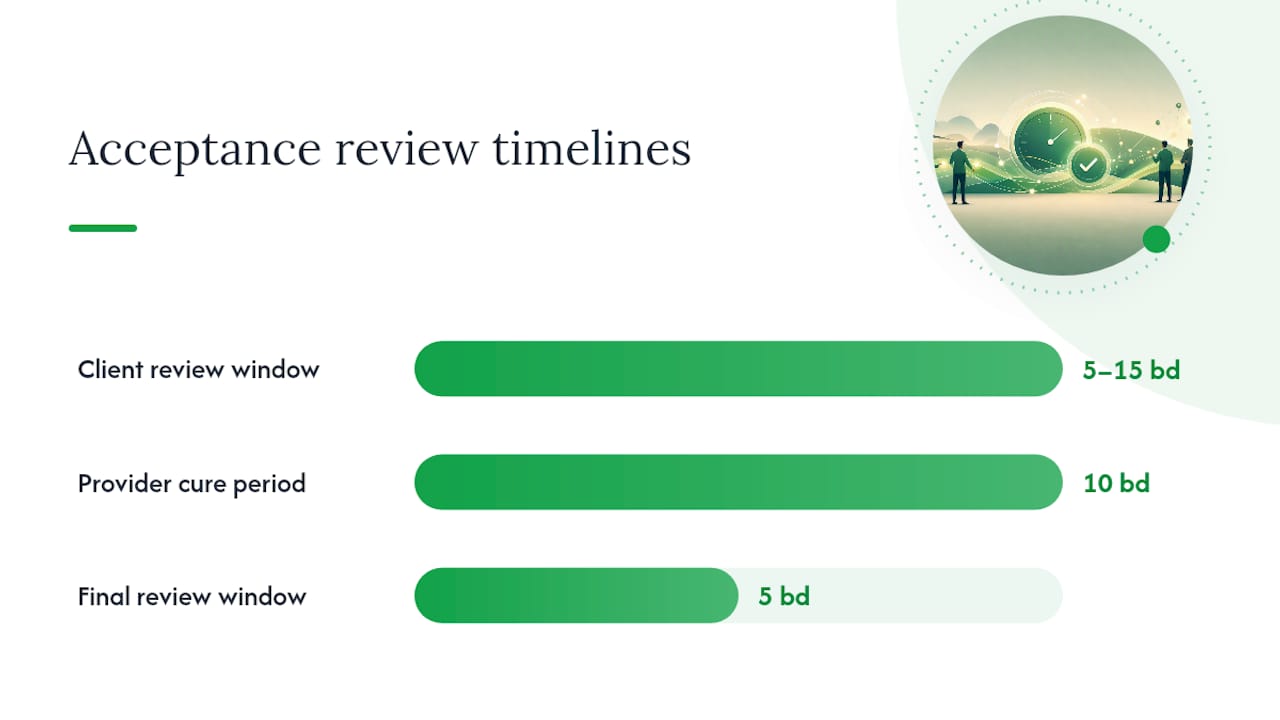
- Inspection/review window: The client has a defined period (typically five to fifteen business days) to review the deliverable against the acceptance criteria.
- Approval or rejection: The client either issues written acceptance or a written rejection notice that identifies specific deficiencies by reference to the acceptance criteria.
- Remediation period: If rejected, the provider has a defined cure period (e.g., ten business days) to correct the identified deficiencies and resubmit.
- Final sign-off: Upon resubmission, the client has a shorter review window (e.g., five business days) and may accept or escalate to a dispute resolution process.
For remedies, the contract should distinguish between scenarios:
- Minor deficiencies: Cure period plus re-performance at the provider’s cost.
- Delay: Financial credits or milestone payment withholding, proportional to delay duration.
- Material breach: Liquidated damages (where the parties agree a pre-set amount is a reasonable estimate of harm) or termination for cause.
Use liquidated damages when delay has a quantifiable downstream cost — a missed product launch date, a regulatory filing deadline, a construction handover. Use re-performance obligations when the harm is primarily quality-based and correctable.
Here is a sample acceptance clause pattern you can adapt:
Sample Acceptance Clause: “Upon delivery of each Deliverable, Client shall have [10] business days to review and either (a) issue written acceptance, or (b) provide a written rejection notice identifying specific deficiencies by reference to the Acceptance Criteria in Exhibit C. If Client does not respond within the review period, the Deliverable shall be deemed accepted. Upon rejection, Provider shall have [10] business days to cure identified deficiencies and resubmit. If the resubmitted Deliverable fails to meet the Acceptance Criteria, Client may, at its election, withhold the associated Milestone Payment, require re-performance, or terminate the applicable Statement of Work for cause.”
Deemed acceptance clauses — where silence equals approval after the review window — are especially important for service providers. Without one, a client can delay acceptance indefinitely and hold up payment with no contractual consequence.
How do you draft measurable, inspectable deliverables?
Use this checklist for every deliverable before it goes into a contract or SOW:
- Name: Give the deliverable a unique, specific name (e.g., “Phase 1 Technical Architecture Document,” not “documentation”).
- Description: One to three sentences describing what the deliverable contains and what it accomplishes.
- Format: Specify the file type, medium, or physical form (PDF, Word, deployed software build, physical prototype).
- Quantity: State the number of units, pages, sessions, or instances.
- Quality/acceptance criteria: Define the measurable standard the deliverable must meet (test pass rate, word count, compliance certification, client sign-off score).
- Dependencies: Note any inputs the provider needs from the client before work can begin (data access, approvals, third-party materials).
- Due date: Tie to a calendar date or a number of days after a preceding milestone.
- Approver: Name the individual (by title, at minimum) who has authority to accept or reject.
- Delivery method: State how the deliverable will be transmitted (email, secure file transfer, physical delivery, deployment to named environment).
- Accompanying documentation: List any supporting materials required at delivery (test reports, compliance certificates, signed acceptance forms, installation guides).
A simple SOW deliverable table captures this efficiently. Here is a format you can paste directly into an SOW:
SMART-style phrasing works well here: specific (named deliverable), measurable (quantified criteria), assigned (named approver), realistic (achievable in the timeline), and time-bound (fixed due date). Acceptance evidence should be concrete: a signed acceptance form, a test report with pass/fail results, a deployment confirmation email, or a completion photo for physical work.
Clear deliverables align teams and stakeholders, provide milestones for tracking, and reduce rework and communication friction during execution. The table format above makes that alignment visible to everyone who touches the contract.
How do you manage deliverables once performance starts?
Drafting a good deliverable table is step one. Keeping it alive during performance is where most contracts quietly fall apart.
Operational controls to put in place:
Assign a single owner to each deliverable on both sides — a provider-side delivery lead and a client-side approver. Without named owners, deliverables drift. Set a reporting cadence: a brief weekly or biweekly status update that references each open deliverable by name, its current status, and any blockers. Acceptance criteria, sign-off owners, and documented change control reduce confusion, rework, and missed deadlines across both internal and client-facing deliverables.
Maintain a single source of truth for deliverable status — a shared project tracker, a contract management platform, or even a shared spreadsheet that both parties can access. The goal is to eliminate “I thought you were handling that” conversations.
Legal and commercial controls:
Enforce change-order discipline from day one. When a client asks for something outside the SOW, the response is a written change order before work begins, not a verbal agreement to sort it out later. Record all approvals in writing, even informal ones. Link every invoice to a specific accepted deliverable, not to a time period. Reserve final payment until final acceptance of the last deliverable.
Pro Tip: Tools that link deliverable sign-offs directly to invoicing close the gap between acceptance and payment. Quote-lock’s quoting and invoicing workflow lets contractors capture scope at the quote stage and convert accepted quotes into invoices, keeping the deliverable record and the payment record in the same place.
What do you do when a deliverable cannot be fully specified upfront?
Some work resists precise specification at contract signing: R&D projects, iterative software builds, creative work where the client’s preferences evolve, or consulting engagements where the scope depends on findings from an earlier phase. Forcing a rigid deliverable definition onto genuinely uncertain work creates its own problems.
Practical alternatives:
- Pilot or prototype phase with objective stopping points: Define the first phase tightly (a working prototype meeting named functional criteria) and make the decision to proceed to full scope contingent on acceptance of that phase. This limits exposure while preserving flexibility.
- Time-and-materials with a not-to-exceed cap: Use T&M billing for uncertain scope, but set a hard cap and require a written change order to exceed it. The cap is the commercial control; the change order is the governance mechanism.
- Outcome-based descriptions with acceptance gates: Instead of specifying the exact form of the deliverable, specify the outcome it must achieve (“the system must process 1,000 transactions per hour with no more than 0.1% error rate”) and build in acceptance gates at defined intervals.
- Progressive elaboration: Define Phase 1 deliverables in full detail, and include a contractual obligation to define Phase 2 deliverables in a written SOW amendment before Phase 2 begins. This preserves the contract structure while acknowledging that later-phase scope is genuinely unknown.
- Success-fee or performance metrics for inherently uncertain outcomes: For work where the value is in the result rather than the output (a sales campaign, a fundraising drive), tie a portion of compensation to a measurable performance metric, with clear measurement methodology agreed upfront.
Vague deliverables create an inevitable gap between client expectations and what the team produces. Outcome-based descriptions narrow that gap without requiring false precision. The risk of outcome-based language is that it can be harder to enforce if the outcome is influenced by factors outside the provider’s control — so always specify what the provider controls (the output) alongside what the parties hope to achieve (the outcome).
What does the evidence say about deliverable clarity and project outcomes?
The project management literature is consistent on this point. The Project Management Institute has long documented that poor requirements definition, including unclear deliverables, is among the top contributors to project failure. Deliverables documented as measurable items turn abstract plans into verifiable checkpoints — and verifiable checkpoints are what make milestone-based payments enforceable.
Key finding: Industry practitioners consistently report that the absence of defined acceptance criteria and named approvers is a leading cause of scope creep and contested project outcomes. When providers hit and get sign-off on deliverables, clients see concrete evidence of progress, which reduces payment friction and dispute likelihood.
From a legal standpoint, U.S. contract law requires that a contract be sufficiently definite to be enforceable — courts have declined to enforce agreements where the scope of services was too vague to determine whether performance occurred. That is not a theoretical risk in high-value B2B deals; it is a documented litigation pattern. Specifying deliverables is not just good project management practice. It is what makes the contract legally coherent.
The operational takeaway: contracts that name every deliverable, assign an approver, set a review window, and tie payment to acceptance consistently produce fewer disputes, faster payments, and cleaner project closures than those that rely on general scope descriptions. That is not a coincidence. It is the direct result of replacing subjective judgment with objective criteria.
How to use Quote-lock to capture deliverables before a contract is signed
The deliverable table and acceptance criteria you draft belong in the contract. But the process of capturing scope, getting client acceptance, and converting that acceptance into an invoice should not require a separate system for each step.
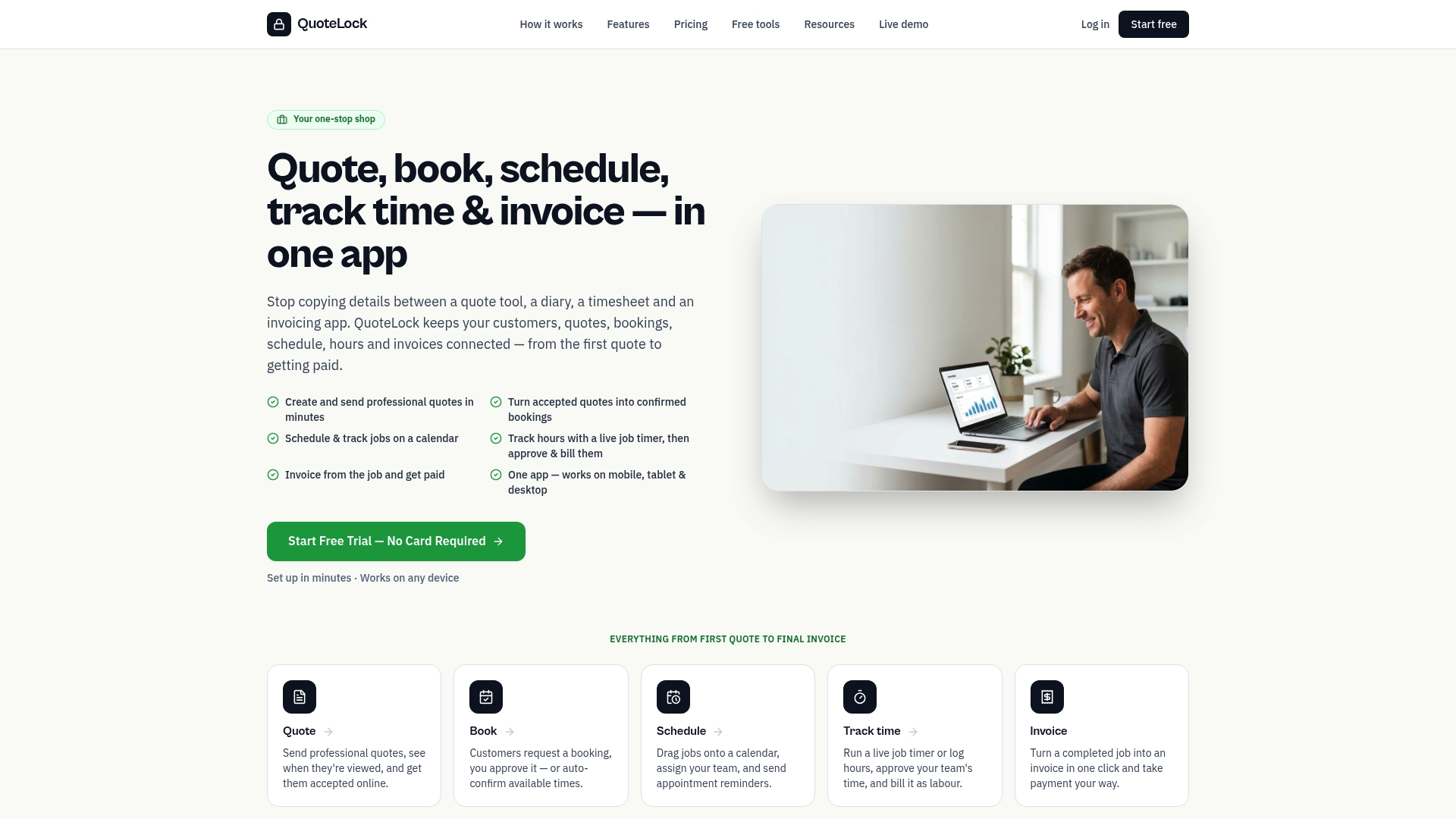
Quote-lock is built for contractors and service businesses who need to move from scope to signed quote to invoice without administrative overhead. You can build a detailed quote that captures deliverable descriptions, quantities, and pricing line by line, send it to the client for online acceptance, and convert the accepted quote directly into an invoice — all without the client needing to log in to any software.
For builders, property maintenance firms, and trade contractors managing milestone-based projects, Quote-lock’s quoting software keeps the deliverable record and the payment record connected from the first client interaction. That connection is exactly what the contract provisions above are designed to enforce.
Start your 7-day free trial at Quote-lock.
The part of this conversation most guides skip
Most articles on deliverables spend their energy on the definition and the checklist. Both matter. But the real problem in practice is not that contract owners don’t know what a deliverable is. It’s that they underestimate how much commercial leverage a well-specified deliverable actually gives them — and how much they give away by leaving it vague.
Here is what the conventional advice misses: the deliverable table is not just a project management tool. It is the primary risk allocation mechanism in a service contract. Every ambiguity in a deliverable description is a risk that one party is silently absorbing. Usually it’s the provider, who ends up doing rework at their own cost. Sometimes it’s the client, who pays for something that doesn’t meet their actual need. The contract doesn’t make that risk disappear — it just determines who bears it when things go wrong.
The second thing most guides understate: the acceptance process is where the contract either works or doesn’t. A beautifully specified deliverable with no formal acceptance process is still vulnerable. If the contract doesn’t define a review window, name an approver, and include a deemed-acceptance clause, the client can delay sign-off indefinitely. That delay is a payment delay. In a multi-milestone project, it compounds.
What to prioritize first: before you add any other clause, add acceptance criteria and a deemed-acceptance provision to every deliverable in your next SOW. Those two elements do more to protect both parties than any other single drafting choice. Everything else — change orders, liquidated damages, warranty periods — builds on that foundation.
This article is general information, not a substitute for advice from a qualified lawyer. Consult a qualified legal professional about your own circumstances before acting on anything here.
Sources
The sources below are worth bookmarking if you draft or review B2B service contracts regularly.
- What Are Project Deliverables in Project Management?
- Professional Services Contracts: Key Terms and Clauses - LegalClarity
- Define Deliverables – Project Management Formula
- Defining clear project deliverables ensures successful outcomes for businesses - Mailchimp Resources
- The importance of clear deliverables - AceProject blog
- What Are Contract Deliverables? Guide to Clarity and Success - Sirion
A note on jurisdiction: All contract drafting guidance in this article applies to U.S. commercial contracts governed by state law. For high-value or high-risk agreements (typically above $50,000, or where IP ownership, liquidated damages, or termination for cause are at stake), have a licensed U.S. attorney review the final contract language before execution.