How Multi-Line Quotes Work in B2B: A Practical Guide

How Multi-Line Quotes Work in B2B: A Practical Guide
A multi-line quote in B2B is a single proposal that bundles multiple distinct products or services into one structured document, giving buyers a complete picture of a complex purchase in one place. Understanding how multi-line quotes work in B2B is the difference between winning a contract and losing it to a competitor who responded faster with a cleaner document. Typical B2B RFQs contain between 10 and 50 line items, each requiring its own pricing logic, quantity confirmation, and availability check. Construction firms, event planners, and service contractors deal with this complexity on every significant job. Get the process right, and you close faster. Get it wrong, and you create disputes, delays, and lost revenue.
How does the multi-line B2B quote process typically work?
The B2B multi-line quote process follows a defined sequence from request intake through final delivery. Each stage adds complexity, and missing a step creates errors that cost time and money.

Stage 1: RFQ intake
A buyer sends a request for quotation, or RFQ, through email, a procurement portal, or an API connection. 50–70% of complex B2B RFQs arrive as unstructured emails with no standard format. That means your team must manually extract each line item before pricing even begins.
Stage 2: Line-by-line pricing and availability
Each line item gets checked individually for current pricing, available stock or labor capacity, and applicable discounts. In manufacturing and construction, this sequential checking process can take 2–5 days when done manually. Every line depends on the previous one being resolved first.
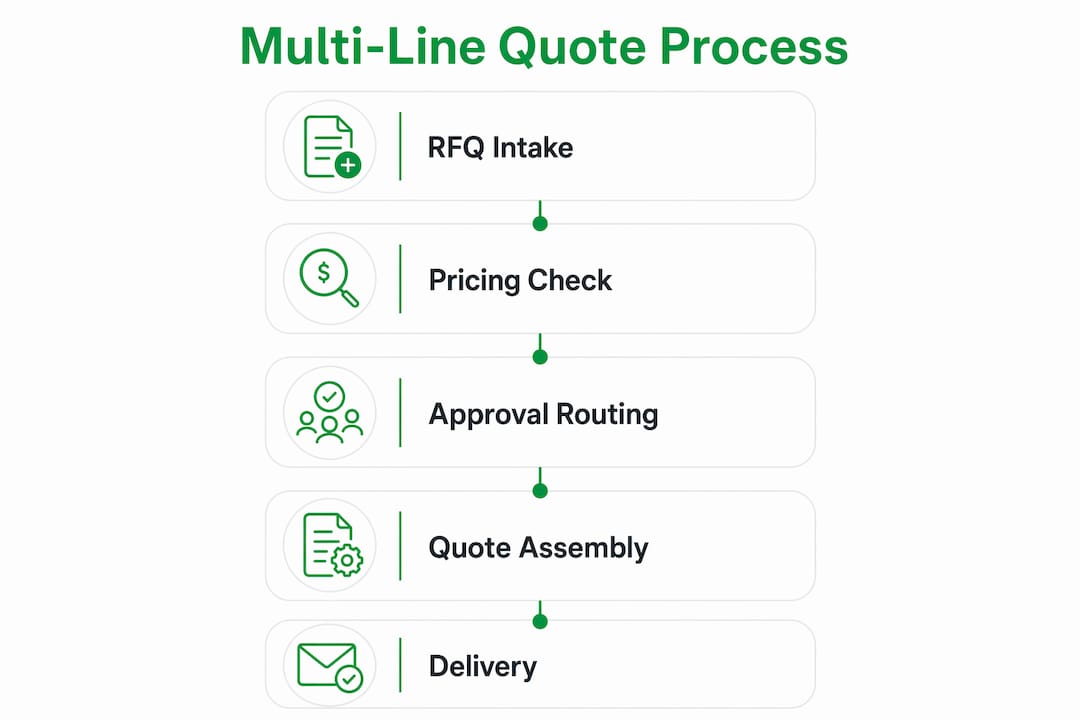
Stage 3: Approval routing
Most B2B quotes above a certain dollar threshold require internal sign-off. Pricing exceptions, custom terms, or large discounts trigger multi-tier approval workflows. Each approver adds time, and without a clear routing system, quotes sit in inboxes for hours or days.
Stage 4: Quote assembly and delivery
Once pricing is confirmed and approvals are granted, the quote gets assembled into a document and sent to the buyer. The B2B quote-to-cash workflow covers eight stages in total, with quote management spanning the first six. That scope shows why a disconnected or manual process creates so many failure points.
Manual processes routinely take 24–72 hours per quote. Automated quoting systems cut that response time to under one hour by removing sequential manual steps. That speed difference is often the deciding factor in competitive bids.
Pro Tip: Number your line items and assign each one a unique reference code in your quote. Buyers can then flag specific lines during negotiation without confusion, which cuts revision cycles significantly.
What are the key challenges in managing multi-line quotes?
Multi-line quoting fails in predictable ways. Knowing where the process breaks down lets you fix it before it costs you a deal.
- Unstructured RFQ formats. When buyers send requests as free-form emails or scanned PDFs, your team spends time decoding the request rather than pricing it. This delays every downstream step.
- Sequential task dependencies. Pricing line 12 often depends on confirming availability for line 7. Manual processes cannot run these checks in parallel, which compounds delays across large RFQs.
- Disconnected systems. Disjointed ecommerce and ERP systems produce static PDFs with outdated pricing. Those errors lead to manual corrections, version mismatches, and invoice disputes after the job is done.
- Complex internal approvals. Large quotes with custom pricing require sign-off from sales managers, finance teams, and sometimes legal. Without a configured routing system, approvals stall.
- Poor quote design. A cluttered layout buries the total price, groups unrelated items together, and forces buyers to hunt for the information they need.
“Buyers scan quotes based on their role. CFOs want a summary total. Procurement teams want line-by-line terms. Technical managers want specs. A single layout that ignores these differences slows every decision in the chain.”
That insight from B2B quote design research explains why quote layout is not a cosmetic concern. It directly affects how fast a buyer approves, escalates, or rejects your proposal.
How should multi-line quotes be structured for clarity and speed?
Quote structure is the single most controllable factor in approval speed. A well-organized multi-line quote reduces the buyer’s cognitive load and removes the friction that delays sign-off.
Use quote line groups
Quote line groups organize related items into labeled sections, such as materials, labor, and equipment rental. Each group carries its own subtotal. Buyers can evaluate one category at a time rather than scanning a single undifferentiated list of 30 items.
Apply progressive disclosure
Show a summary first. Put the total cost, key deliverables, and timeline at the top of the document. Detailed line items follow in collapsible sections or on subsequent pages. Progressive disclosure in quote design helps decision-makers approve faster without sifting through irrelevant details.
Separate one-time and recurring charges
Mixing a one-time setup fee with a monthly service charge in the same line group confuses buyers and creates billing disputes. Label each section clearly and include a subtotal for each charge type.
The table below contrasts two common approaches to multi-line quote structure:
| Structuring approach | Buyer experience | Approval speed |
|---|---|---|
| Single undifferentiated list | Buyer must scan all lines to find relevant data | Slow; requires multiple review rounds |
| Grouped by category with subtotals | Buyer evaluates one section at a time | Faster; each stakeholder finds their section |
| Progressive disclosure with summary first | Decision-maker sees total and scope immediately | Fastest; approvals happen at summary level |
Pro Tip: Apply discounts at the group level, not only at the grand total. A buyer who sees a 10% discount on the labor section understands exactly what they are saving. A single discount line at the bottom of a 40-item quote tells them nothing useful.
Align your groupings with how the buyer evaluates the purchase, not with how your internal catalog is organized. A construction client thinks in terms of phases: demolition, framing, finishing. Your internal system may organize by product SKU. The quote should reflect the buyer’s mental model.
What technologies improve multi-line quoting efficiency in 2026?
The gap between manual and automated multi-line quoting has widened significantly. The tools available in 2026 remove bottlenecks that previously required days of human effort.
AI-powered RFQ intake parses unstructured emails, extracts line items, and matches them to product catalogs automatically. That removes the manual decoding step that delays every subsequent stage. Real-time ERP integration then pulls live pricing and inventory data for each matched item, eliminating the static PDF problem entirely.
Quote-to-cash platforms maintain workflow continuity from initial quote through negotiation, approval, and order conversion. Without that continuity, teams re-enter data at each handoff, which introduces errors and creates the version mismatches that generate invoice disputes.
The table below summarizes key technology features and their direct operational impact:
| Technology feature | Operational benefit |
|---|---|
| AI-based RFQ parsing | Extracts line items from unstructured emails without manual effort |
| Real-time ERP pricing integration | Eliminates outdated pricing errors in delivered quotes |
| Configurable approval workflows | Routes quotes to the right approver without manual escalation |
| Partial quote acceptance | Lets buyers approve ready lines while others are still negotiated |
| Audit trail and status tracking | Reduces follow-up calls and shows buyers the quote is active |
| Automated PDF proposal generation | Produces formatted, professional documents in seconds |
Configurable approval workflows deserve special attention. The best systems let operations teams set routing rules without writing code. A rule might say: any quote over $15,000 with a discount above 12% goes to the regional sales director before delivery. That logic runs automatically on every quote, removing the human memory dependency that causes approvals to get skipped.
For contractors and service businesses, tools like Quote-lock for builders apply these principles at the scale that trades businesses actually operate at, without requiring enterprise software training or complex setup.
Key Takeaways
A well-structured multi-line B2B quote, supported by real-time pricing data and role-aligned layout, cuts approval time and reduces invoice disputes across every stage of the quote-to-cash cycle.
| Point | Details |
|---|---|
| Define each line item clearly | Assign unique reference codes and quantities to every line to prevent revision confusion. |
| Group items by buyer logic | Organize sections around how the buyer evaluates the purchase, not your internal catalog. |
| Automate RFQ intake | AI parsing removes the manual decoding step that delays pricing on unstructured email requests. |
| Integrate ERP in real time | Live pricing data eliminates static PDF errors and the invoice disputes that follow. |
| Apply progressive disclosure | Lead with a summary total so decision-makers can approve at a glance and drill down only when needed. |
What I have learned from watching multi-line quotes fail in the field
After watching contractors and service firms lose bids they should have won, the pattern is almost always the same. The quote arrived late, or it arrived on time but looked like a spreadsheet that a buyer had to decode on their own. Neither outcome is acceptable when the competition is one click away.
The part that surprises most contractors is how much the layout matters. A builder who prices a job correctly but buries the total on page three of a 40-line document is handing the deal to whoever sent a one-page summary with a clear number at the top. Buyers do not reward effort. They reward clarity.
The second thing I have seen consistently is that manual approval chains are the hidden killer of quote speed. A contractor waits for a supplier to confirm a price. The supplier waits for their manager. The manager is on site. The buyer has already called someone else. Configurable digital workflows eliminate that chain entirely, and the contractors who adopt them close faster without working harder.
The third observation is harder to act on but worth stating directly. Treating a quote as a negotiated artifact with a status history, expiry date, and relationship-based pricing is the professional standard. Treating it as a one-time PDF you fire off and forget is how you lose track of open opportunities and leave money on the table. The businesses winning in construction and services right now are the ones that manage their quotes the way they manage their jobs: with visibility, accountability, and follow-through.
— Robert
Quote-lock and the multi-line quoting process
Multi-line quoting does not have to mean hours of manual assembly and back-and-forth emails. Quote-lock is built for contractors and service professionals who need to create detailed, multi-line quotes fast and convert accepted quotes directly into invoices without re-entering a single number.
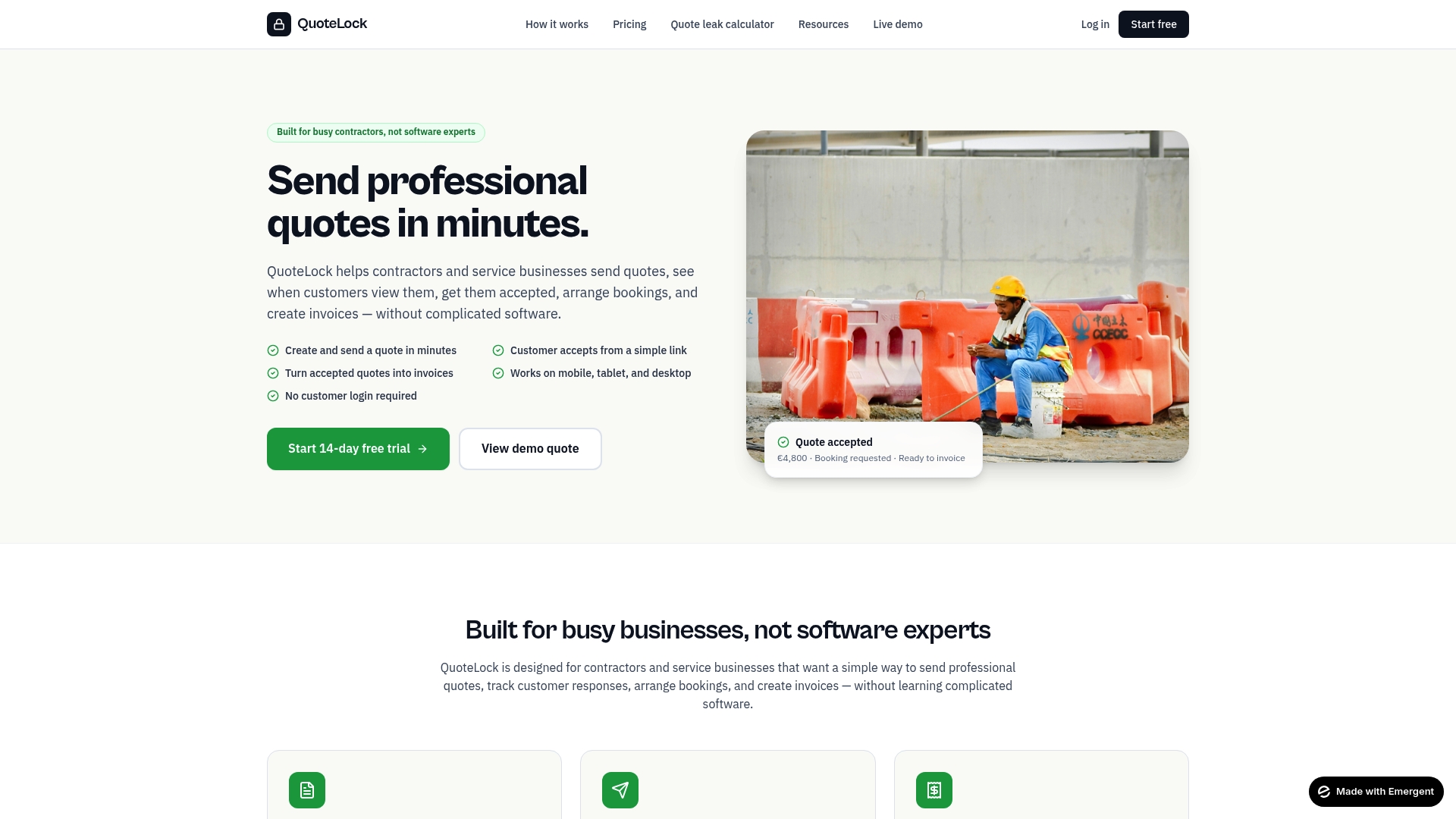
Quote-lock handles variable quantities, grouped line items, and complex discount structures without requiring software training or client logins. You can track when a buyer opens your quote, send automated reminders, and move from accepted quote to invoice in minutes. For landscapers, builders, and tradespeople managing multiple active quotes at once, that reduction in admin time is the difference between taking on more work and drowning in paperwork.
FAQ
What is a multi-line quote in B2B?
A multi-line quote is a single proposal that lists multiple distinct products or services as separate line items, each with its own quantity, unit price, and total. It gives buyers a complete breakdown of a complex purchase in one document.
How many line items does a typical B2B RFQ contain?
Typical B2B RFQs contain between 10 and 50 line items, each requiring individual pricing and availability confirmation. That range is why manual processing takes significantly longer than automated systems.
Why do multi-line quotes take so long to produce manually?
Manual multi-line quoting requires sequential checks for each line item, internal approval routing, and document assembly, a process that commonly takes 24–72 hours. Automated systems reduce that to under one hour by running checks in parallel and routing approvals digitally.
What is the best way to organize a multi-line B2B quote?
Group related items into labeled sections with subtotals, place a summary total at the top, and separate one-time charges from recurring ones. That structure lets each buyer stakeholder find their relevant section without reading the entire document.
How does ERP integration improve multi-line quoting?
Real-time ERP integration pulls live pricing and inventory data directly into the quote, eliminating the static PDF errors that cause invoice disputes. Without it, quotes reflect pricing that may already be outdated by the time the buyer receives them.