B2B Proposal Mistakes Service Firms Must Stop Making

B2B Proposal Mistakes Service Firms Must Stop Making
Most service firms lose proposals not because their work is weak, but because their proposals are. The common B2B proposal mistakes service firms repeat fall into predictable patterns: failing to address what the client actually needs, burying pricing, skipping follow-up, and sending generic documents that could have gone to anyone. Here is a quick map of the most damaging errors before we dig into each one:
- Ignoring client-specific requirements and failing to show ROI
- Using jargon or technical language that alienates decision-makers
- Proposals that are too long, too vague, or structurally unfocused
- Unclear or hidden pricing that creates hesitation
- No defined next steps or call to action
- Sending the proposal and going silent
- Spelling errors, inconsistent formatting, and poor visual flow
- Generic boilerplate with no customization
- Skipping competitor differentiation
- Omitting case studies, testimonials, or any proof of credibility
- Misalignment with the client’s actual business goals
- Failing to articulate a unique value proposition
1. Why failing to address client requirements kills your proposal
Proposals that ignore what the client specifically asked for get rejected fast. Decision-makers can tell within the first two pages whether you read their brief or just sent your standard deck. Missing ROI clarity and measurable success criteria are among the leading causes of proposal rejection, because without them, your offer looks like a cost, not an investment.
The fix is not complicated, but it requires real work before you write a single word. Go back to your discovery notes. What exact problem did the client describe? What metric would tell them the project succeeded? Build your proposal around those answers.
- Restate the client’s problem in their own words before presenting your solution
- Tie every deliverable to a measurable outcome the client cares about
- Avoid vague phrases like “improve performance” and replace them with specific targets
- Show how your approach reduces a risk or closes a gap the client named
Pro Tip: Write the executive summary last. Once the full proposal is done, you will have a much clearer picture of the single strongest case for your services, and the summary will be sharper for it.
2. Avoiding language and clarity mistakes in B2B proposals
Jargon is a trust killer. When a proposal is loaded with acronyms, technical shorthand, or industry-insider language, the reader’s brain works harder and their confidence in you drops. Using the client’s own language and focusing on outcomes rather than process builds trust and raises your close rate.
The most common language pitfalls in B2B proposals:
- Passive voice throughout (“services were delivered” instead of “we delivered”)
- Over-qualification (“we believe we can” instead of “we will”)
- Vague differentiators like “collaborative” or “integrated approach” that appear in every competitor’s proposal
- Abbreviating your firm’s name before the client knows it well
- Technical descriptions that explain how you work instead of what the client gets
Active voice signals confidence. Specific language signals preparation. If your proposal could be sent to any client in your category without changing a word, it is not specific enough.
Pro Tip: After drafting, read every sentence and ask: “Does this tell the client what they get, or does it describe what I do?” Cut or reframe anything that answers only the second question.

3. Structuring proposals effectively: length, focus, and next steps
Proposal length is a real problem in both directions. A 40-page proposal signals you did not do the work of synthesizing. A one-page document that answers nothing signals you did not take the engagement seriously. For standard service engagements, 5–10 pages is the effective range; simpler projects may need only 1–3.
Structure best practices for service firm proposals:
- Open with the client’s problem, not your company history
- Follow with your recommended solution and specific deliverables
- Define scope clearly, including what is excluded
- Present pricing with context, not as a standalone number
- Close with a single, unambiguous next step
The next step section is where most proposals fall apart. Ending with “let us know if you have questions” creates no momentum. Tell the client exactly what to do: schedule a call, sign the agreement, approve the scope. Make it one action, not three options.

4. Common presentation and grammar errors that undermine proposal credibility
A typo on page one tells the client everything they need to know about your attention to detail on the job. Proposals that lack clarity and visual flow fail to inspire confidence, and a single formatting inconsistency can undermine an otherwise strong document.
Presentation pitfalls to eliminate before you hit send:
- Spelling errors and misused words (your vs. you’re, their vs. there)
- Inconsistent capitalization across bullet points and headings
- Brand colors used for body text, which strains the reader’s eyes
- Full paragraphs where bullet points and headers would serve better
- Fonts that are decorative rather than readable
- Inconsistent punctuation at the end of bullet points
Print the proposal before sending it. Your eyes catch errors on paper that they miss on screen. If printing is not practical, switch devices, moving from a laptop to a tablet, for example. Give yourself at least 24 hours between writing and final proofread. The mistakes you missed at 9 PM will be obvious the next morning.
5. Research-backed recommendations for proposal success
Sending a proposal before aligning on budget, scope, and timeline is one of the most common reasons deals stall. A proposal should document what has already been agreed on conceptually, not introduce new information. If pricing has not been discussed informally, the proposal is premature.
Research-backed practices that move the needle:
- Offer 2–3 pricing options rather than a single fixed price; it shifts the client from a yes/no decision to a “which one” decision
- Build an economic roadmap that links your services to financial outcomes like revenue growth or cost savings
- Personalize the situation summary at minimum; ideally, personalize the approach section too
- Confirm stakeholder alignment before sending, since the person you spoke with is rarely the only decision-maker
- Track your win rate before and after implementing these changes so you can see what is working
Quote-lock’s tracking features let you see exactly when a client opens your quote, so you know the right moment to follow up rather than guessing.
6. How to effectively follow up on your B2B proposal
Sending the proposal and waiting is not a strategy. Most deals close after multiple follow-up contacts, and silence after submission usually means the process stalled, not that the client said no. Proactive follow-up is what separates firms with strong close rates from those that wonder why good conversations go nowhere.
Follow-up steps that keep deals moving:
- Schedule a live walkthrough at the same time you deliver the proposal; this single step significantly improves conversion rates by letting you address objections in real time
- Follow up with value, not pressure: share a relevant industry insight, a short article, or a project update that keeps you visible without feeling desperate
- Assume five or more follow-up touches are normal before a deal closes
- Set a specific follow-up date in your calendar the moment you send the proposal
- If you get no response after two touches, try a different channel or contact
The firms that win consistently are the ones that treat follow-up as part of the proposal process, not an afterthought. Quote-lock’s reminder features automate this so nothing slips through the cracks.
7. Pricing mistakes that stall deals before they start
Unclear pricing is one of the fastest ways to lose a deal you should have won. Complex or hidden pricing prompts hesitation and slows deal progression, because clients who have to hunt for numbers or ask for clarification often disengage entirely.
The two most common pricing errors are presenting a number with no context and offering only one option. A single price forces a yes/no decision. Two or three options move the client into a “which one” decision, which is psychologically easier and gives you a negotiation lever. If a client wants to reduce investment, you can reduce scope instead of discounting the same deliverables.
Tie every price to the outcome it produces. “This package costs $8,000” lands differently than “this package is designed to reduce your onboarding time by 30%, at $8,000.” The second version frames the investment against a return. Never drop a number without that frame.
8. Ignoring competitor analysis and differentiation
You are not the only firm bidding. Pretending otherwise in your proposal is a missed opportunity to make a clear case for why you specifically are the right choice. Clients evaluating multiple proposals are actively looking for reasons to narrow the field, and a proposal that does not address differentiation gives them nothing to hold onto.
Differentiation does not mean attacking other firms. It means being specific about what makes your approach distinct. Generic claims like “we are collaborative” or “we bring a proven methodology” appear in every proposal and register as noise. What you want instead is a concrete, client-specific reason: a relevant past result, a specific capability that addresses their stated risk, or a delivery model that fits their timeline better than the standard approach.
Acknowledging the competitive landscape also builds credibility. Clients know you are not the only option. Showing that you understand the market and can articulate your position within it signals confidence, not arrogance. Firms that make common mistakes selling services often skip this step entirely and wonder why technically strong proposals lose to less experienced competitors.
9. Omitting proofs of credibility such as case studies or testimonials
Claims without evidence are just marketing copy. A proposal that says “we deliver results” without showing a single example of those results gives the client no reason to believe you over anyone else. Two or three relevant case studies with specific metrics do more for your credibility than three pages of capability descriptions.
Keep proof sections tight and relevant. A case study from a completely different industry or project type can actually hurt you by making the client wonder whether you understand their context. Pick examples that mirror the client’s situation as closely as possible: similar industry, similar problem, similar scale. State the outcome in numbers where you can. “Reduced project delivery time by three weeks” is far more convincing than “improved efficiency.”
Testimonials work the same way. A short, specific quote from a named client in a recognizable role carries weight. A generic “great to work with” adds nothing. If you do not have strong testimonials yet, a detailed case study with measurable results will do more work.
10. Not aligning the proposal with client’s business objectives
A proposal that solves the wrong problem is worse than no proposal at all. It tells the client you were not listening. The most common version of this mistake is a proposal built around your service catalog rather than the client’s stated goals, where you describe what you offer instead of what they need.
Alignment starts in discovery. Before writing anything, confirm what the client is actually trying to achieve at the business level, not just the project level. Are they trying to reduce costs, enter a new market, retain customers, or hit a specific revenue target? Every section of your proposal should connect back to one of those objectives. If a deliverable does not serve a stated goal, cut it or reframe it.
Buyers reject proposals for exactly this reason: the offer does not map to what they said they needed. Reading back the client’s own language and goals in your proposal is not flattery. It is proof that you were paying attention.
11. Neglecting to highlight unique value propositions
Leading with your company credentials rather than the client’s problem weakens proposals and lowers close rates. Credentials belong after you have demonstrated that you understand the problem and have a credible solution. Credentials that appear before the problem-solution narrative feel like self-promotion. Credentials that appear after feel like evidence.
Your unique value proposition is not your years in business or your team size. It is the specific combination of experience, method, and outcome that you deliver and that others in your category do not. Articulating that clearly requires knowing what your clients actually value most, which is a discovery question, not a marketing exercise.
State it plainly and early. “We specialize in X for Y clients and have delivered Z result in similar engagements” is a value proposition. “We are a full-service firm committed to excellence” is not. The more specific you are, the more credible you become.
Key Takeaways
The most damaging B2B proposal errors service firms make come down to one pattern: writing for yourself instead of the client, then sending the document and hoping for the best.
| Point | Details |
|---|---|
| Address client requirements first | Tie every deliverable to a measurable outcome the client named in discovery. |
| Keep proposals 5–10 pages | Standard service engagements perform best in this range; simpler projects need only 1–3 pages. |
| Offer multiple pricing options | Two or three packages shift clients from a yes/no decision to a choosing decision. |
| Follow up at least five times | Most deals close after multiple contacts; scheduling a live walkthrough at delivery raises conversion. |
| Proof beats claims | Two or three case studies with specific metrics outperform pages of capability descriptions. |
Stop losing deals after the proposal goes out
Most of the mistakes in this article happen after the proposal is written: no follow-up system, no way to know if the client even opened the document, no reminder when a quote goes cold. Quote-lock solves exactly that. You can see when a client views your quote, send reminders automatically, and convert accepted quotes directly into invoices without touching a spreadsheet.
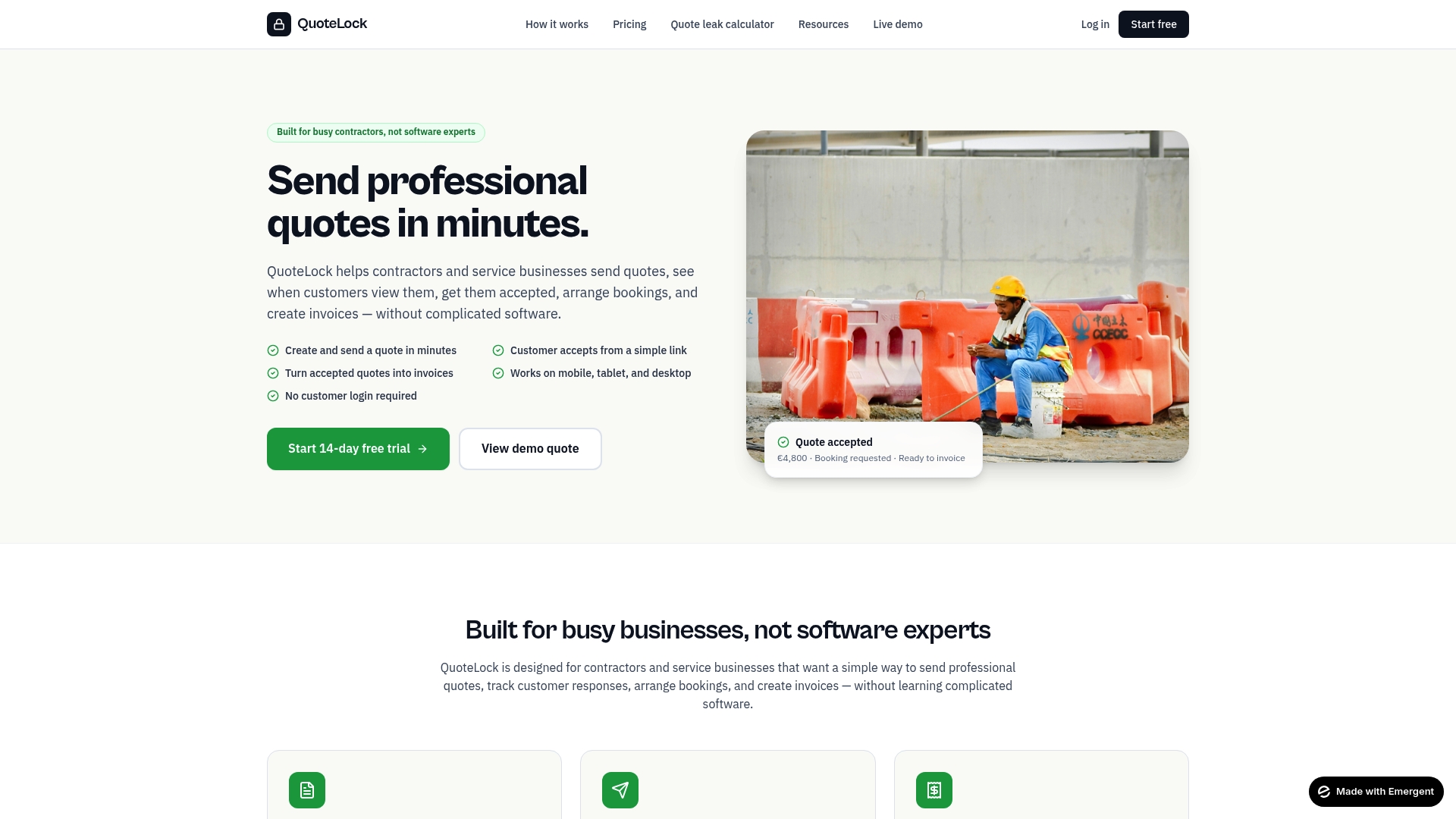
Service firms using Quote-lock spend less time chasing and more time closing. If your proposals are solid but your follow-through is not, that is where the deal is being lost.