Why Follow-Up Matters for Event Bookings: 10 Key Reasons

Why Follow-Up Matters for Event Bookings: 10 Key Reasons
Follow-up is the single most decisive factor in converting event inquiries into confirmed bookings. Prospects contact multiple venues simultaneously, decisions stall, and without consistent outreach, your lead quietly books elsewhere. The venues that stay fully booked aren’t always the most beautiful or the most affordable. They’re the ones that respond first, follow up persistently, and add real value at every touchpoint.
Here’s what effective follow-up actually covers:
- Responding to the initial inquiry within minutes, not hours
- Sending a tour booking link before the prospect moves on
- Nurturing leads post-tour with quotes, photos, and testimonials
- Creating urgency through named, expiring date holds
- Re-engaging cold leads who never officially said no
- Tracking every touchpoint so nothing slips through the cracks
Why follow-up often determines your event booking success
Event leads move fast. A prospective client typically contacts 3–4 venues within minutes of each other, and the first venue to reply with real information, not just a generic acknowledgment, holds a genuine advantage. By the time a next-morning response arrives, the prospect has often already started forming a preference around whoever answered first.
Delayed or fragmented follow-up creates what practitioners call invisible pipeline leaks. You never get a rejection email. The lead just goes quiet, and three weeks later the date is still open on your calendar. Venues often don’t realize how many bookings they’re losing this way until they audit their last 20 inquiries and check how many received a substantive reply within the hour.
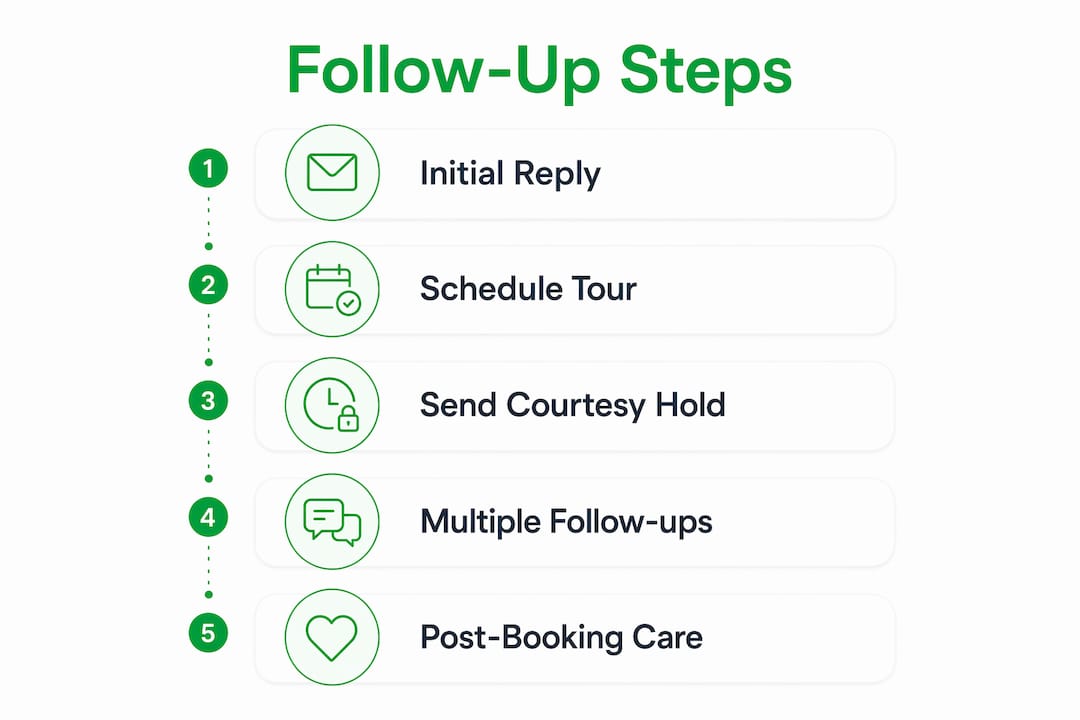
The persistence gap is equally costly. Nearly 80% of sales require multiple follow-ups to close, yet a large share of sales professionals abandon outreach after just one or two attempts. For event bookings specifically, that pattern is devastating. Prospects planning a wedding or corporate event are juggling dozens of decisions at once. A non-reply rarely means disinterest. It usually means they got busy.
Speed and consistency together determine whether your pipeline fills or leaks. A venue that answers quickly and follows up multiple times will outbook a nicer venue that answers the next morning and sends one email.

Best practices for effective event follow-up
Every follow-up message should move the process forward. A check-in that says “just wanted to see if you had any questions” adds nothing. Effective follow-ups provide something new every time: a photo gallery of a similar event, a client testimonial, a direct link to book a tour, or a clear answer to a question the prospect raised.
Personalization matters more than volume. Reference the prospect’s specific event type, their date, their guest count. A message that reads like it was written for them specifically builds more trust than five generic check-ins. CRM tools like HubSpot or a simple spreadsheet can track these details so every message feels considered rather than automated.
- Open with their event details, not a generic greeting
- Attach something visual: real event photos from your space perform better than stock images
- Include a direct booking link so the next step requires zero friction
- Address any objection they raised during the inquiry or tour
- Close with a clear, single call to action
Pro Tip: Use a named, expiring courtesy hold after a tour. A 7-day expiring hold tied to the prospect’s name creates real urgency without pressure tactics. It protects your inventory and gives the prospect a concrete reason to decide rather than drift.
Avoid the mistake of treating follow-up as chasing. When each message delivers something useful, the prospect experiences you as organized and attentive, which is exactly the impression you want to create before they hand you their event.
How a strong follow-up system affects booking rates and client relationships
Automated instant replies change the math on lead conversion. When an inquiry comes in at 9 PM on a Friday, a system that responds within 60 seconds with real availability information and a tour booking link keeps that lead in your pipeline. A human response the following Monday often arrives after the prospect has already toured a competitor.
The relationship doesn’t end at the signed contract, either. Proactive communication after booking confirms the client made the right choice, reduces buyer’s remorse, and sets the tone for a smooth event. Clients who feel well-managed before the event are far more likely to leave a review, refer a friend, and return for an anniversary dinner or next year’s corporate party.

| Follow-up action | Impact on bookings |
|---|---|
| Automated reply within 60 seconds | Keeps lead in pipeline during off-hours |
| Structured post-tour sequence | Converts stalled leads before they drift |
| Named, expiring date hold | Creates urgency without pressure |
| Post-event thank-you and review request | Drives referrals and repeat bookings |
| Re-engagement of cold leads | Recovers bookings from leads written off |
Tracking every touchpoint across all channels prevents the duplication and gaps that signal disorganization to prospects. Fragmented follow-up across phone, email, and form submissions, with no unified view, means some leads get three messages and others get none. Prospects notice. They’re evaluating your organizational competence during the sales process, and a scattered follow-up suggests a scattered event.
Recommended timing and sequence for following up event leads
Timing your follow-up sequence correctly is as important as the content of each message. The goal is consistent presence without becoming noise.
Initial inquiry response:
- Reply within 60 seconds if possible, or as fast as your system allows
- Confirm availability, share a pricing range, and include a direct tour booking link
- Don’t make the prospect ask twice for basic information
Pre-tour sequence (if they haven’t booked a tour yet):
- Day 1: Inquiry response with availability and tour link
- Day 3: A photo gallery or short video of a real event similar to theirs
- Day 6: A client story or review from someone who booked the same event type
- Day 10: A simple, honest check-in asking if anything is holding them back
Post-tour sequence:
- Day 1–2 after tour: Send the quote and offer an informal date hold
- Day 7: Soft check-in confirming they received everything and asking about any questions
- Day 10–14: Transparent heads-up if another party has expressed interest in their date
Post-tour follow-up with honest communication about competing interest is the single most effective nudge for stalled prospects. It’s not a sales trick. For venues, it’s simply true, and a real deadline moves people who are stuck far more reliably than another generic check-in.
Cold leads from past inquiries deserve one respectful re-engagement message. Something like “you reached out about a spring event a while back, and we’d still love to host you” costs nothing and regularly revives bookings from leads everyone had written off. Just verify they haven’t already booked with you before sending.
How consistent follow-up prevents pipeline leaks and accelerates bookings
Speed beats price and location more often than venue owners expect. A prospect comparing four venues will frequently book with the one that answered fastest and stayed in touch, even if another option was slightly nicer or cheaper. The follow-up communicates something the space itself cannot: that the team is organized, responsive, and worth trusting with an important event.
Multiple follow-ups are necessary because prospects are genuinely busy, not because they’re avoiding you. Planning an event involves coordinating family opinions, budget approvals, and competing venue tours. A structured sequence that keeps you present across two weeks respects that reality without abandoning the lead.
Pro Tip: Integrate a live calendar link into your first automated response. Removing the back-and-forth of scheduling a tour is one of the highest-leverage fixes available. Removing booking friction through live calendar links and immediate quotes cuts the time from inquiry to tour dramatically.
Leading venues also use named, expiring holds as a closing mechanism for stalled leads. After a tour, offering a prospect a hold with their name on it for seven days creates a concrete deadline without manufactured pressure. It protects your inventory and gives the prospect a clear frame for their decision.
Structured sequences also eliminate human error. When follow-up depends on memory or manual tracking, some leads get multiple nudges and others get none. Automating the sequence ensures every lead receives the same quality of attention regardless of how busy the team is during peak season.
Common mistakes to avoid in event booking follow-up
Most follow-up failures aren’t dramatic. They’re quiet, repeated errors that compound over time and drain the pipeline without anyone noticing.
Waiting too long to respond. A 4-hour callback policy isn’t a response standard. It’s a lead-loss policy. By the time you call back, the prospect has already spoken to two other venues. The 60-second rule applies even if the first response is automated: acknowledge the inquiry, provide real information, and give a next step.
Sending one message and stopping. One follow-up email is not a follow-up strategy. Given that 80% of sales require multiple contacts to close, stopping after one or two attempts means abandoning the majority of your potential bookings.
Generic, content-free messages. “Just checking in to see if you have any questions” is the weakest possible follow-up. It signals that you have nothing new to offer and that you’re following up out of obligation rather than genuine interest. Every message should contain something the prospect didn’t have before.
Treating all channels separately. When your catering manager responds to an email and your sales coordinator responds to the form submission with different availability quotes, the prospect assumes you’re disorganized. A unified inbox or CRM that logs all touchpoints from the same lead prevents this.
Forgetting the post-booking relationship. Signing the contract is not the finish line. Buyer’s remorse is real, and a client who goes quiet after signing can be vulnerable to second thoughts. Regular, warm communication between booking and event day reinforces their decision and builds the kind of loyalty that generates referrals.
Ignoring cold leads entirely. Leads who inquired six months ago and never booked aren’t necessarily lost. Some postponed. Some are planning a new event. A single, respectful re-engagement message costs nothing and occasionally recovers a booking from a lead the team had completely written off.
Examples of successful follow-up in event bookings
The patterns that separate high-booking venues from low-booking ones are consistent across venue types and markets.
The 60-second automated first response. A wedding venue receiving inquiries through multiple channels, including their website form, Instagram DMs, and phone calls, sets up an automated system that replies to every inquiry within 60 seconds with availability, a pricing range, and a direct tour booking link. The message reads like a human wrote it. Prospects who inquire at 10 PM on a Sunday receive a substantive reply before they’ve closed their browser tab. The result: more tours booked, fewer leads lost to competitors who reply the next morning.
The post-tour sequence that closes stalled leads. A corporate event venue notices that many prospects tour, say they’ll think about it, and then go silent. They implement a four-message post-tour sequence: a quote with an informal date hold on day two, a soft check-in on day seven, a transparent heads-up about competing interest on day twelve, and a final re-engagement on day twenty. The timed post-tour sequence converts a meaningful share of leads who would otherwise have drifted away, not because they chose a competitor, but because no one stayed in front of them.
The cold-lead re-engagement campaign. A venue pulls every inquiry from the past twelve months that never converted. They send a single, personalized message to each: acknowledging the original inquiry, noting that dates are still available, and inviting them to reconnect. Several of those leads respond. Some had postponed their event. Others had a new event coming up. The re-engagement costs nothing beyond the time to write one message template and costs nothing in new marketing spend.
The named hold that closes the deal. After a tour, a venue sales coordinator offers the prospect a seven-day named hold on their preferred date. The hold is informal but specific: it has the prospect’s name attached, and it expires on a set date. The prospect, who had been comparing two venues without committing, books within four days. The hold created a real deadline where none existed before, and the prospect later said it was the nudge they needed to stop deliberating.
These aren’t outliers. They’re the direct result of treating follow-up as a system rather than an afterthought.
Quote-lock helps service businesses and event professionals stop losing revenue after the first contact. With built-in quote tracking, automated reminders, and instant invoice conversion, you can see exactly when a prospect views your quote and follow up at precisely the right moment. No complex software. No client logins required.
Stop letting booked dates slip away. Start following up smarter with Quote-lock today.
Key Takeaways
Consistent, fast, value-driven follow-up is the primary driver of event booking conversion, and venues that automate and structure their outreach consistently outbook those that rely on memory and manual effort.
| Point | Details |
|---|---|
| Speed wins leads | Prospects contact 3–4 venues at once; the first to reply with real information holds the advantage. |
| Persistence closes deals | Nearly 80% of sales require multiple follow-ups, making a structured sequence non-negotiable. |
| Every message needs value | Generic check-ins lose prospects; photos, testimonials, and quotes keep them engaged. |
| Named holds create urgency | A 7-day expiring courtesy hold nudges stalled prospects to decide without pressure tactics. |
| Automation prevents leaks | Automated replies within 60 seconds and tracked sequences eliminate the gaps that cost bookings. |