Benefits of Centralized Quote Management for Contractors

Benefits of Centralized Quote Management for Contractors
Centralized quote management is defined as the practice of consolidating all pricing data, customer terms, and approval workflows into a single system that every team member accesses and updates in real time. The benefits of centralized quote management are immediate and measurable: manufacturers moving from manual to centralized quoting reduce turnaround times from 8 days to 48 hours and achieve a 75% increase in quote accuracy. Sales teams report a 50–80% reduction in the time needed to build and send quotes. For contractors and service businesses, those numbers translate directly into more jobs won, fewer billing disputes, and less time spent on paperwork.
1. How does centralized quote management improve quote accuracy?
Scattered spreadsheets and email threads create a specific, costly problem: stale data. When a salesperson pulls pricing from a file that was last updated three weeks ago, the resulting quote erodes your margin before the job even starts. Centralized quoting eliminates that risk by maintaining a single source of truth for every price, discount rule, and customer term.

Automated pricing rules enforce consistency across every quote your business sends. No one can accidentally apply an expired discount or forget a material cost increase. The system applies the current rate every time, without manual checking.
Key accuracy improvements from centralized quoting include:
- Elimination of manual data entry errors that occur when copying figures between spreadsheets, emails, and invoices
- Standardized approval workflows that flag quotes outside acceptable margin thresholds before they reach the client
- Real-time pricing updates so every quote reflects current labor rates, material costs, and supplier terms
- Audit trails that show exactly who approved what and when, reducing internal disputes
Stale data usage in isolated spreadsheets is the primary driver of profit-eroding margin leakage, typically discovered only at invoicing time. Catching that problem at the quoting stage protects your bottom line on every single job.
Pro Tip: Set a mandatory review trigger in your quoting system whenever material costs change by more than 5%. That single rule prevents the most common source of margin erosion on long-cycle projects.
2. What impact does centralized quoting have on sales cycle speed?
Speed is a competitive advantage in contracting. The client who receives a clear, professional quote within hours of a site visit is far more likely to accept it than one who waits three days. Approval cycles run 75% faster on average when routing is automated rather than handled through email chains.
The mechanism is straightforward. When pricing data, product configurations, and customer terms all live in one place, building a quote becomes a guided process rather than a research exercise. Your team stops hunting for the right rate card and starts filling in job-specific details.
The downstream effect on deal closure is significant:
- Faster quote delivery gives clients less time to shop around or lose interest after the initial conversation
- Automated approval routing removes the bottleneck of waiting for a manager to respond to an email
- Pipeline visibility lets you see which quotes are pending, viewed, or overdue for follow-up
- Consistent presentation builds client confidence, which directly supports acceptance rates
Deal closure rates improve by roughly 30% with automated, rules-based quoting compared to manual processes. That improvement comes from speed, consistency, and the ability to follow up at exactly the right moment.
71% of manufacturers take at least a full day to produce a single quote. That statistic reflects a manual quoting culture that centralized systems eliminate almost immediately.
3. How centralized systems improve invoicing and revenue assurance
The quote-to-cash handoff is where disconnected quoting processes cause the most financial damage. When a quote lives in one system and an invoice gets built in another, discrepancies appear. Scope creep goes unbilled. Agreed discounts get applied twice. Line items get dropped.
A centralized quoting system solves this by making the accepted quote the verified foundation for every invoice that follows. The structured quote serves as a validated agreement, reducing billing disputes and revenue leakage downstream.
| Problem in disconnected workflows | How centralized quoting fixes it |
|---|---|
| Invoice doesn’t match agreed scope | Quote terms carry directly into the invoice |
| Discounts applied inconsistently | Approval workflow locks in agreed pricing |
| Unbilled change orders | Structured data flags scope additions |
| Billing disputes from clients | Audit trail shows agreed quote details |
Quote automation integrates CRM, CPQ, and ERP systems so every quote reflects current pricing, stock levels, and customer terms. That integration means the invoice your client receives matches exactly what they agreed to, with no manual reconciliation required.
Pro Tip: Convert accepted quotes to invoices with a single click rather than retyping line items. Retyping is where billing errors enter the process. Quote-lock does this automatically, removing that risk entirely.
4. What are the best practices for implementing centralized quote management tools?
Adopting a centralized quoting system delivers results only when the underlying data and processes are disciplined. The technology is the easy part. The harder work is building the habits that make the system reliable.
Effective implementation follows a clear set of practices:
- Integrate with your existing systems. A quoting tool that connects to your CRM, accounting software, and supplier pricing feeds eliminates duplicate data entry. CRM and ERP integration ensures quotes reflect current customer terms and stock availability without manual lookups.
- Use guided configuration and rules-based pricing. Replacing open-ended fields with structured inputs reduces the chance of omission. Rules-based pricing means the system calculates margins automatically rather than relying on individual judgment.
- Normalize your data. Normalization converts disparate supplier offers and customer pricing tiers into a comparable format. Normalization reduces manual effort from 30–90 minutes per quote to minutes, and it supports better decision-making across the business.
- Establish approval discipline. Define clear thresholds for who can approve what discount level. Without this, centralized systems still produce inconsistent pricing because approvals happen informally.
- Monitor quoting metrics continuously. Track quote-to-close rate, average quote value, and time from quote to acceptance. These numbers tell you where your process breaks down and where your pricing may be off.
- Train your team on data entry standards. A centralized system is only as accurate as the data entered into it. Consistent line-item descriptions, unit costs, and scope definitions make downstream reporting and invoicing reliable.
Sales reps spend 28% of their workweek on quoting and data entry tasks under manual systems. Centralized tools with guided inputs and automation reclaim most of that time for client-facing work.
Replacing manual quoting spreadsheets with guided, rules-based systems is also critical for identifying cross-sell and upsell opportunities. When every quote follows a consistent structure, patterns emerge. You can see which job types generate the highest margins and which clients accept premium pricing without pushback.
5. Why treating quoting as a standalone task limits your business
Quoting treated as a disconnected, reactive task limits efficiency across every department it touches. When sales, operations, and finance each maintain their own version of pricing and scope, the business cannot make reliable decisions about capacity, margin, or cash flow.
The shift to a single source of truth changes that dynamic. Operations knows what was promised. Finance knows what to bill. Sales knows which quotes are pending and which need follow-up. That shared visibility is the real advantage of centralized quoting, not just the speed.
Engineering quote preparation time drops by up to 85% when centralized tools replace manual processes. That figure reflects not just faster typing but the elimination of the research, verification, and approval steps that consume most of the time in manual quoting.
For contractors specifically, the practical impact shows up in two places: fewer jobs lost to slow response times, and fewer billing disputes that damage client relationships. Both outcomes improve profitability without requiring more staff or longer hours.
Key takeaways
Centralized quote management reduces errors, accelerates approvals, and protects revenue by connecting pricing, approvals, and invoicing in one system.
| Point | Details |
|---|---|
| Accuracy improvement | Centralized systems eliminate stale pricing and enforce rules, achieving up to 75% better quote accuracy. |
| Speed gains | Sales teams cut quote build time by 50–80% and approval cycles run 75% faster with automated routing. |
| Revenue protection | Structured quotes carry directly into invoices, reducing billing disputes and revenue leakage. |
| Faster deal closure | Automated, rules-based quoting improves deal closure rates by roughly 30% compared to manual processes. |
| Implementation discipline | Integration with CRM and ERP systems, combined with data normalization, delivers the full benefit of centralization. |
Why I think most contractors adopt centralized quoting too late
The contractors I’ve seen struggle most with quoting share one trait: they built their quoting process around what worked when they had five clients, and never updated it as the business grew. A spreadsheet and a few email templates feel adequate until they don’t. By the time the cracks show, the business has already lost margin on dozens of jobs and frustrated clients with inconsistent pricing.
The uncomfortable truth is that manual quoting feels faster than it is. You think you’re saving time by skipping a system. You’re actually spending it on corrections, follow-up calls, and billing disputes you never track as a cost.
Adopting a centralized system early, before the volume demands it, is the decision that separates contractors who scale from those who stay stuck. The data integrity and cross-department visibility you build from day one become the foundation for every growth decision you make later. I’ve watched businesses using simple quoting software win more jobs at better margins simply because they could respond faster and invoice without errors. That’s not a technology story. That’s a discipline story that technology makes easier.
— Robert
Quote-lock makes centralized quoting practical for contractors
Contractors and service businesses don’t need enterprise software to get the benefits of centralized quoting. They need a tool built for how they actually work.
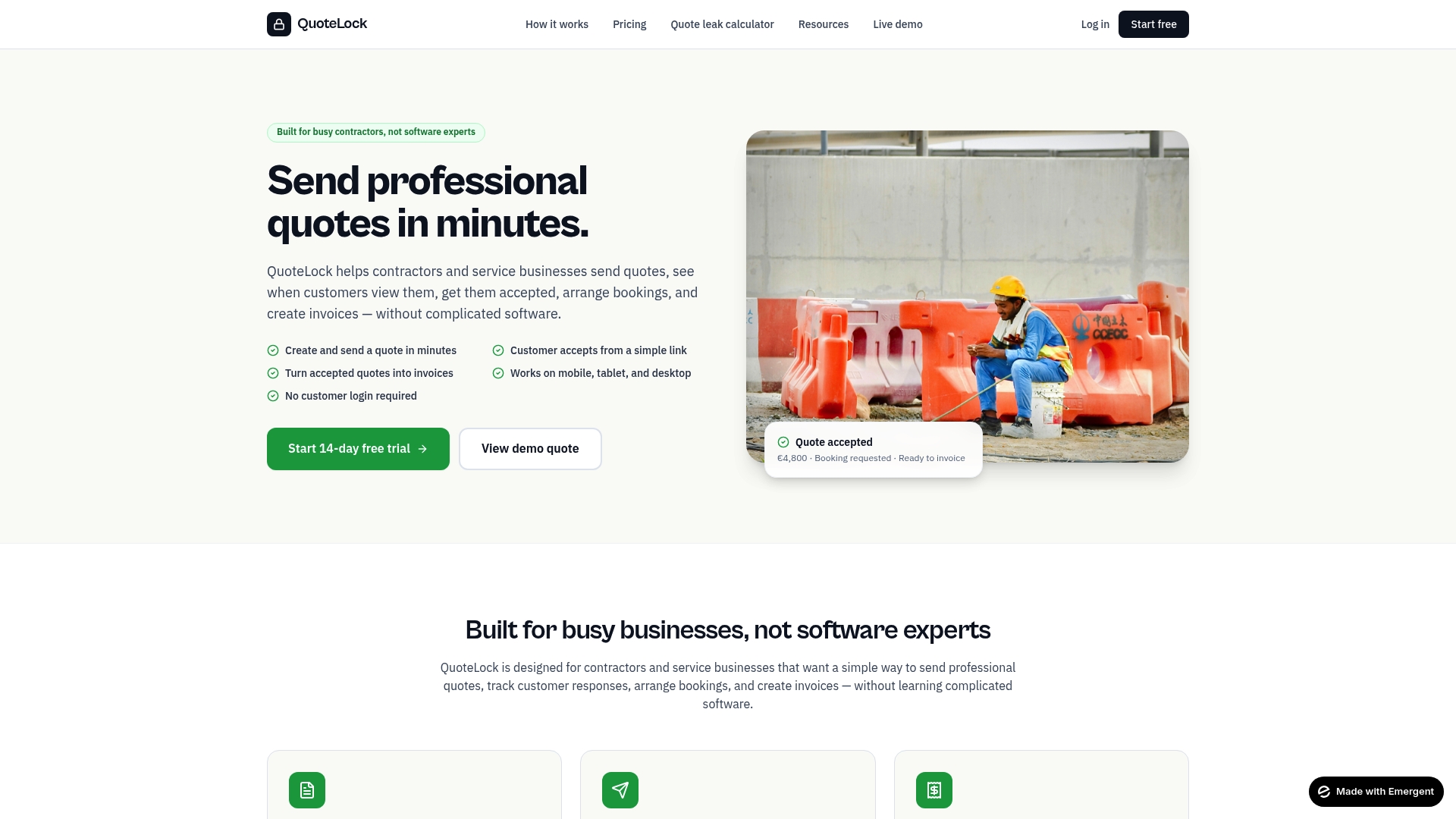
Quote-lock lets you create and send professional quotes in minutes, track when clients view them, and convert accepted quotes directly into invoices without retyping a single line. There’s no client login required and no software training for your team. For builders and renovation contractors, electricians, landscapers, and other tradespeople, Quote-lock removes the administrative overhead that slows down the quote-to-cash process. The quoting software for contractors is designed to make centralized quoting the path of least resistance, so you spend more time on the job and less time chasing paperwork.
FAQ
What is centralized quote management?
Centralized quote management is the practice of managing all quotes, pricing data, and approvals in a single system accessible to every relevant team member. It replaces scattered spreadsheets and email threads with one consistent, real-time source of pricing and client terms.
How much time does centralized quoting save?
Sales teams report a 50–80% reduction in the time needed to build and send quotes, and approval cycles run 75% faster with automated routing compared to manual email-based processes.
Does centralized quoting reduce billing disputes?
Yes. When an accepted quote carries directly into the invoice without manual reentry, the scope, pricing, and terms remain consistent. That consistency eliminates the most common source of billing disputes between contractors and clients.
What systems should a centralized quoting tool integrate with?
The highest-value integrations are CRM, ERP, and accounting systems. These connections ensure every quote reflects current customer terms, material costs, and stock availability without requiring manual lookups or duplicate data entry.
Is centralized quote management only for large businesses?
No. Contractors and small service businesses benefit from centralized quoting from their first client. The accuracy, speed, and invoicing consistency it provides are valuable at any volume, and the habits built early support growth without requiring a system change later.