B2B Quote Expiry Policy Best Practices: 2026 Guide

B2B Quote Expiry Policy Best Practices: 2026 Guide
A quote validity period is the defined window during which a seller guarantees the prices, terms, and conditions stated in a proposal. Without a clear expiry policy, buyers stall, costs shift, and your margins erode quietly. B2B quote expiry policy best practices exist to solve all three problems at once. They create fact-based urgency, protect your pricing, and give buyers a professional reason to act. This guide covers the exact steps to build a policy that works in the real world.
1. B2B quote expiry policy best practices start with the right validity period
The first decision in any expiry policy is how long a quote should stay valid. Standard validity periods vary by product type: 7–14 days for volatile commodities, 30 days for standard products, and 60 or more days for complex projects. That range exists because pricing risk is not the same across industries.
A landscaper quoting mulch and labor faces different cost exposure than a builder pricing a full renovation. Material costs, subcontractor rates, and fuel all move. The longer your quote sits open, the more those movements eat into your margin.
Factors that shorten a valid period:
- High material cost volatility (lumber, steel, fuel)
- Tight subcontractor availability
- Seasonal demand spikes
- Short supply chains with limited stock
Factors that justify a longer window:
- Complex approval cycles on the buyer’s side
- Government or institutional procurement timelines
- Fixed-price contracts with locked input costs
Pro Tip: Set your default validity period shorter than you think you need. You can always extend it for a specific client. You cannot easily claw back a price you already locked in for too long.
2. Why explicit expiry dates outperform vague validity language

Explicit expiry dates reduce buyer confusion and legal ambiguity far more effectively than phrases like “valid for 30 days.” When a quote says “expires June 15, 2026,” the buyer does not need to calculate anything. The deadline is clear, and so is the consequence of missing it.
Vague language creates friction in two directions. The buyer has to do mental math, which slows decisions. Your sales team has to argue about when the clock started, which creates disputes. A specific date removes both problems instantly.
The difference in buyer behavior is real. A concrete date gives procurement teams something to put in their internal calendar. “Valid for 30 days” gets filed and forgotten. “Expires June 15” gets flagged for action.
Pro Tip: Always state the expiry date in the subject line of the email you use to send the quote. Buyers scan inboxes fast. If the deadline is visible before they open the document, it registers immediately.
3. How to structure your expiry communication timeline
Sending one quote and waiting is not a policy. A real expiry communication flow has four distinct stages, each with a specific purpose. Effective expiry messaging follows this cadence: 7 days before to create awareness, 3 days to push review, 24 hours to trigger action, and a refresh pathway immediately after expiration.
Each message in that sequence does a different job. The 7-day message reminds the buyer the quote exists. The 3-day message asks if they have questions. The 24-hour message creates urgency without pressure. The post-expiry message opens the door to a refreshed offer.
Every message in the sequence should follow the same structure. Message hierarchy works best when you lead with status, follow with impact, and close with a clear action step. That order respects the buyer’s time and gives them everything they need in the first two sentences.
Here is a reference table for the full communication flow:
| Stage | Timing | Primary Goal |
|---|---|---|
| Awareness | 7 days before expiry | Remind buyer the quote is active |
| Review push | 3 days before expiry | Prompt questions and internal review |
| Action trigger | 24 hours before expiry | Create urgency tied to price or availability |
| Close loop | Day of expiry | Confirm status, offer next step |
| Refresh | After expiry | Present updated quote, re-engage buyer |
Pro Tip: Frame your 24-hour message around facts, not pressure. A line like “Your quote expires tomorrow. Prices and stock can change after that” is more effective than urgency language that sounds like a sales push.
4. Using escalation clauses for long-term or complex quotes
Some projects require quotes that stay open for 60, 90, or even 120 days. That length of exposure to cost changes is a real financial risk. The solution is an escalation clause, a written provision that allows you to adjust the quoted price if input costs rise beyond a defined threshold.
Industry best practice for quotes exceeding 60 days is to tie price adjustments to a measurable index, such as a 5% change in the Consumer Price Index or a specific commodity cost index. That approach gives both parties a neutral, verifiable trigger rather than a subjective judgment call.
Key elements of a well-written escalation clause:
- The specific index used to measure cost changes (CPI, lumber futures, fuel index)
- The percentage threshold that triggers a price review
- Which line items in the quote are subject to adjustment
- Which items are firm and will not change regardless of market movement
- The process for notifying the buyer when a threshold is reached
Communicate the clause clearly in the quote itself, not buried in fine print. Buyers who understand the clause upfront are far less likely to dispute an adjustment later. Transparency here protects the relationship as much as it protects your margin.
5. Handling expired quotes without losing the deal
Automatically honoring an expired quote is one of the most common and costly mistakes in B2B sales. Honoring old prices signals that your expiry dates are not real, which trains buyers to ignore them on every future quote. The right move is always a formal re-quote.
A structured refresh process keeps you in control without damaging the relationship. Follow these steps when a quote expires without acceptance:
- Notify the buyer immediately that the quote has expired and is no longer valid at the stated price.
- Review your current costs before issuing any new number.
- Prepare a refreshed quote that reflects current material prices, labor rates, and availability.
- Send the new quote with a fresh expiry date and a brief note explaining what changed.
- Use the re-quote as a natural reason to follow up by phone or video call.
- If the buyer pushes back on a price increase, walk them through the specific cost drivers.
- Document the expired quote and the refreshed version in your records for future reference.
The re-quote process is not a punishment for the buyer. It is a professional checkpoint that keeps your business financially sound. Buyers who respect your process are the ones worth working with long term.
6. Tailoring expiry messages to buyer type
Not every buyer responds to the same message. A self-serve buyer who found you online needs different language than a procurement manager at a mid-size company who has to get three approvals before signing anything. Your expiry communication should account for that difference.
For self-serve buyers, keep messages short and direct. They are making the decision themselves, so your job is to remove friction. One clear sentence about the expiry date and one clear call to action is enough. For sales-assisted buyers, your message should give them language they can use internally. Expiration messages framed as neutral status updates increase buyer trust and help procurement teams justify urgency to their own leadership without feeling pressured.
Tone matters as much as timing. Avoid language that sounds like a threat or a countdown. Phrases like “act now or lose this price” push buyers away. Phrases like “your quote is valid through Friday” give them the same information without the pressure. The goal is to make the deadline feel like a fact, not a sales tactic.
Pro Tip: For complex B2B deals with long approval chains, send your 3-day reminder to both the day-to-day contact and the decision-maker. The contact may have forgotten to escalate it internally.
7. Treating expiry policy as a sales tool, not just a legal formality
Clear expiration dates give buyers a professional, defensible reason to make a decision. That is not just risk management. It is a sales tool. A well-designed expiry policy removes the ambiguity that lets buyers stall indefinitely, which is one of the most common causes of lost deals in B2B services.
The primary goal of an expiry policy is managing buyer inertia. Buyers do not always delay because they are uninterested. They delay because nothing is forcing a decision. A firm expiry date tied to a real business reason, like material costs or subcontractor availability, gives them the push they need without making you look pushy.
Treat your expiry policy as part of your overall quote management approach. Review it at least twice a year. If your industry is experiencing cost volatility, shorten your default validity window. If you are losing deals because buyers need more time, consider adding a formal extension request process rather than simply letting quotes drift past their date.
Key takeaways
A disciplined B2B quote expiry policy protects your margins, reduces buyer stalling, and creates a professional sales process that buyers respect and respond to.
| Point | Details |
|---|---|
| Match validity to product type | Use 7–14 days for commodities, 30 days for standard work, and 60+ days for complex projects. |
| Use explicit expiry dates | State the exact date, not a duration, to remove ambiguity and reduce disputes. |
| Follow a four-stage reminder sequence | Send messages at 7 days, 3 days, 24 hours, and post-expiry to keep buyers moving. |
| Add escalation clauses for long quotes | Tie price adjustments to a measurable index like CPI for any quote open beyond 60 days. |
| Always re-quote after expiry | Never honor expired prices; issue a refreshed quote to maintain pricing control. |
What I’ve learned from watching expiry policies succeed and fail
The most common mistake I see is treating the expiry date as a formality. Businesses put “valid for 30 days” at the bottom of a PDF and then wonder why buyers ghost them for six weeks and then expect the same price. The expiry date means nothing if you are not prepared to enforce it.
The second mistake is going too far the other way. I have seen contractors use aggressive countdown language that makes buyers feel cornered. That approach kills trust, especially in B2B relationships where the buyer has to justify the decision to a boss or a board. Neutral, factual language works better every time.
The businesses that get this right treat their expiry policy as a system, not a sentence on a document. They have a default validity period, a communication schedule, a re-quote protocol, and a clear escalation clause for big jobs. That system runs in the background and protects them without requiring a judgment call on every single quote.
The practical payoff is real. When buyers know your quotes expire and that you will not simply honor old prices, they take your timelines seriously. That changes the dynamic of the entire sales conversation.
— Robert
Quote-lock takes the manual work out of expiry management
Managing expiry dates, reminder schedules, and re-quote workflows by hand is time-consuming and easy to get wrong. Quote-lock is built for contractors and service businesses who need a faster, cleaner way to handle the full quote lifecycle.
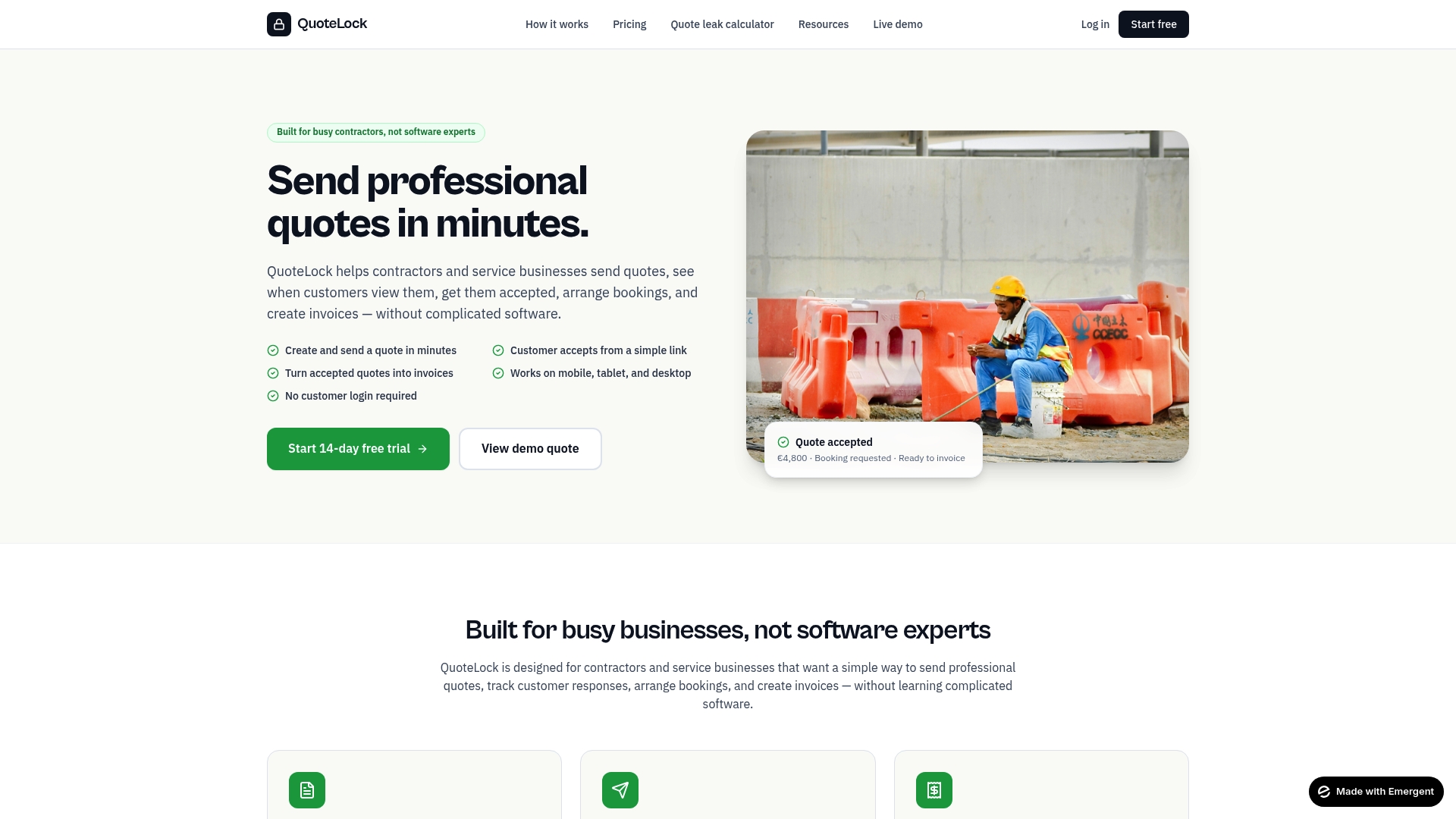
With Quote-lock, you set an expiry date when you create the quote, and the platform tracks it automatically. You can see when a buyer has viewed the quote, send reminders without switching tools, and convert accepted quotes directly into invoices. For builders, landscapers, and tradespeople who send multiple quotes a week, that kind of quoting software removes the administrative load and keeps every deal moving. Check out Quote-lock pricing to find the plan that fits your business.
FAQ
What does quote validity period mean in B2B?
A quote validity period is the defined timeframe during which a seller guarantees the prices and terms in a proposal. Once that period ends, the seller is not obligated to honor the original pricing.
How long should a B2B quote be valid?
Standard validity periods run 7–14 days for commodity items, 30 days for standard products, and 60 or more days for complex projects. Match the window to your cost exposure and the buyer’s approval timeline.
What is an escalation clause in a B2B quote?
An escalation clause is a written provision that allows the seller to adjust the quoted price if input costs rise beyond a set threshold, such as a 5% change in the Consumer Price Index. It protects both parties on long-duration quotes.
Should I honor a quote after it expires?
No. Honoring expired quotes signals that your expiry dates are not enforceable, which trains buyers to ignore them. Always issue a refreshed quote that reflects current costs.
How do I write an effective quote expiry reminder?
Lead with the expiry date, follow with the potential impact on pricing or availability, and close with one clear action step. Keep the tone factual and neutral rather than urgent or pressuring.