Why Tradespeople Lose Revenue on Admin Tasks

Why Tradespeople Lose Revenue on Admin Tasks
Admin overhead is the collective time tradespeople spend on non-billable business tasks: quoting, invoicing, chasing payments, scheduling, and compliance paperwork. It is the single largest silent drain on trades revenue. Admin overhead consumes 20%–35% of total labor hours in trades businesses with 10–25 staff. That means for every eight-hour day, up to three hours generate zero income. Understanding why tradespeople lose revenue on admin starts with recognizing that those hours are not free. They carry a real cost, and most contractors never measure it.
Why tradespeople lose revenue on admin: the core problem
Admin overhead in trades is not just a time problem. It is a revenue problem with a specific mechanism. Every hour spent on paperwork is an hour not spent on a job site generating billable income. When a plumber charges $95 per hour on the tools but spends 15 hours a week on manual invoicing and payment chasing, that is $74,000 in lost annual billing capacity. That figure does not include errors, delays, or the cost of working evenings to catch up.
The industry term for this problem is administrative overhead, sometimes called admin drag. It covers every task that supports the business but does not directly produce a finished job. Quoting, invoicing, scheduling, compliance documentation, and client communication all fall into this category. None of them appear on a timesheet. None of them get charged to a client. But all of them take real time from a real person who could be earning on site.
83% of trades business owners have never calculated the annual cost of their admin time. That number explains why the problem persists. You cannot fix a cost you have never measured.
What tasks eat the most admin time for tradespeople?
The admin burden in trades is not one big task. It is a cluster of smaller tasks that each feel manageable but stack up fast. The most time-consuming include:
- Quoting and estimating: Writing quotes manually from scratch, recalculating materials, and formatting documents for each new job.
- Invoicing: Creating invoices after job completion, often from memory or handwritten notes taken hours earlier.
- Payment chasing: Following up on overdue invoices by phone, text, or email, sometimes multiple times per client.
- Scheduling and job coordination: Booking jobs, rescheduling around delays, and communicating changes to clients and subcontractors.
- Compliance paperwork: Health and safety records, certificates of completion, and insurance documentation.
- Redundant data entry: Entering the same job details into a quote, then a job sheet, then an invoice, then an accounting system.
The last item is particularly damaging. Redundant data entry does not just waste time. It creates opportunities for errors at every step. A builder who writes a quote on paper, transfers it to a spreadsheet, and then types it again into an invoice has three chances to get the numbers wrong. Each error can cost money directly or damage client trust.
Late invoicing compounds the problem further. A contractor who invoices a week after job completion has already lost ground on cash flow. Fragmented communication, where job details live across text messages, emails, and notebooks, makes accurate billing even harder.

How does admin inefficiency translate into real financial loss?
The financial impact of admin overhead operates on two levels: direct and hidden.
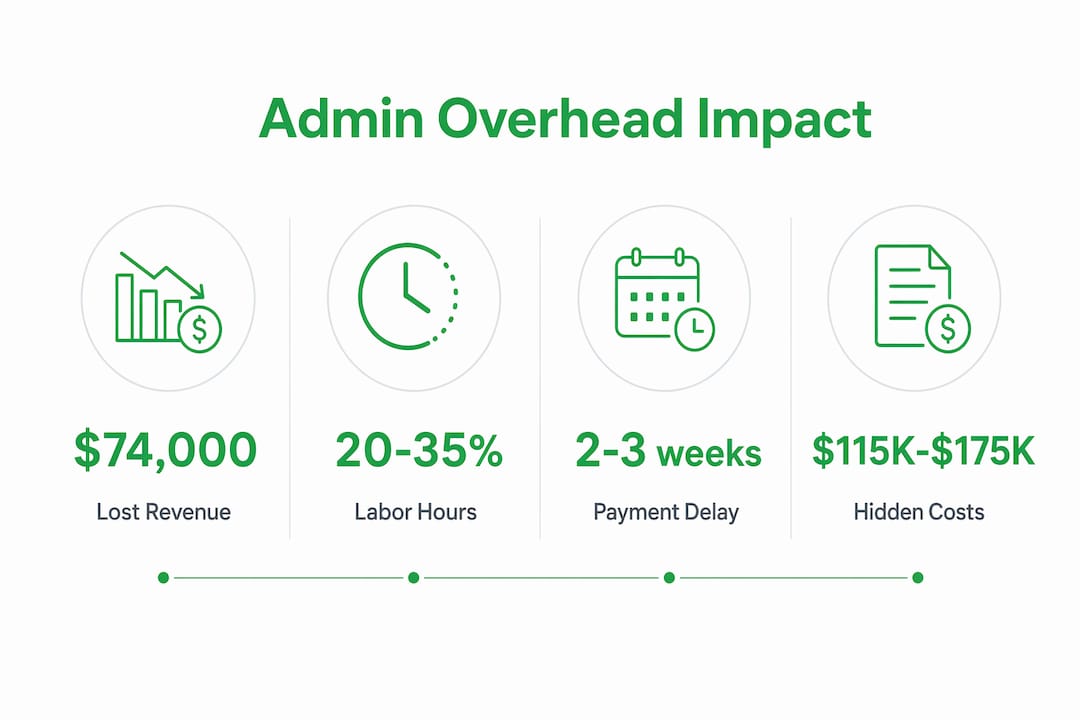
Direct losses are the billable hours you simply cannot sell because you are doing paperwork instead. At $95 per hour, 15 admin hours per week equals $1,425 in unbilled time every week. Over a 52-week year, that is the $74,000 figure cited above. Most contractors absorb this loss without ever naming it.
Hidden losses are subtler and often larger. Delayed invoicing extends cash cycles by 2–3 weeks, costing $115,000–$175,000 in working capital on a $3 million revenue business. That is not lost revenue in the traditional sense. It is money you have earned but cannot access, which forces you to fund operations from reserves or credit.
Poorly managed admin workflow degrades data quality, causing pricing errors, miscalculated materials, and costly rework. A landscaper who forgets to include a materials markup on an invoice has effectively donated that margin to the client. A builder who misquotes labor hours because the original estimate was rushed ends up working part of the job for free.
The third hidden cost is the most overlooked. When tradespeople do not price admin overhead into their rates, they subsidize those hours out of their own take-home pay. Admin time is a real business cost. If it is not recovered through pricing, it reduces net income directly. A contractor earning $80,000 per year who spends 25% of working time on unpaid admin is effectively earning the equivalent of $60,000 for the hours they actually work.
| Financial impact | Mechanism | Scale |
|---|---|---|
| Lost billable hours | Admin time replaces on-site time | Up to $74,000/year at $95/hour |
| Delayed cash flow | Late invoicing extends payment cycles | $115K–$175K on $3M revenue |
| Pricing errors | Data entered from memory, not real-time | Margin loss per job |
| Subsidized admin | Overhead not included in day rate | Reduces take-home pay directly |
Pro Tip: Calculate your own admin cost before anything else. Multiply your hourly rate by the hours you spend on admin each week, then multiply by 52. Most contractors are shocked by the result.
Why do tradespeople struggle to cut admin overhead?
The barriers to fixing admin overhead are behavioral and structural, not just technical.
The awareness gap is the biggest barrier. 83% of trades business owners have never calculated their admin cost, and 77% do admin during evenings, with nearly 50% working through weekends to catch up. When admin happens after hours, it feels like a personal inconvenience rather than a business cost. That framing stops most tradespeople from treating it as a financial problem worth solving.
Technology resistance is often misdiagnosed. Tradespeople are not anti-technology. They struggle because available admin tools are often poorly suited to trades workflows or come with inadequate training. A complex enterprise platform built for office teams does not fit a sole trader quoting from a van. The tool mismatch leads to abandonment, not adoption.
The “outsourcing chaos” trap catches many growing trades businesses. Hiring admin help or buying software without fixing inefficient workflows first means paying to manage a broken system rather than replacing it. The cost goes up. The inefficiency stays.
Cultural factors also play a role. Tradespeople are trained to value time on the tools. Paperwork feels like a distraction from real work. That mindset is understandable, but it prevents the kind of process thinking that would actually free up more tool time in the long run.
What practical strategies help tradespeople reclaim lost revenue?
Fixing admin overhead requires a specific sequence. Automation before simplification creates faster chaos, not less of it.
- Audit your current admin tasks. Write down every non-billable task you do in a week and how long each takes. This single step makes the cost visible and identifies the biggest time drains.
- Standardize before you automate. Successful contractors simplify and standardize manual processes with templates and checklists before introducing software. A standard quote template cuts quoting time by half before any tool is involved.
- Price admin into your day rate. Admin overhead must be included as a cost per billable hour to avoid subsidizing it from personal pay. If admin takes 20% of your working week, that cost belongs in your rate, not in your personal loss column.
- Adopt integrated job management tools selectively. Integrated systems can reduce admin to under 5 hours weekly within 90 days by automating invoicing, quoting, scheduling, and compliance documentation. The key word is “integrated.” Separate tools for quoting, invoicing, and scheduling still require manual data transfer between them.
- Start with quick wins. Automate invoicing first. It is the highest-value admin task and the one most directly connected to cash flow. Once invoicing runs without manual effort, tackle quoting, then scheduling.
- Roll out changes in stages. Trying to change every admin process at once creates confusion and abandonment. One system at a time, tested and confirmed, builds lasting habits.
Pro Tip: Convert accepted quotes directly into invoices without retyping. That single step eliminates one of the most common sources of billing errors and saves 20–30 minutes per job.
Tools like Quote-lock are built specifically for this workflow. Quote-lock lets contractors create and send quotes in minutes, track when clients view them, and convert accepted quotes into invoices without re-entering data. No client login required. No software training needed for the client side. That design removes friction at both ends of the billing process.
Key takeaways
Admin overhead is the leading cause of silent revenue loss in trades businesses, and most contractors have never measured its true cost.
| Point | Details |
|---|---|
| Admin overhead scale | Admin consumes 20%–35% of labor hours, replacing billable time with unpaid work. |
| Direct revenue loss | 15 admin hours per week equals up to $74,000 in lost annual billing at $95/hour. |
| Cash flow damage | Delayed invoicing can cost $115,000–$175,000 in working capital on a $3M business. |
| Pricing gap | Admin time not included in day rates reduces take-home pay directly. |
| Fix sequence | Standardize workflows first, then automate. Skipping this step wastes money. |
The real reason most tradespeople never fix this
Most articles on admin overhead focus on growth. More revenue, bigger business, faster scaling. That framing misses what actually motivates most tradespeople to change. Most trades business owners want relief, not growth. They want to stop doing invoices at 10 p.m. They want a weekend that does not include chasing payments.
That is a completely legitimate goal, and it changes how you should approach the problem. If your target is relief, you do not need to overhaul your entire business. You need to eliminate the two or three admin tasks that consume the most time and happen at the worst hours. For most tradespeople, that is invoicing and payment chasing.
What I have seen consistently is that tradespeople underestimate how much their admin costs them and overestimate how hard it is to fix. The calculation is simple. The fix is often one or two process changes. The barrier is almost always awareness, not complexity.
The pricing piece is the one most people get wrong. You cannot fix admin overhead by working faster. You fix it by either reducing the time it takes or recovering the cost through your rates. Ideally both. A contractor who spends 10 hours a week on admin and charges $95 per hour is losing $950 per week in unbilled capacity. That is not a minor inefficiency. That is a structural problem in how the business is priced.
My honest advice: calculate the number first. Write it down. Then decide what to fix.
— Robert
Quote-lock cuts admin time where it hurts most
Admin overhead costs tradespeople real money every week. The fix does not require a complex system or a steep learning curve.

Quote-lock is built for contractors who need to quote fast, invoice without re-entering data, and track payments without chasing manually. You create a quote in minutes, send it directly to the client, and convert it to an invoice the moment it is accepted. Quote-lock tracks when clients view quotes and sends reminders automatically, so no opportunity slips through. There is no client login, no training required, and no bloated feature set to navigate. For builders, plumbers, landscapers, and handymen, Quote-lock reduces admin overhead to the minimum it needs to be.
FAQ
Why do tradespeople lose so much revenue on admin?
Admin tasks replace billable hours without generating income. At $95 per hour, 15 weekly admin hours equals $74,000 in lost annual billing capacity.
What is admin overhead for tradespeople?
Admin overhead is the time spent on non-billable business tasks including quoting, invoicing, payment chasing, scheduling, and compliance paperwork. It typically consumes 20%–35% of total labor hours in trades businesses.
How does late invoicing affect cash flow?
Delayed invoicing extends payment cycles by 2–3 weeks. On a $3 million revenue business, that delay can cost $115,000–$175,000 in working capital.
Should tradespeople include admin time in their day rate?
Yes. Admin overhead is a real business cost. If it is not priced into the day rate, it reduces take-home pay directly. Every hour of unpaid admin effectively lowers the contractor’s net hourly earnings.
What is the fastest way to reduce admin overhead?
Automate invoicing first, since it is the highest-value admin task and most directly tied to cash flow. Standardize quote templates before adding any software to avoid automating a broken process.