Why Follow-Up Quotes Matter for Closing More Sales

Why Follow-Up Quotes Matter for Closing More Sales
Why follow-up quotes are vital for business growth
Most quotes don’t close on the first send. 80% of B2B sales close between the 5th and 12th contact, yet the majority of salespeople quit after one or two attempts. That gap is where revenue disappears.
Follow-up quotes do more than remind a prospect your bid exists. They signal professionalism, demonstrate reliability, and keep your business visible while the client works through internal approvals, budget conversations, or competing priorities. Clients frequently delay decisions not because they’ve moved on, but because life got in the way.
The core reasons follow-up quotes matter:
- They recover deals lost to silence, not disinterest
- They show clients how you’ll behave on the actual job
- They let you address unspoken objections before a competitor does
- They maintain visibility across a decision cycle that rarely moves fast
- Responding quickly to an inquiry makes you 7x more likely to qualify the lead than waiting even an hour longer
Table of Contents
- How follow-up shapes client perception and outcomes
- Common challenges that break consistent follow-up
- Best practices and tools that actually improve follow-up
- Start following up and stop leaving revenue on the table
- Key takeaways
How follow-up shapes client perception and outcomes
Clients evaluating multiple bids aren’t just comparing prices. They’re watching how you communicate. A contractor who follows up professionally is implicitly saying: I pay attention, I follow through, and I’ll do the same on your project.

Research confirms that clients assess responsiveness and communication ease alongside price when choosing between vendors. The follow-up phase is where those judgments form. A well-timed check-in after a quote lands differently than a generic “just checking in” message sent three weeks later.
Timing compounds the effect. Following up within 24–48 hours of sending a quote keeps your bid fresh in the client’s mind and signals that you’re organized. Many prospects need multiple reminders simply because decisions are collaborative or deferred, not because they’ve lost interest.
Pro Tip: Reference something specific from your initial conversation in each follow-up. A line like “You mentioned the timeline was tight for March” costs nothing and signals genuine attention.
Common challenges that break consistent follow-up
Most businesses don’t fail at follow-up because they don’t care. They fail because the process is manual and memory is unreliable.
The real obstacles:
- Bandwidth. Tracking multiple leads manually becomes overwhelming fast. When you’re running a crew and managing three active jobs, a follow-up call falls to the bottom of the list.
- Fear of seeming pushy. Many business owners hold back after one attempt, worried about annoying the prospect. The reality: a professional, helpful message reads nothing like pressure.
- Low-value messages. “Just checking in” emails rarely generate replies because they add nothing. They ask the reader to do the work.
- Quitting too early. Stopping at one or two attempts means walking away from the majority of deals that were still winnable.
- No system. Without a defined sequence, follow-up depends on memory. Memory fails when you’re busy, which is always.
The fear of rejection also plays a role. As long as you haven’t followed up, the quote feels like it’s still in play. But that uncertainty isn’t protecting you. It’s just delaying the information you need to move on or close.
Best practices and tools that actually improve follow-up
The businesses that follow up consistently aren’t more disciplined. They have a process that runs whether they remember or not.
A proven structure:
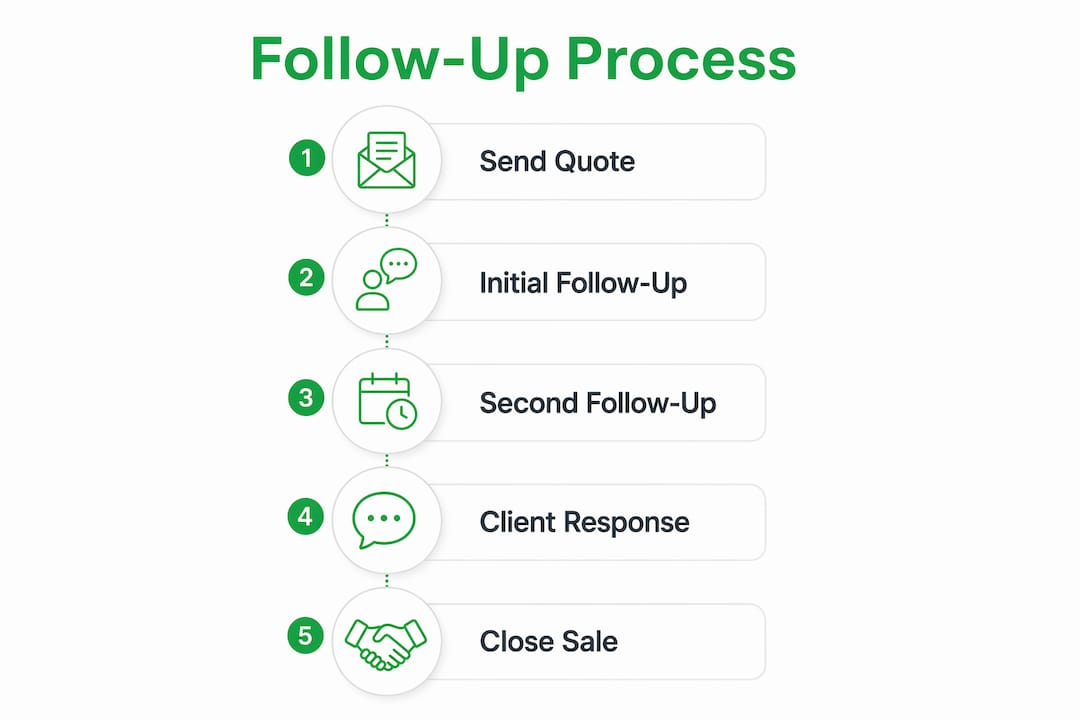
- Day 2–3: Confirm the quote arrived. Offer to answer questions. Keep it short.
- Day 7–10: Address the most common objections before they’re raised. Mention timeline, scope, or payment terms.
- Day 14–21: Social proof. Reference a similar job you completed. Show them they’re not the first.
- Final touch: A short “closing the file” email. This triggers loss aversion and recovers 10–20% of remaining responses from prospects who were meaning to reply.
Every message should add something the client actually wants to read. A peer case study, a relevant benchmark, a direct answer to a question they haven’t asked yet. Multi-channel sequences combining phone, email, and LinkedIn significantly outperform single-channel approaches. Rotate the channel and change the angle each time.
Automation removes the human error. When follow-up workflows run automatically, nothing slips through because you were on a job site. You can also explore how customer service automation principles apply directly to quote follow-up cadences.
Quote-lock is built for exactly this. It lets contractors send quotes in minutes, track when clients view them, and send automatic reminders without needing a CRM or software training. The Quote-lock features include quote-view tracking and timed reminders, so you know when to follow up and the system handles it when you don’t. No client login required. No complex setup.
Pro Tip: Tie your follow-up timing to a real expiry date on the quote. “This price holds until March 14” creates a genuine reason to act, without manufactured urgency.
Start following up and stop leaving revenue on the table
Persistent, value-driven follow-up is the single highest-return activity in your sales process. The leads are already there. The quotes are already sent. What’s missing is the second, third, and fourth touch that turns a maybe into a signed job.
- Follow up on every quote, no exceptions
- Add value in each message: answer an objection, share a result, reference a deadline
- Use mixed channels and space touches 2–5 days apart early, then weekly
- Track response rates and conversion rates to see what’s working
- Let automation handle the cadence so nothing falls through when you’re busy
Quote-lock removes the manual burden so you can focus on the work, not the paperwork.
Key takeaways
Follow-up quotes are the most overlooked revenue lever in service businesses: structured sequences lift conversion rates from 15% to 35% without a single new lead.
| Point | Details |
|---|---|
| Persistence closes deals | 80% of B2B sales close between the 5th and 12th contact; quitting early costs most of your pipeline. |
| Speed qualifies leads | Responding within one hour makes you 7x more likely to qualify a lead than waiting longer. |
| Clients judge follow-up | Responsiveness and professionalism during follow-up directly influence hiring decisions beyond price. |
| Value beats check-ins | Every follow-up message must add something real; “just checking in” generates roughly a 1% reply rate. |
| Automation sustains it | Tools like Quote-lock track quote views and send reminders automatically, so no opportunity goes quiet. |