Multi-Service Event Quotes: Examples for Planners

Multi-Service Event Quotes: Examples for Planners
A multi-service event quote is an itemized pricing document that covers every vendor service for a single event, from venue rental and catering to AV, entertainment, and logistics. These quotes give event planners a single source of truth for budgeting and make side-by-side service comparisons possible without chasing down five separate proposals. The best examples of multi-service event quotes combine layered line items, clear contingency allowances, and bundled package options that reduce both client confusion and planner workload. Professional event planning fees in 2026 follow flat, percentage-based, or hybrid models, with flat fees ranging from $1,500 to $50,000+ and percentage fees running around 15–20%. Understanding which model fits your event type is the first decision every quote must answer.
1. Examples of multi-service event quotes explained
Complex events require complex quotes. A multi-day retreat quote typically covers 60+ line items across lodging, meals, activities, AV, space rental, and deposit structures. Each category needs its own section so clients can scan the document without getting lost.

A practical quote for a three-day corporate retreat might look like this:
| Line Item | Unit | Rate | Total |
|---|---|---|---|
| Lodging (standard rooms) | 20 rooms x 3 nights | $150/night | $9,000 |
| Meal plan (breakfast + lunch + dinner) | 20 guests x 3 days | $65/day | $3,900 |
| Conference room rental | 3 days | $400/day | $1,200 |
| AV equipment package | Flat | $800 | $800 |
| Team-building activity | Per person | $45 | $900 |
| Logistics and transport | Flat | $600 | $600 |
| Contingency allowance (10%) | $1,640 | ||
| Total | $18,040 |
This structure gives clients a clear picture of where every dollar goes. A layered breakdown also creates natural upsell opportunities. Clients who see a basic meal plan line item often ask about upgrading to a catered dinner, which increases the total without any extra selling effort.
Pro Tip: Keep each section of your quote to one page or less. Clients who scroll past three pages before seeing a total tend to disengage. Put the grand total at both the top and bottom of the document.
AI-assisted quoting tools can reduce quote generation time from hours to seconds by applying rule-based assembly. That speed matters when a client asks for three scenario variations before committing.
2. How bundled service packages save money and simplify quoting
Bundling is the single most effective way to reduce quote complexity while protecting your margin. When you group related services into a named package, clients make one decision instead of five. That reduces negotiation time and speeds up acceptance.
The savings are real and measurable. Booking a DJ, photo booth, and lighting separately costs around $2,400. Bundled entertainment packages for the same three services run $1,600–$1,900, saving clients $500–$800. That gap is enough to close deals faster and position you as the more cost-effective option.
Common bundled combinations that perform well include:
- DJ + photo booth + uplighting
- Catering + bar service + rentals (linens, chairs, tableware)
- Photography + videography + same-day highlight reel
- Venue + AV + event coordination
- Floral design + décor setup + teardown
A comparison of typical bundle tiers helps planners set client expectations before the first call:
| Bundle tier | Services included | Typical price range |
|---|---|---|
| Entry-level | DJ + basic lighting | $800–$1,200 |
| Mid-range | DJ + photo booth + uplighting | $1,600–$1,900 |
| Premium | Full entertainment + AV + coordination | $3,500–$5,500 |
Bundling event services also reduces vendor coordination overhead. Instead of managing five separate contracts, you manage one. That operational benefit is worth pricing into the package itself.
Pro Tip: Name your bundles. “The Signature Experience” converts better than “Package B.” A named bundle signals value and makes the choice feel intentional rather than arbitrary.
3. Common pricing models and dynamic factors affecting event quotes
Event planners use three core fee structures, and each one fits a different business model. Knowing which to use on a given quote is as important as knowing what to charge.
Flat fee quotes work best for production-heavy events like trade shows and conferences where scope is fixed and predictable. A flat fee of $5,000 for a 200-person corporate conference gives the client certainty and protects the planner from scope creep if the contract is written tightly.
Percentage-based fees suit high-budget social events like weddings and galas. At 15–20% of total event spend, the planner’s fee scales naturally with event complexity. A $100,000 wedding generates $15,000–$20,000 in planning fees without requiring a separate negotiation.
Hybrid models combine a base flat fee with a percentage of vendor spend above a set threshold. This structure protects planners on smaller events while capturing upside on larger ones.
Dynamic pricing factors that should adjust any quote include:
- Seasonal demand. Peak wedding season (may through october) and holiday corporate events command higher rates.
- Date scarcity. Dynamic minimums based on date scarcity protect high-demand calendar slots. When a date fills up six months out, rates should increase immediately.
- Annual rate adjustments. Top-tier planners adjust rates by 5–10% annually to outpace inflation and protect margins.
- Logistics buffers. Every quote should include a contingency line of 8–12% to cover unexpected costs like last-minute vendor substitutions or weather-related changes.
The contingency line is not optional. Quotes that omit it leave planners absorbing costs that clients should be funding. A 10% buffer on an $18,000 event adds $1,800 to the quote and prevents a $1,800 loss.
4. Situational recommendations: Choosing the right quote format for your event
The right quote format depends on event size, complexity, and what the client actually needs to make a decision. A one-size-fits-all template loses deals at both ends of the market.
For small, single-day events like birthday parties or private dinners, a simplified quote with three to five line items and a clear total is more effective than a 60-line spreadsheet. Clients at this level want to know the bottom line quickly. Overloading them with detail signals that the process will be complicated.
For large multi-day corporate conferences or executive retreats, the opposite is true. Detailed breakdowns by day, by service category, and by room type build confidence. Clients spending $50,000+ on an event need to justify that spend internally. A thorough quote gives them the documentation to do it.
Per-person pricing suits experience-heavy events like galas, award dinners, and incentive trips where headcount drives cost. Flat fees suit production-heavy events where labor and logistics are fixed regardless of attendance.
Key format decisions by event type:
- Small social events (under 50 guests). Use a one-page quote with bundled totals. Skip the line-item breakdown unless the client asks.
- Mid-size corporate events (50–200 guests). Use a two-section quote: a summary page and a detailed breakdown. Let the client choose their reading depth.
- Large multi-day events (200+ guests or multiple days). Use a fully layered quote with day-by-day schedules, per-room lodging grids, and explicit contingency mapping.
- Trade shows and exhibitions. Use flat-fee quotes with clearly scoped deliverables. Avoid percentage models where total spend is hard to predict.
Quote clarity directly affects conversion. Quotes that detail contingencies for weather, payment terms, and VAT outperform vague proposals. Clients read specificity as professionalism.
Key takeaways
Multi-service event quotes convert faster when they combine layered line items, named bundles, and explicit contingency allowances tailored to the event type and client budget.
| Point | Details |
|---|---|
| Use layered quote structures | Break quotes into sections by service category to build trust and create upsell opportunities. |
| Bundle services for savings | Grouped packages save clients $500–$800 versus a la carte and reduce vendor coordination time. |
| Match pricing model to event type | Use flat fees for production-heavy events and percentage fees for high-budget social events. |
| Adjust rates annually | Increase rates by 5–10% each year and apply dynamic minimums for high-demand dates. |
| Include contingency allowances | Add 8–12% contingency to every quote to protect margins against unexpected costs. |
Why I think most event quotes are doing the heavy lifting wrong
Most event planners treat a quote as a price list. That framing costs them deals and margin. A quote is a communication tool. Every line item either builds confidence or raises a question the client will ask before signing.
The planners I respect most write quotes the way a good lawyer writes a contract: every scenario is anticipated, every cost is explained, and nothing is left for the client to interpret on their own. That means explicit contingency lines, clear payment terms, and a named bundle that tells a story about the experience the client is buying.
The bundling insight is the one most planners underuse. When you name a package and price it as a unit, you shift the client’s mental frame from “is this too expensive?” to “which package fits my event?” That is a fundamentally different conversation, and it closes faster.
Rate adjustments are the other area where I see planners leave money on the table. Holding rates flat for two or three years while costs rise is not loyalty to clients. It is a slow margin squeeze that eventually forces a painful correction. A 5–10% annual increase, communicated clearly and early, is far less disruptive than a 20% jump after three years of stagnation.
Treat your quote as the first deliverable you hand a client. If it is clear, detailed, and well-structured, it signals that the event itself will be the same.
— Robert
Quote-lock makes multi-service event quoting faster
Building a detailed, professional multi-service quote from scratch takes time that most planners do not have between site visits and vendor calls. Quote-lock is built for exactly this situation: creating and sending quotes in minutes, converting accepted quotes directly into invoices, and tracking when clients open and review the document.
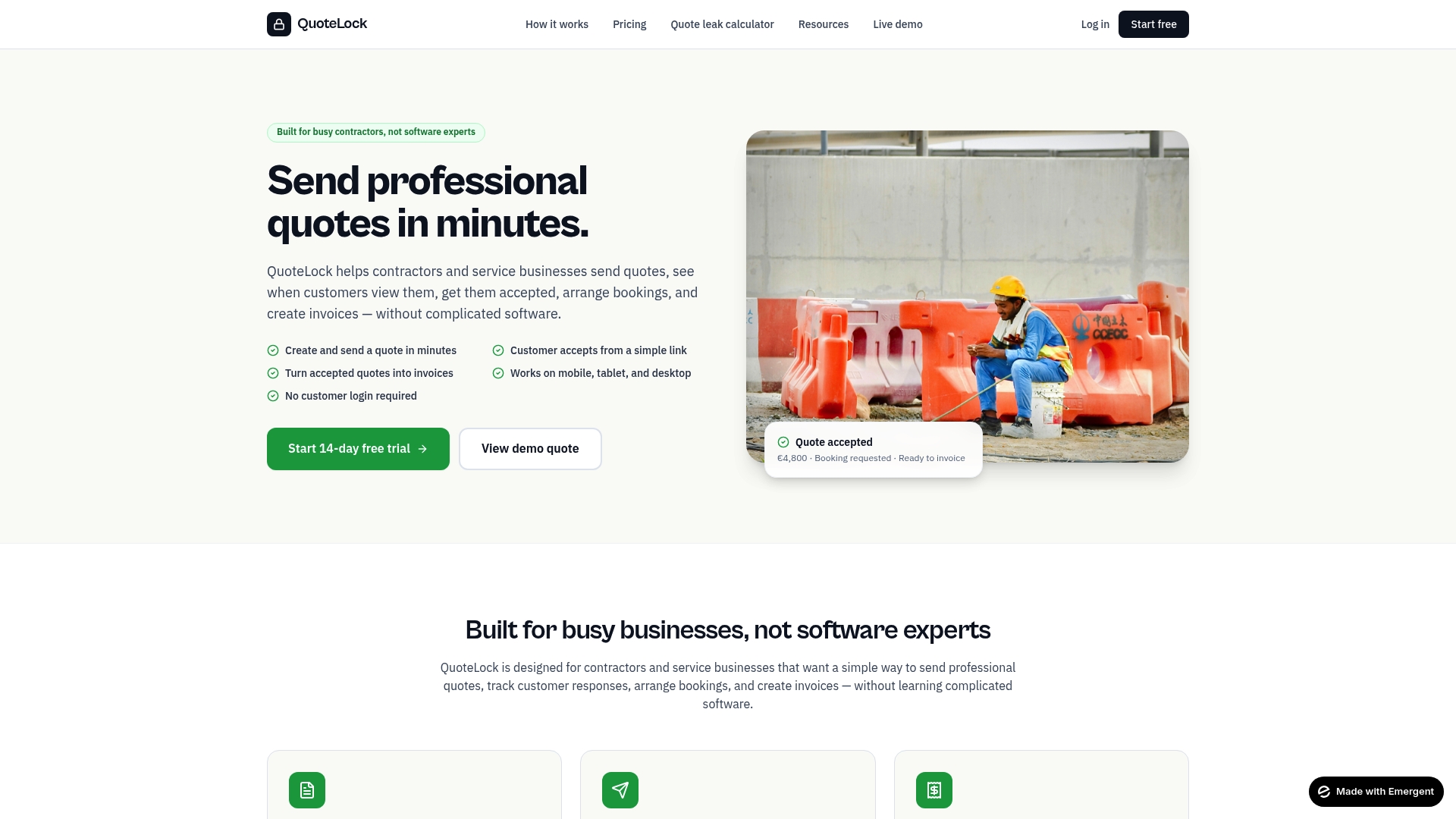
With Quote-lock, you can build itemized service quotes that cover every line item from lodging to contingency allowances, without complex software or client logins. The platform sends automatic reminders so no accepted quote goes cold before it converts to a booking. For planners managing multiple events and vendor relationships, that reduction in administrative work is the difference between a profitable quarter and a chaotic one. Visit Quote-lock to see how it fits your quoting process.
FAQ
What is a multi-service event quote?
A multi-service event quote is an itemized pricing document that covers all vendor services for a single event, including venue, catering, AV, entertainment, and logistics. It gives clients a complete cost picture and planners a structured framework for budgeting.
How much do professional event planning fees typically run?
Professional event planning fees range from $1,500 to $50,000+ for flat-fee engagements, with percentage-based models running 15–20% of total event spend. Corporate conferences can scale to $100,000+ in planning fees alone.
What services are commonly bundled in event packages?
DJ, photo booth, and uplighting are the most common entertainment bundle. Catering, bar service, and rentals are frequently grouped together for reception-style events.
How much can bundling save compared to booking services separately?
Bundled entertainment packages save clients $500–$800 compared to booking the same services individually. A DJ, photo booth, and lighting bundle runs $1,600–$1,900 versus $2,400 booked separately.
Should every event quote include a contingency allowance?
Every quote should include a contingency line of 8–12% to cover unexpected costs. Quotes that explicitly address contingencies for weather, vendor substitutions, and payment terms build more client trust and protect planner margins.