Discounting in B2B Quotes: Strategy or Margin Risk?

Discounting in B2B Quotes: Strategy or Margin Risk?
Discounting in B2B quotes is defined as the deliberate reduction of list price to close deals, retain customers, or respond to competitive pressure. The role of discounting in B2B quotes is to act as a strategic lever that improves win rates and customer satisfaction without permanently eroding profit margins. The problem is that most discounting is neither deliberate nor strategic. 40–60% of discount volume in B2B deals is habitual rather than tied to any real business case. That single fact explains why so many service businesses and contractors watch their margins shrink quarter after quarter despite strong revenue.
What is the role of discounting in B2B quotes?
Discounting in B2B quoting is not simply a price reduction. The industry term for the practice is price concession management, and it covers every decision about when, how much, and under what conditions you lower your quoted price. Done well, it accelerates deal cycles and builds customer loyalty. Done poorly, it trains buyers to expect discounts and permanently anchors your pricing lower than it needs to be.
The gap between your list price and what you actually collect is called realized price. The median realized price in B2B SaaS sits at roughly 84% of list price. That 16% gap represents margin that businesses give away, often without a clear reason. For contractors and service businesses quoting jobs daily, that gap compounds fast.

A common misconception is that discounts build loyalty. Real loyalty programs reward future behavior without permanently lowering your price. A one-time discount to close a deal is a tool. A repeated, unconditional discount is a new price floor.
The impact of discounts on B2B quotes extends beyond the individual deal. Each concession sets a negotiation anchor for every future conversation with that customer. Buyers remember what they paid last time, and they will use it as the starting point next time.
Why does unstructured discounting destroy margins?
Unstructured discounting is the single biggest source of preventable margin loss in B2B sales. The root cause is rarely a bad salesperson. It is a broken system.
Over-discounting is driven by three system failures: unclear pricing guidelines, slow approval processes, and incentive structures that reward revenue over margin. When a sales rep faces a stalled deal and has no fast path to approval, the easiest move is to drop the price. That behavior is rational given the incentives, but it is destructive at scale.
The financial stakes are significant. A 1% improvement in realized pricing increases operating profit by roughly 11%. That means recovering even a fraction of habitual discounts has an outsized effect on your bottom line.
Unstructured discounting also creates two compounding problems:
- Negotiation anchoring. Buyers who received a 15% discount last quarter will open their next negotiation expecting 15% as the baseline, not as a concession.
- Renewal pricing damage. Discounts without time limits become permanent prices. When renewal time arrives, customers treat the discounted rate as the real price and resist any increase.
The pattern accelerates when different sales reps grant inconsistent discounts for the same service. Inconsistent discounts across reps create margin leakage that is nearly impossible to detect without versioned quote records and audit trails.
What makes a discount strategic?
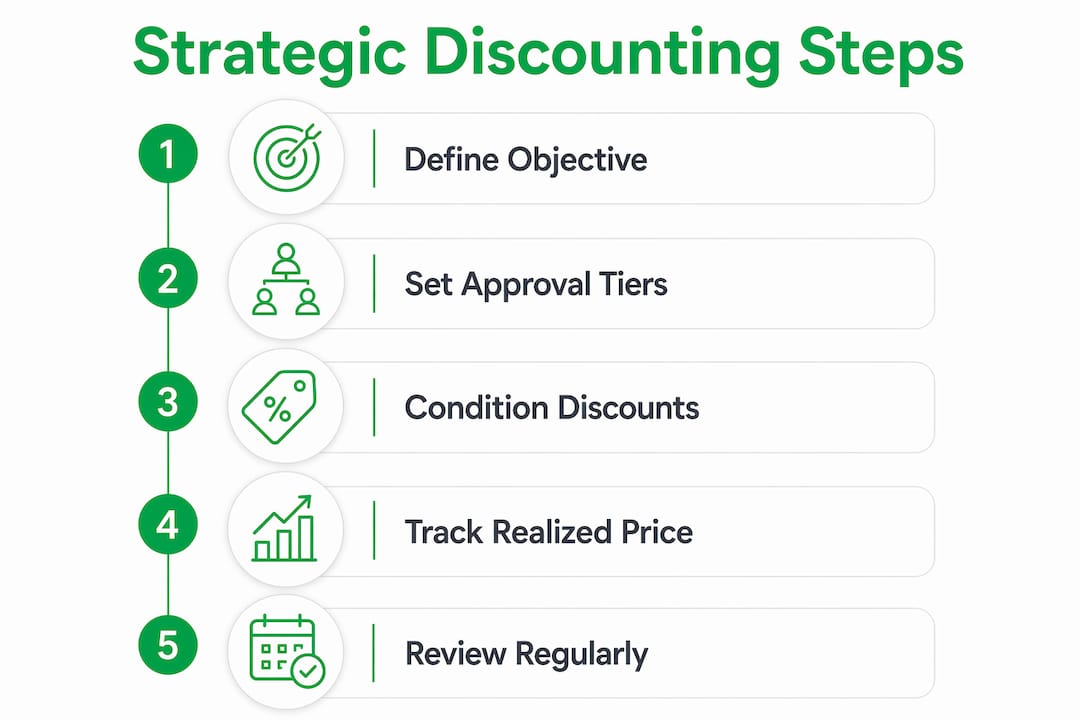
A strategic discount requires a value exchange. The customer gets a lower price. You get something measurable in return. This is called reciprocal discounting, and it is the standard that separates disciplined pricing from reactive price-cutting.
Discounts must be reciprocal, with customers providing value such as multi-year contracts, case study participation, referrals, or prepayment to justify the price reduction. Without that exchange, you are simply giving money away.
Effective reciprocal discount structures tie price reductions to specific buyer behaviors:
- Volume commitments. A customer who commits to a larger scope or longer contract term earns a lower unit rate.
- Prepayment. A customer who pays upfront removes your collection risk and improves cash flow, which justifies a modest reduction.
- Referrals. A customer who refers a qualified lead provides measurable marketing value in exchange for a discount.
- Case study or testimonial. A customer who agrees to a public reference provides sales collateral worth real money.
Each of these structures gives you something back. None of them permanently lower your price floor.
Pro Tip: Add a contractual sunset date to every promotional price. Successful B2B companies require clear reversion terms post-discount so buyers understand the reduced rate is time-bound, not permanent.
The psychological effect of attaching conditions to a discount is also significant. When buyers must do something to earn a lower price, they perceive the discount as a reward rather than a concession. That framing protects your pricing integrity in future negotiations.
Structured discounting tied to buyer behavior increases sales retention and revenue without eroding margins. The condition itself signals that your list price is real and defensible.
How do quoting systems control discount volume?
The most effective way to control discounting is to build the rules into your quoting process itself. Policy documents and training alone do not work. When a rep is under pressure to close a deal, a PDF policy guide will not stop them from offering an extra 10%.
Structured discount bands with approval workflows are the proven solution. A well-designed band model works like this:
| Discount level | Who approves | Required condition |
|---|---|---|
| Up to 10% | Sales rep | Standard deal terms |
| 10–20% | Sales manager | Customer commitment required |
| Above 20% | Deal desk | Contractual reciprocity required |
This model, drawn from best-practice discount policy in B2B firms, does two things. It slows down large discounts without blocking them entirely. It also forces a conversation about what the customer is offering in return before the price drops.
Real-time margin visibility inside the quoting tool is equally important. When a rep can see the margin impact of each discount as they build the quote, they make better decisions. Without that visibility, discounting feels costless until the monthly P&L arrives.
Discount authority tiers integrated with CRM systems prevent reps from quoting below floor price without approvals. That single control improves pricing accuracy and protects margin at the point of sale, not after the fact.
Pro Tip: Track realized price as a monthly KPI. Monitoring realized price monthly with discount reasons attached enables early detection of margin leakage and discounting drift before it becomes a structural problem.
Practical tips to sharpen your B2B discount strategy
Disciplined discount strategies do not require complex systems. They require clear rules, consistent enforcement, and regular measurement. The following practices apply directly to contractors and service businesses managing quotes.
- Set explicit discount authority. Every person who quotes work should know their ceiling. Ambiguity creates over-discounting. A written policy with named approval levels removes the ambiguity.
- Require a reason for every discount. Log the reason in your quoting tool. Over time, patterns emerge. If 80% of discounts are logged as “competitive pressure,” that is a signal to address your value communication, not your price.
- Use value-adds before price cuts. White-glove service, priority scheduling, or executive briefings can influence B2B buyers more effectively than a straight discount. Offer these first.
- Audit discounting patterns quarterly. Compare discount rates across customers, reps, and deal sizes. Outliers reveal where pricing discipline is breaking down.
- Train your team on value-based selling. A rep who can articulate why your service is worth the list price needs to discount less. Invest in that skill before investing in a lower price.
- Never discount without a condition. Every price reduction should have a named reason, a named customer commitment, and an expiration date. No exceptions.
Discounting should be treated as a capital allocation decision. Discounts are strategic investments with measurable returns, not reflexive reactions to buyer pushback. That framing changes how your team approaches every negotiation.
Key Takeaways
Strategic discounting in B2B quotes requires reciprocal conditions, approval controls, and realized-price tracking to protect margins and improve long-term sales outcomes.
| Point | Details |
|---|---|
| Habitual discounting is the core problem | 40–60% of B2B discounts are unneeded and erode margin without improving win rates. |
| Realized price is the key metric | The gap between list price and collected price reveals true margin leakage across your quotes. |
| Reciprocal conditions protect price integrity | Every discount should require a customer commitment such as prepayment, volume, or a referral. |
| Approval tiers reduce unauthorized discounts | Structured bands with manager and deal desk approval prevent reps from discounting below floor price. |
| Sunset dates prevent permanent price erosion | Time-bound discounts with clear reversion terms stop promotional rates from becoming the new baseline. |
The uncomfortable truth about discounting culture
Most discounting problems are not pricing problems. They are culture problems. I have seen service businesses with perfectly reasonable list prices that still bleed margin every month because their team treats discounting as the default closing tool rather than the last resort.
The shift that actually works is reframing discounts as investments with expected returns. When a rep has to justify a 15% discount by naming what the customer is giving back, the conversation changes. Suddenly, the rep is negotiating for value on both sides instead of just giving ground.
Tracking realized price monthly is the single most clarifying practice I have seen in B2B quoting. When you put that number in front of your team every month alongside the reasons for each discount, patterns become impossible to ignore. One rep consistently discounting 20% more than peers is a coaching conversation, not a pricing problem.
The other thing worth saying directly: buyers respect businesses that hold their price. A contractor who caves immediately signals that the list price was inflated to begin with. A contractor who explains the value clearly and offers a conditional discount when appropriate signals confidence. Confidence closes deals at better margins.
— Robert
Quote-lock helps you quote with confidence and control
Contractors and service businesses lose margin not because their prices are wrong, but because their quoting process has no guardrails. Quote-lock is built to fix that.
With Quote-lock, you can create and send quotes in minutes, track when clients view them, and convert accepted quotes directly into invoices without any extra steps. The platform is designed for tradespeople who need pricing discipline without the burden of complex software. No client logins. No training overhead. Just clean, professional quotes that reflect your actual value. If you are ready to stop giving away margin on every job, Quote-lock for contractors gives you the control and visibility to quote with confidence. Check out Quote-lock pricing to find the plan that fits your business.
FAQ
What is the role of discounting in B2B quotes?
Discounting in B2B quotes is a price concession tool used to close deals, respond to competition, or reward customer commitments. Its role is strategic when tied to conditions, and destructive when applied habitually without a value exchange.
How do discounts affect B2B sales margins?
A 1% improvement in realized pricing increases operating profit by roughly 11%, which means even small reductions in unnecessary discounting have a significant financial impact on your business.
What is reciprocal discounting?
Reciprocal discounting is a pricing practice where a price reduction is granted only in exchange for a measurable customer commitment, such as a multi-year contract, prepayment, or referral, protecting your margin while rewarding buyer behavior.
How can quoting software reduce over-discounting?
Quoting software with built-in discount approval tiers prevents sales reps from quoting below floor price without manager sign-off, reducing unauthorized discounts and improving pricing accuracy at the point of sale.
Why do discounts without expiration dates damage renewal pricing?
Discounts without time limits become the customer’s perceived baseline price. When renewal arrives, buyers treat the discounted rate as the real price and resist any increase, permanently lowering your effective price floor.